Hawker Siddeley Trident variant
Hawker Siddeley Trident 1C
First production Trident, tailored to BEA: three Rolls-Royce Spey 505s, 24 built, first flight on 9 January 1962 and in service from 1 April 1964.

- January 9, 1962
- First flight
- 24
- Units built
- 3,260 km
- Range
- 109
- Passengers
History
The Trident built to BEA's measure
The Trident 1C is the first production version of the trijet conceived at de Havilland, and the one that set the type's layout. It was born of a reduction: British European Airways judged the original DH.121, with 111 seats and Rolls-Royce Medway engines, too large for its routes, and the project was reworked to suit the airline. The resulting aircraft had three Rolls-Royce Spey 505s, a scaled-down Medway derivative of 9,850 lbf (43.8 kN), a maximum weight of 48,000 kg, 1,500 km of range and 97 seats in a single-class layout. This redesigned aircraft is what BEA ordered on 24 August 1959: 24 firm with 12 options, and no prototypes. Towards the end of 1959 de Havilland became part of Hawker Siddeley, and in September 1960 the Trident name was announced at the Farnborough Airshow.
From Trident 1 to 1C
While Hawker Siddeley looked for other customers and studied longer-range versions, some of those changes were folded into BEA's design, which was renamed Trident 1C. The main difference was a larger fuel tank in the wing centre section: capacity rose from 3,840 to 4,840 imperial gallons (about 22 m³), maximum take-off weight went up to 115,000 lb (52,163 kg) and range to about 2,300 km.
The first Trident 1, registered G-ARPA, took off from Hatfield on 9 January 1962. By January 1963 four aircraft were in the test programme, which logged around 2,300 flying hours before the Certificate of Airworthiness was granted in February 1964. The 1C entered revenue service with BEA on 1 April 1964, two months after its main rival, the Boeing 727, began carrying passengers.
What it was like
It was 34.98 m long, with a 27.38 m wingspan and a height of 8.23 m, a wing swept at 35 degrees and about 126 m² of wing area (1,358 sq ft). The three engines sat at the rear, two in pods on the sides of the fuselage and the third in the tailcone, fed by an S-shaped duct, beneath a T-tail. Sources disagree on the Spey 505's thrust: some give 9,850 lbf, while the variant comparison table gives 10,400 lbf (about 46 kN) per engine. The flight deck carried three crew (captain, first officer and flight engineer) and the typical layout was 101 seats; other sources give 98 to 109 depending on configuration. Typical empty weight was around 67,200 lb (about 30.5 t).
The 1C's wing had inboard Krueger flaps, leading-edge droops and double-slotted trailing-edge flaps. On every later version the droops were replaced by leading-edge slats, and that is the feature that separates the 1C from the 1E. It also had an unusual ability: it could use reverse thrust before touchdown. The throttles were closed in the flare and reverse idle was selected to open the reverser buckets, and at the pilot's discretion up to full reverse could then be applied.
Avionics and automatic landing
The Trident was designed to land itself. Hawker Siddeley and Smiths Aircraft Instruments developed a complete automatic blind-landing system, whose first stage, called Autoflare, left the flare to the autopilot while the pilot kept the aircraft lined up with the runway. According to Russian sources, the Trident 1 and 1E were certified for Category II automatic landings, while the full three-channel system came with BEA's 2E. In the 1C's early years, the Trident made the world's first automatic landing on a scheduled commercial service on 10 June 1965, and on 4 November 1966 the first automatic landing by an airliner in fog.
In service with BEA
By 1965 BEA had 15 Tridents, and by March 1966 the fleet had grown to 21. Twenty-four Trident 1Cs were built, all for BEA, but only 23 were delivered: G-ARPY entered a deep stall on a test flight on 3 June 1966 and crashed at Felthorpe, Norfolk, killing its four crew. G-ARPJ, the tenth production aircraft, was delivered in May 1964 and flew with the airline until March 1975. On 3 July 1968 at Heathrow, an Airspeed Ambassador that ran off the runway struck two parked Trident 1s: G-ARPT was written off and G-ARPI was repaired.
That same G-ARPI, a Trident 1C, was the aircraft of BEA Flight 548, which on 18 June 1972 entered a deep stall shortly after take-off from Heathrow and came down near Staines. All 118 people on board were killed. The investigation found that the leading-edge devices had been retracted prematurely at low speed and that the stall recovery system had been manually overridden. It remains the worst aviation accident on British soil.
One airframe, c/n 2114, was built as a 1C and converted to 1E standard in 1966 before delivery to Kuwait Airways. When British Airways was formed, the surviving 1Cs passed to the new airline, which flew its Tridents on European and domestic routes and on the Heathrow Shuttle. In 1977 fatigue cracks were found in the wings of British Airways' Trident 1s, 2s and 3s, which were repaired before returning to service.
Surviving aircraft
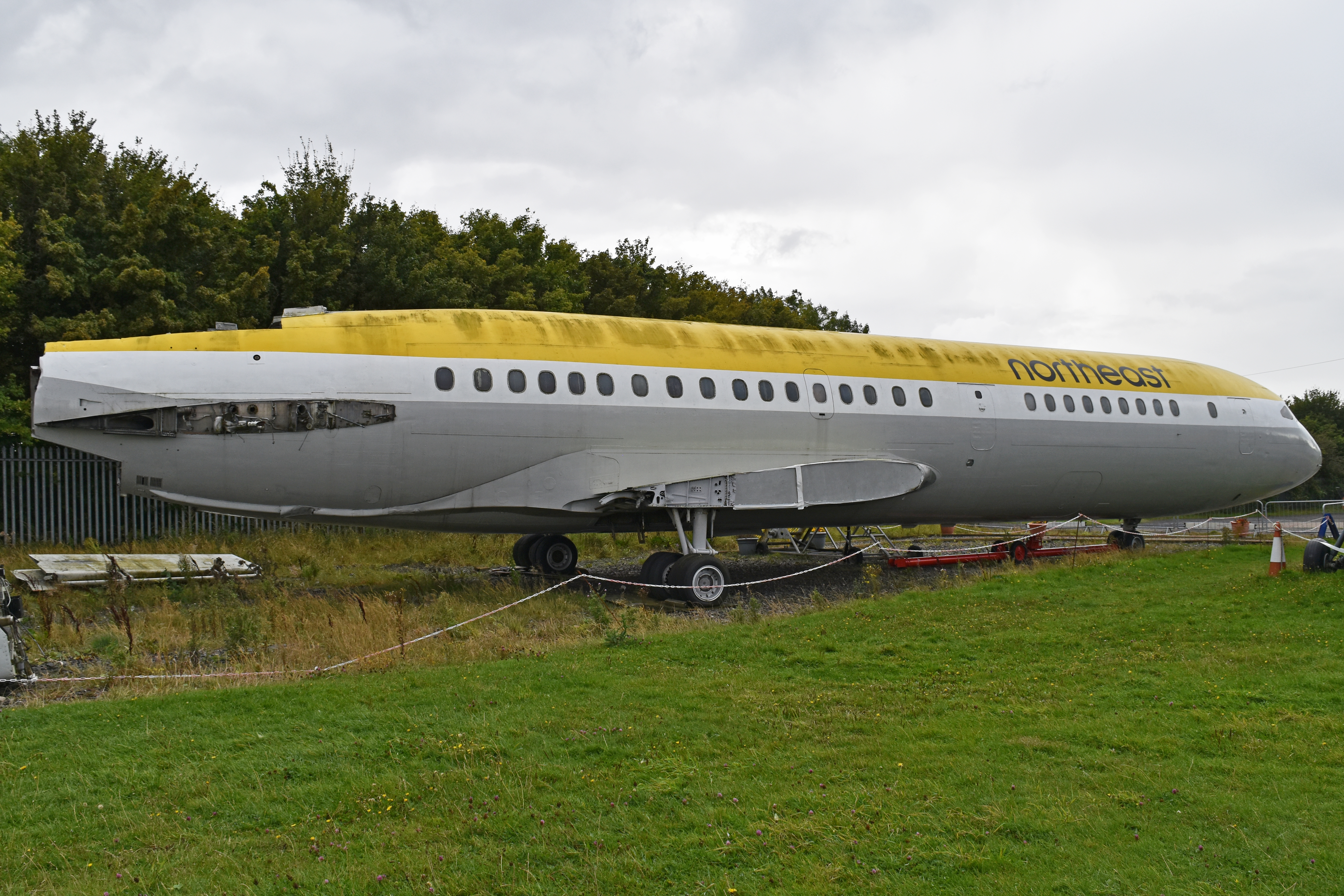
G-ARPO survives complete in Northeast Airlines colours at the North East Land, Sea and Air Museums in Sunderland, and the nose section of G-ARPP is at the Solway Aviation Museum at Carlisle Airport.
Multimedia


-1600.webp)
-1600.webp)

_British_Airways._(5651204998)-1600.webp)
-1600.webp)


-1600.webp)


