Fokker F28 Fellowship variant
Fokker F28 Fellowship F.28 Mk 1000
The original production version of the Fokker F28 Fellowship: short 65-seat fuselage, the original wing without tip extensions and two Rolls-Royce Spey Mk 555-15 turbofans. It flew in May 1967, was certified in February 1969 and entered revenue service with Braathens SAFE.

- May 9, 1967
- First flight
- 97
- Units built
- 1,705 km
- Range
- 70
- Passengers
History
The F.28 Mk 1000 was the original production version of the Fokker F28 Fellowship, the twin-jet regional airliner with which Fokker set out to give customers of its F27 Friendship turboprop a jet-powered complement. Every later variant of the family was built on its airframe.
Design origins. In the early 1960s British European Airways issued a specification for a fast turbofan-powered regional airliner, and Fokker became interested in developing its own short-haul jet; the programme was announced in April 1962. The initial concept called for about 50 seats and a range of up to 1,650 km, but market research, especially in North America, led the design team to enlarge the cabin to 65 seats five abreast, which noticeably increased the maximum take-off weight. Fokker had planned to use Bristol Siddeley BS.75 engines, which ceased to be available; Rolls-Royce then offered a simplified, lightened version of the Spey, the "Spey Junior", and from the first prototype onwards the aircraft flew exclusively with Spey engines. Manufacture was shared among European partners: Fokker built the nose, centre fuselage and inner wing; MBB and VFW-Fokker in West Germany built the forward and rear fuselage and the tail assembly; and Short Brothers in Northern Ireland designed and built the outer wings. Final assembly took place at Schiphol.
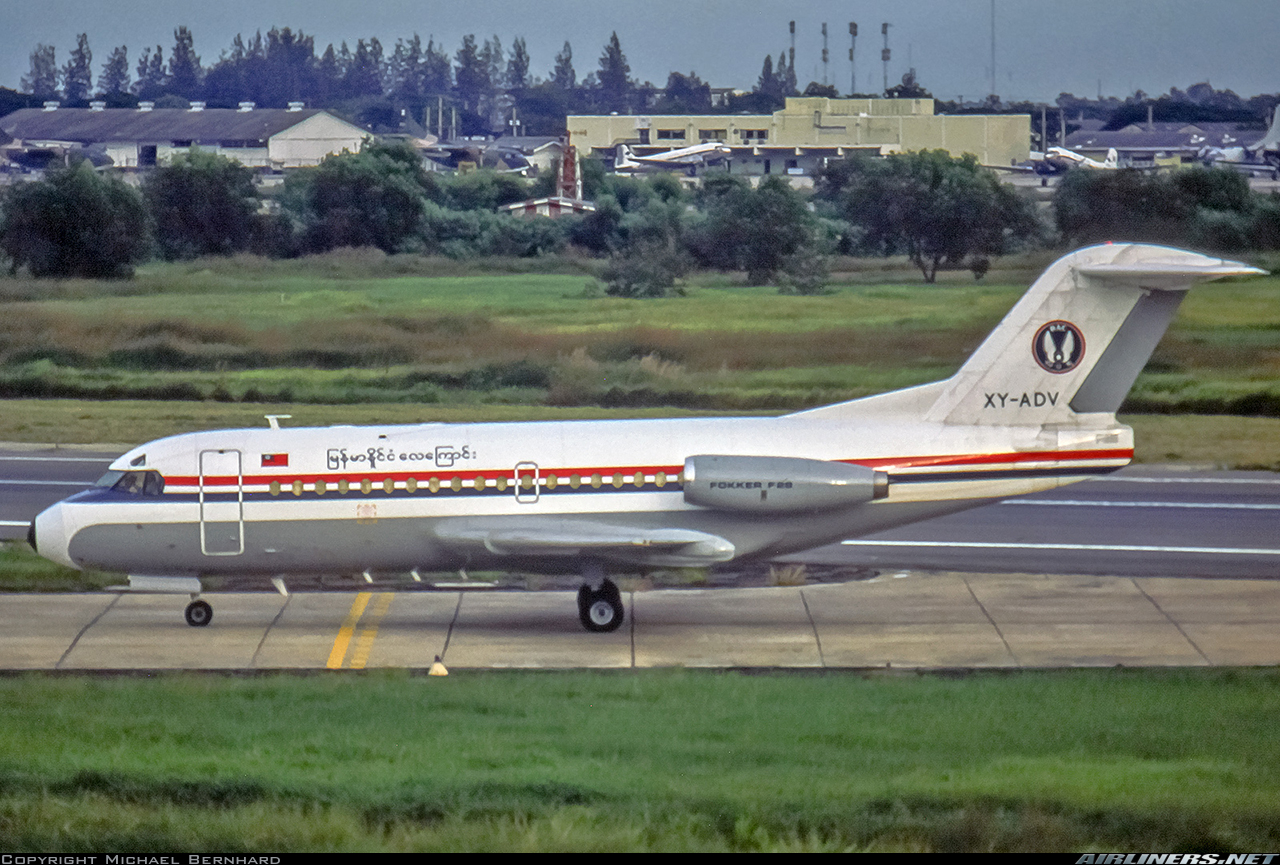
Prototypes and certification. The first commercial order was placed by German charter airline LTU on 17 November 1965. The prototype, registered PH-JHG, was rolled out on 4 April 1967 and first flew on 9 May 1967, flown by chief test pilot Jas Moll with test pilot Abe van der Schraaf and flight engineer Cees Dik. A second prototype (PH-WEV) flew on 3 August 1967 and the first production aircraft (PH-MOL) on 20 October 1967. The Dutch Certificate of Airworthiness and West German type certification were both granted on 24 February 1969. Although LTU was the launch customer, the first airline to fly the type in revenue service was Norway's Braathens SAFE, which opened a Stavanger–Rotterdam–Palma route with it on 28 March 1969 and eventually operated a fleet of five F28s.
Configuration. The Mk 1000 paired the short fuselage, 27.40 m long, with the original wing of 23.58 m span, without the tip extensions later given to the Mk 3000 and Mk 4000, a height of 8.47 m and a wing area of 76.4 m² with 16° of sweep. It was powered by two rear-mounted Rolls-Royce RB.183 Spey Mk 555-15 turbofans of 9,850 lbf (43.9 kN) thrust each, under a T-tail. Instead of thrust reversers it used wing lift dumpers and a tail-cone airbrake made of two halves opened hydraulically; besides slowing the aircraft, it allowed steep descents and let the engines be kept at higher settings on approach so that they spooled up faster for a go-around. Fokker did without water-methanol injection, judging hot-and-high performance sufficient. The retractable tricycle undercarriage, with large low-pressure tyres and anti-skid brakes, allowed operations from short and unpaved strips, and the airframe used the metal-to-metal bonding technique inherited from the F27.
Published figures for the version give a maximum take-off weight of 29,485 kg, an operating empty weight of 16,144 kg, a maximum cruise speed of 848 km/h (Mach 0.75), a take-off field length of 1,676 m at maximum weight at sea level in ISA conditions, a range of 1,705 km with maximum payload and fuel burn of about 1,480 kg per hour at long-range cruise speed (666 km/h). The cabin was 3.10 m wide, 13.09 m long and 2.02 m high, seating 65 passengers in 13 rows of five at a pitch of about 79 cm; the maximum approved capacity was 70 passengers.
Production and service. According to Modern Airliners, 97 Mk 1000s were built, out of 241 F28s of all versions produced between 1967 and 1987. It gave rise to the Mk 1000C, with a large main-deck cargo door, and to the stretched Mk 2000, whose prototype was the converted first Mk 1000 prototype and flew on 28 April 1971; the Mk 3000 succeeded it with the same short fuselage and the enlarged wing. Braathens SAFE used it on Norwegian domestic routes between Oslo, Bergen and Stavanger; Nigeria Airways began operating it in October 1971 on domestic and West African routes, and Ghana Airways flew it on similar services. In Italy it was flown by Itavia; in the United States by Piedmont Airlines; in South America by Aerolíneas Argentinas and LADE, the Argentine Air Force's state airline, which kept its F28 flying into the 2020s with 73 seats (4 business and 69 economy); and in Indonesia by Garuda Indonesia, Merpati Nusantara Airlines and Pelita Air Service. Preserved examples include c/n 11009 (LN-SUC), displayed in Braathens SAFE colours at the Norwegian Aviation Museum in Bodø, and c/n 11016 (N500WN), at Wayne Newton's Casa de Shenandoah estate in Las Vegas.
Multimedia


-800.webp)
-800.webp)
-800.webp)
-800.webp)
_C-FONF_-_Fokker_F-28-1000_-_Air_Ontario_at_Toronto_Lester_B._Pearson_Airport_(YYZ)-1600.webp)
-1600.webp)

-1600.webp)
-1600.webp)
-1600.webp)
-1600.webp)


-1600.webp)
-1600.webp)


