B-29 Superfortress | The Birth Of The American Super Bomber
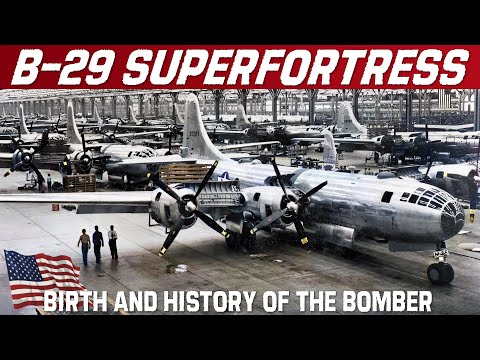
Video from the channel DroneScapes about Boeing B-29 Superfortress, linked on its Above Ten Thousand entry. Duration: 1:28:36. Language: English. Video type: Documentary.
What it's about
A retrospective documentary on the origin and combat use of the Boeing B-29 Superfortress. It combines narration, interviews with veterans and historians, and period footage. Its second half includes a contemporary newsreel on the aircraft's manufacture and a training film for its pilots.
Historical context
Before Pearl Harbor, Hap Arnold pushed for a long-range bomber designed for the Pacific. The program began in 1939, when the Army Air Forces requested an aircraft able to carry bombs thousands of miles out to sea. Boeing won the contract, while Douglas and Lockheed had little involvement. 764 aircraft were ordered before the first flight, to be built in Wichita and Renton (Boeing), Omaha (Bell) and Marietta (Martin). Development suffered from engine overheating and propeller and carburetor problems. Eddie Allen, Boeing's chief test pilot, died in a crash. By March 1944 no aircraft was yet ready. Arnold demanded 175 B-29s and Wichita delivered them in four weeks. The XB-30, the XB-31 and Consolidated's B-32 Dominator were considered as alternatives; the Dominator was the only one of them to fly, though in small numbers. The 20th Air Force was created around the aircraft, directed by Arnold from Washington. The first mission flew out of India on 5 June 1944. On 15 June, 47 aircraft took off from China to attack Japan; there, half a million people had built the runways by hand. After the capture of the Marianas, LeMay directed the firebombing campaign. The Enola Gay struck Hiroshima on 6 August 1945, killing around 80,000 people, and the Bockscar struck Nagasaki three days later.
Key facts
The aircraft had a pressurized cabin and more than 60,000 parts, and its weight grew from 85,000 to about 110,000 pounds. Its wingspan of 141 feet far exceeded the B-17's 104. Pressurization kept a cabin altitude of 8,000 feet up to 30,000, split across three airtight compartments. Its armament consisted of ten .50-caliber machine guns in remote-controlled turrets and a 20mm cannon in the tail. The training film explains the pre-flight inspection, take-off with flaps at 25° and rotation at 95 mph, cruise at around 65% power and landing at 95-100 mph. Of the more than 3,000 aircraft built, 1,600 came out of Wichita. When the war ended, Boeing laid off 70,000 workers.