Pan Am Film: "The Double-Decker 'Strato' Clipper," promoting the Boeing 377 Stratocruiser (1950)
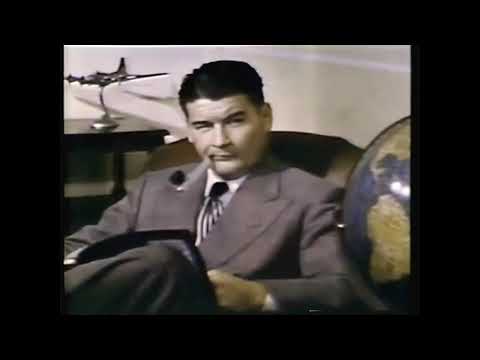
Video from the channel Pan Am Museum Foundation about Boeing 377 Stratocruiser, linked on its Above Ten Thousand entry. Duration: 24:28. Language: English. Video type: Archive footage.
What it shows
Promotional film by Pan American World Airways about the Boeing 377 Stratocruiser, which the airline presented as its two-deck "Clipper." It opens with the aircraft on the ground: baggage and cargo are loaded into two lower holds with a capacity of 10,000 pounds, and food for more than 70 people is boarded through a galley hatch. Then it shows the startup of the four engines with a ground power unit, coordinated from one of the largest flight decks of its time, and takeoff at a weight of 142,000 pounds. The middle part reconstructs the aircraft's development. The final part recreates a long-haul night flight: a seven-course dinner served from the galley, reclining seats, bridge games, the lower-deck lounge, berths and a dressing room. Meanwhile, the crew watches the instruments and the stewardess checks passengers' customs papers.
When and where it was filmed
The title dates the film to 1950. It includes footage of Boeing's plant in Seattle, with the assembly line and the figure-eight-shaped fuselage section. It also shows wind tunnel tests, a cold chamber for testing the engines, a landing gear test stand, and shots of the aircraft in flight. The narrator mentions stops on Pan Am's network such as New York, London, Brussels, Frankfurt, Honolulu, Los Angeles and San Francisco.
Context
The film presents the 377 as the latest link in Pan Am's tradition of Clippers. It reviews the S-38, the 1931 Commodore flying boat, the S-42, the M-130 China Clipper (which on November 22, 1935 opened the first regular scheduled flight across the Pacific), the Boeing 307, the Boeing 314, the Douglas DC-4 and the Lockheed Constellation. According to the narrator, the project began in 1944 in meetings between Boeing and Pan Am engineers, who wanted to combine passenger comfort with the experience of the B-17, B-29, C-97 and B-50. The design consumed six million square feet of drawings and 720 hours of wind tunnel testing. The first flight was in 1947, followed by 250,000 miles of test flights. The film gives a length of 110 feet 4 inches, a wingspan of 141 feet 3 inches, a cruise speed of more than 300 miles per hour, a range of 4,200 miles and 14,000 horsepower among the four engines. Pan Am appears as the model's first customer and first operator. The tone is promotional, and claims such as that it flew higher than any other airliner belong to the campaign.