Warum die 247 Boeing eine Lektion erteilte und dann die DC-3 erschuf
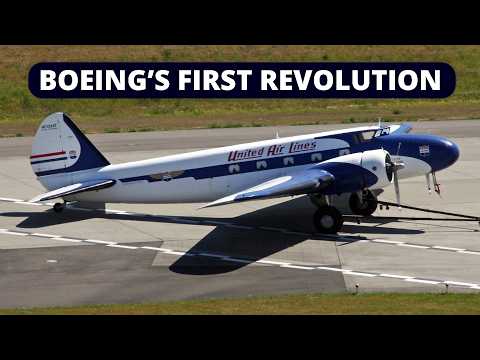
Video from the channel Flight Heritage about Boeing 247, linked on its Above Ten Thousand entry. Duration: 12:41. Language: English. Video type: Documentary.
What it's about
A documentary about how the decision to reserve the Boeing 247 for United Airlines opened the door for Douglas, whose response culminated in the DC-3.
Historical background
In 1931 Boeing concluded that the age of the trimotor was coming to an end. Chief engineer Monteith's team drew on what had been learned with the Monomail and the Model 215 bomber, and the 247 prototype flew on 8 February 1933. Boeing was part of United Aircraft and Transport Corporation, which grouped together the airlines that formed United Airlines, along with Pratt & Whitney and Hamilton Standard. United ordered 60 aircraft, the entire first production run, and the other airlines would have to wait about two years. TWA, under Jack Frye, sent a specification to several manufacturers in August 1932, and only Douglas responded in earnest.
Highlights
The 247 carried 10 passengers at 189 mph, with retractable landing gear, stressed-skin metal construction and de-icing boots. It cut the coast-to-coast crossing from about 27 hours to under 20. The DC-1 flew on 1 July 1933, and the DC-2 on 11 May 1934, with 14 seats and 170 mph. At the request of C. R. Smith of American Airlines, the DST was born, whose daytime version was the DC-3: it flew on 17 December 1935 and entered service on 25 June 1936. By 1939 the DC-3 handled 90% of US commercial air traffic. 75 examples of the 247 were built, against 16,079 of the DC-3 family. The 1934 Air Mail Act dissolved the group, and William Boeing left the board that May.