Airliner · Civil · France
Airbus A380
- April 27, 2005
- First flight
- 2007
- Introduced
- In service
- Status
- 251
- Units built


_Airbus_A380_of_Emirates_over_Bichlh%C3%A4usl_in_Frankenfels%2C_Austria-1600.webp)


The Airbus A380 is the largest passenger aircraft ever built: the only commercial jet with two full-length decks, carrying more than 500 passengers in typical layouts and certified for up to 853. It was Europe's great bet on the 21st-century sky: after studies begun in 1994, the programme was launched in 2000 with a clear premise — to challenge the 747's reign on the great hub-to-hub routes. Building it demanded a continental industrial chain, with giant sections travelling by ship, barge and road to the Toulouse assembly line. It first flew on 27 April 2005 and entered service with Singapore Airlines in 2007. For passengers it was a comfort revolution — quiet, stable, with unheard-of space — and Emirates made it the backbone of its global network. The market, however, turned to efficient point-to-point twinjets, and production closed in 2021. The pandemic seemed to doom it, but recovering demand brought the "superjumbo" back into the air: it remains the king of maximum-density routes and the airliner passengers love most.
Related sheets
Category
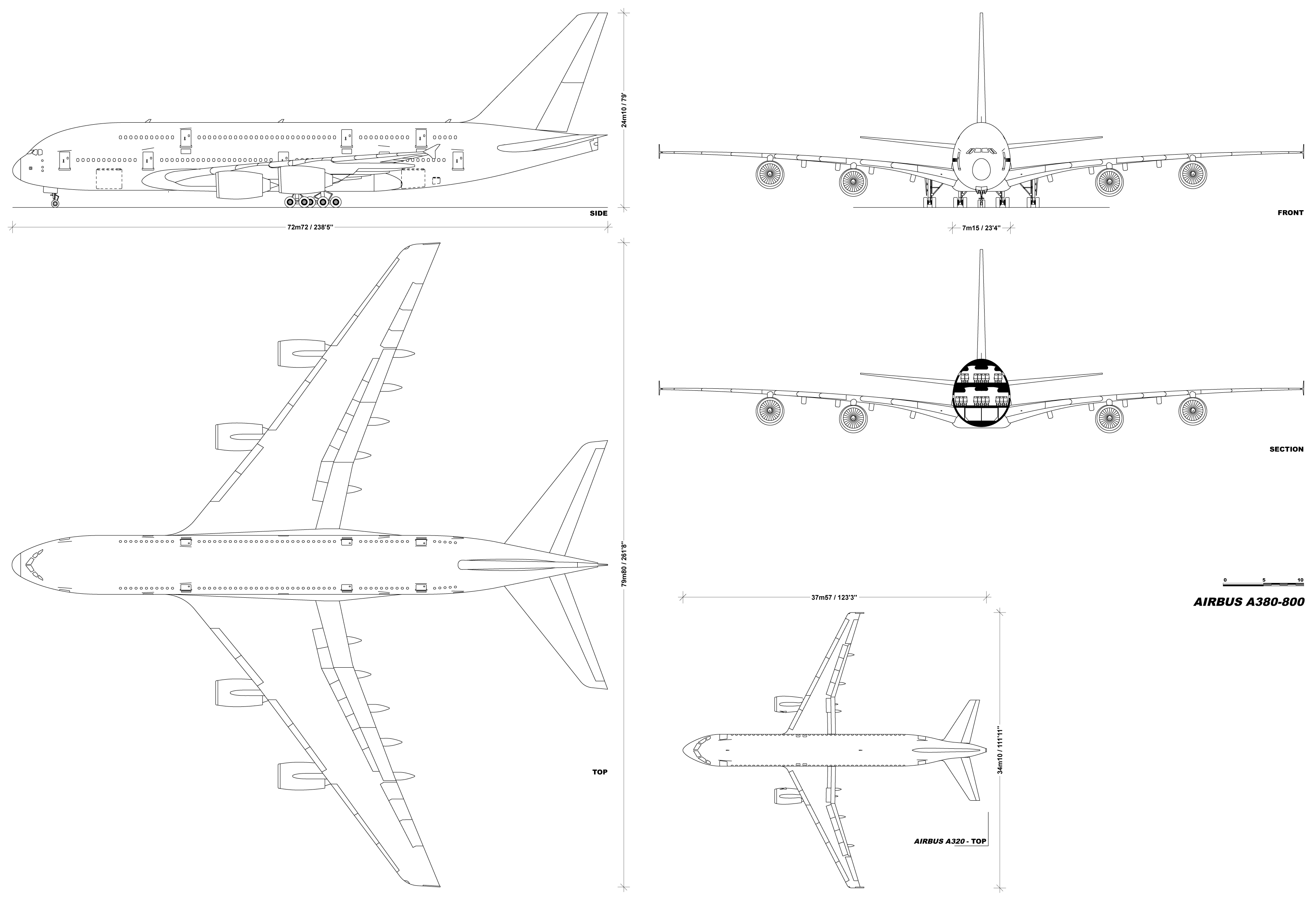
Three-view drawing
History
The A380 first flew on April 27, 2005 and entered service with Singapore Airlines in 2007. Its two full decks redefined very-high-capacity air travel.
Production ended in 2021 after 254 aircraft, but the «superjumbo» still rules high-density routes.
Origin and development
Airbus had studied a very-large aircraft since 1994, convinced that traffic between major hubs would keep growing and that the 747 needed a European successor. The programme was formally launched in 2000, and with it one of aviation's greatest industrial adventures: wings built in Wales, fuselage sections in Germany and France, stabilisers in Spain, and a logistical parade of ships, barges and night-time road convoys to Toulouse that became an attraction in its own right.
A troubled debut
The first flight, on 27 April 2005, was a technical triumph, but the programme then stumbled into a famous crisis: mismatches between the design tools of the German and French plants turned the wiring —hundreds of kilometres per aircraft— into a puzzle that delayed deliveries and forced a deep reorganisation of Airbus. Singapore Airlines finally debuted it in 2007, and every airline that received it made it its flagship.
King of the hubs
In service the A380 delivered on its promise to passengers: the quietest, most stable cabin in the sky, first-class showers and lounges, and room for innovations no other aircraft allowed. Emirates made it its backbone and became by far the largest operator, proving that the super-hub model could sustain an entire superjumbo fleet.
The end of the line
The market went the other way: long-range twinjets made hub-bypassing point-to-point routes profitable, and orders dried up. Airbus announced the programme's end in 2019 and delivered the final aircraft in 2021. The 2020 pandemic sent the fleets to the desert and many wrote the type off.
The comeback
The recovery of long-haul traffic from 2022 rewrote the script: with airports congested and demand surging, airlines reactivated their A380s one after another. By 2025 the superjumbo was again an everyday sight at the great hubs — an unexpectedly sweet late act for the most ambitious airliner ever built.
Variants
| A380-800 | |
|---|---|
| First flight | April 27, 2005 |
| Aircraft type | Very-long-range wide-body airliner with a full double deck |
| Powerplant | Four high-bypass turbofans, in two certified installations the customer could choose between without altering airframe or pylon. The Rolls-Royce Trent 900 branch gives the A380-841, with Trent 970-84 or 970B-84 rated at 348.31 kN each, and the A380-842, with Trent 972-84, 972B-84 or 972E-84 rated up to 356.81 kN each (341.41 kN on the E version); this sheet takes the Trent 972B-84 as its reference designation. The American branch, the Engine Alliance GP7270 —a General Electric and Pratt & Whitney joint venture— gives the A380-861, rated at 332.44 kN each. All of them turn a fan 2.95 m across that swallows over a tonne of air every second. The auxiliary power unit is a Pratt & Whitney Canada PW980A. |
| Powerplant | 4 × Rolls-Royce Trent 972B-84 |
| Thrust per engine | 357 kN |
| Length | 72.7 m |
| Wingspan | 79.8 m |
| Height | 24.1 m |
| Wing area | 845 m² |
| Empty weight | 285,000 kg |
| MTOW | 575,000 kg |
| Top speed | 945 km/h |
| Max speed altitude | 10,363 m |
| Cruise speed | 903 km/h |
| Cruise altitude | 11,200 m |
| Service ceiling | 13,106 m |
| Initial climb rate | 8 m/s |
| Range | 15,000 km |
| Combat radius | 0 km |
| Range conditions | Airbus quoted 15,000 km —8,000 nautical miles— with a full load of 545 passengers in four classes; with full tanks at maximum take-off weight operational references stretch the stage to some 16,100 km. The type certificate sets 324,339 litres of usable fuel, 259,471 kg, spread between the wing tanks and the stabiliser trim tank, enough for non-stop flights of over fifteen hours. |
| Armament | None. The A380 is a civil passenger transport; no armed version was ever offered or certified. |
| Max weapons load | 0 kg |
| Payload | 84,000 kg |
| Cargo capacity | Airbus quoted 525 seats in three classes as the typical layout and 545 in the four-class arrangement it used as its commercial reference, with a manufacturer-certified maximum of 853 passengers in a single class. The current EASA A.110 type certificate approves up to 868 seats for emergency evacuation, 538 on the main deck and 330 on the upper one. Below the floor the holds take 28,577 kg forward, 20,310 kg aft and 2,515 kg in the bulk compartment: more than 51 t of revenue load on top of the passengers' baggage. |
| Crew | 2 |
| Passengers | 853 |
| Units built | 254 |
Images