Family: Long March
Long March 10B
Launch statistics
- 1
- Launches (as of July 27, 2026)
- 1
- Successes
- 0
- Failures
- 100.0 %
- Success rate
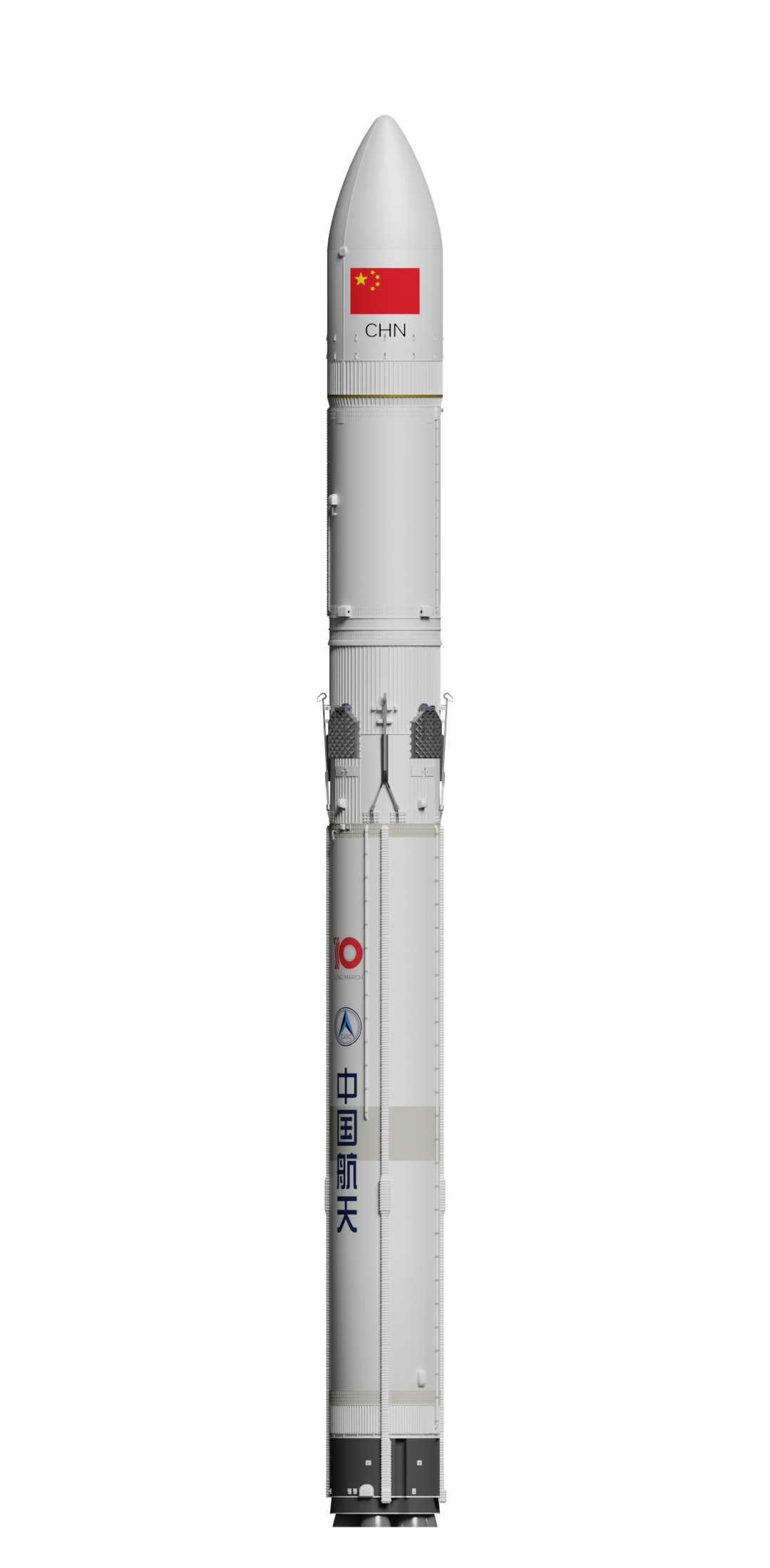
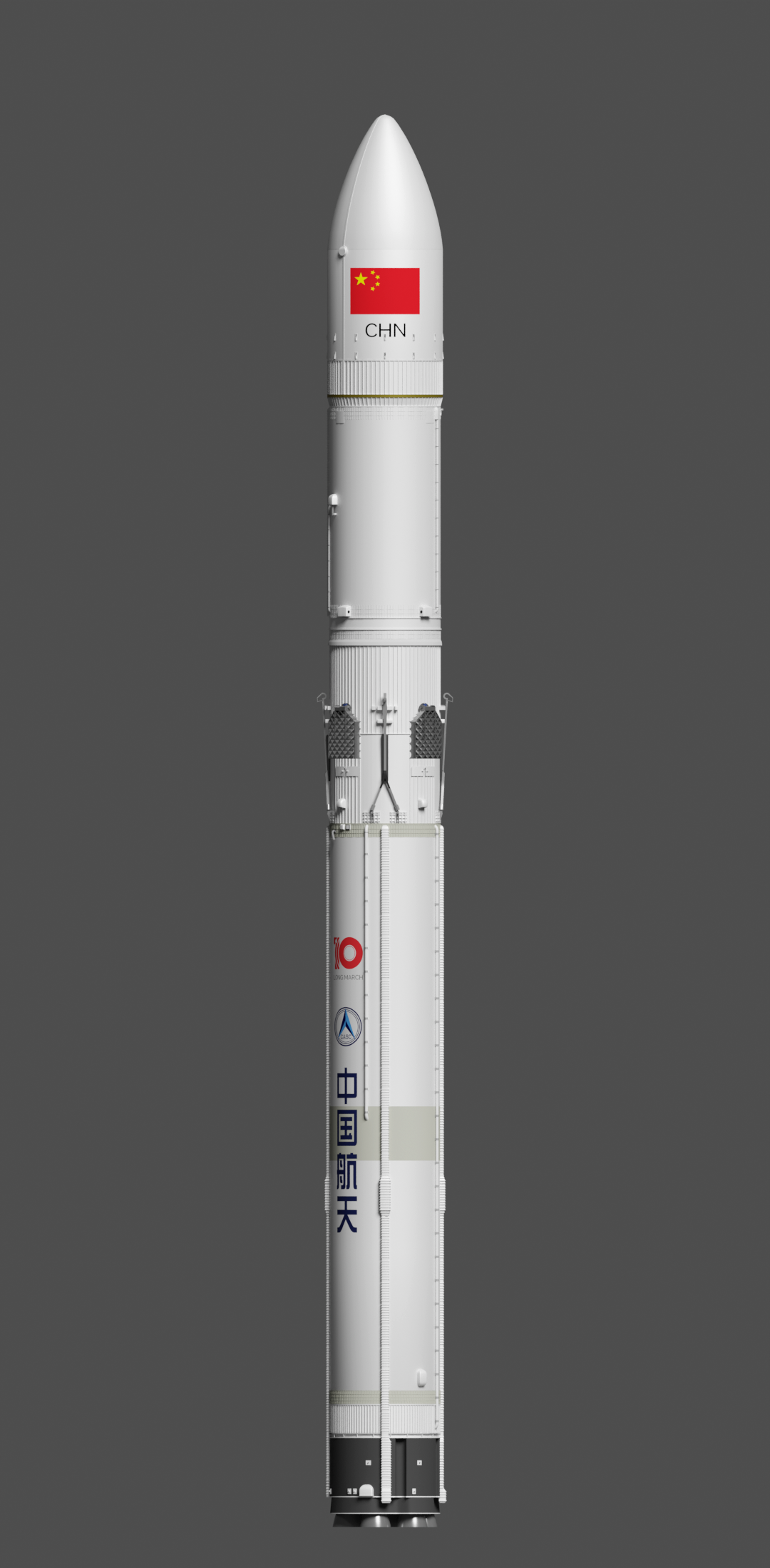
The Long March 10B (CZ-10B) is a Chinese partially reusable, two-stage medium-lift launch vehicle. It is the third member of the Long March 10 series and is derived from technologies developed for the Long March 10A — that is, it is a commercial configuration within that family rather than an entirely new design. It is developed by China Rocket, the commercial subsidiary of the China Academy of Launch Vehicle Technology (CALT), part of the state-owned CASC. Its stages measure five metres in diameter, like those of the heavy-lift Long March 5. The kerolox first stage is powered by seven YF-100K engines; the second stage uses a single YF-219 methalox engine, more powerful than the one on the 10A variant, which gives the vehicle greater lifting capacity. Whereas the 10A is designed to carry crewed spacecraft to low Earth orbit, the 10B is aimed at cargo missions and at serving China's commercial space sector, notably the deployment of the country's satellite internet megaconstellation. Its announced capacity exceeds 16 tonnes to a 200 km orbit and 11 tonnes to a 900 km orbit, in both cases in recoverable mode. Its most distinctive feature is the recovery system: the first stage carries hooks that catch a network of tensioned wires on a floating platform, an approach that shifts the mass of the landing hardware from the rocket to the ship. The vehicle is active following a successful maiden flight in July 2026, on which China achieved its first orbital booster recovery.
History
A commercial derivative of the Long March 10
The Long March 10 series was born out of China's crewed lunar programme, intended to fly the Mengzhou spacecraft to the Moon. In December 2025, at the Wenchang International Aviation and Aerospace Forum, a representative of China Rocket presented plans for a commercial variant of the Long March 10A. That variant, named Long March 10B, was announced with a capacity of at least 16 tonnes to a 200 km low Earth orbit, likely in reusable mode, and at least 11 tonnes to a 900 km orbit at 50 degrees inclination.
Division of labour with the 10A
In a July 2026 interview, Qian Hang of CASC's First Academy described the 10B as the 'younger sibling' of the 10A. The programme logic is for the 10B to gather flight data for the 10A — a launcher meant for crewed missions and a comprehensive evolution of the older Long March 2F and Long March 7 — thereby reducing development risk and improving the reliability of future crewed flights. The 10B also serves as a testbed for recovery technologies and will be able to reuse boosters recovered from 10A missions.
Cable-net recovery
The chosen recovery approach differs from landing-leg systems. Instead of carrying legs and reinforcing structure throughout the flight, the 10B carries only lightweight hooks and leaves the capture and shock-absorbing hardware on the barge: tensioned wires held by rail-mounted dollies that reposition themselves automatically, in a principle comparable to a fighter aircraft landing on an aircraft carrier. This reduces booster mass, simplifies its structure and tolerates greater landing error in difficult maritime conditions.
The maiden flight
The first launch took place on 10 July 2026 at 04:15 UTC from the Wenchang Commercial Space Launch Site. The upper stage placed its satellite in the designated orbit and the first stage was successfully recovered aboard the vessel Linghangzhe ('Navigator'). It was the first orbital booster recovery achieved by China — the second country to do so after the United States — and the world's first recovery using a net-based system. The same stage is scheduled to be reflown.
Launch timeline
| Date | Launch site | Outcome | Payload |
|---|---|---|---|
| Jul 10, 2026, 4:15 AM | Commercial LC-2 | Success | First launch of the Long March 10B rocket and first ever successful rocket booster recovery of a Chinese launch vehicle. This launch also deployed a SatNet LEO constellation test satellite named Chuangxin-26 (CX-26) to LEO. |
Images