Did you know…
Why was the Bv 141 so unusual?
Short answer
Because of its unusual structural asymmetry. The single engine was fixed directly to the front end of the tail boom, while the crew sat in a glazed Plexiglas gondola, with the boom and gondola connected through the wing. It was an unconventional tactical reconnaissance aircraft from Blohm & Voss.
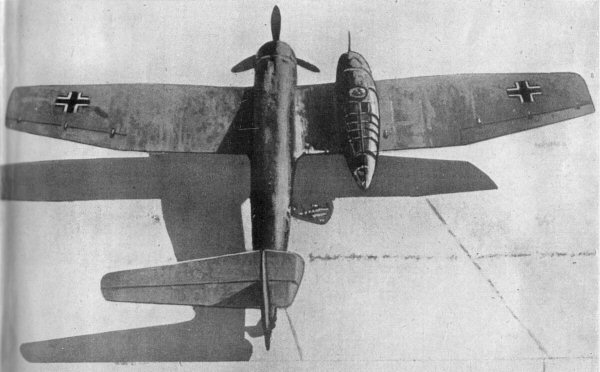
An asymmetric configuration
The Blohm & Voss BV 141, initially the Ha 141, was an unconventional tactical reconnaissance aircraft developed by the German manufacturer Blohm & Voss. It stood out for its unusual structural asymmetry. In its overall configuration, the single engine was attached directly to the front end of the tail boom, while the crew occupied a glazed Plexiglas gondola; the boom and gondola were connected through the wing. That arrangement gave visibility characteristics in all directions superior to those usually offered by parasol-wing aircraft.
From first flight to the cancellation of the BV 141A
On 25 February 1938, the Ha 141-0 made its maiden flight, and it was soon determined to present relatively few problems. The RLM, nevertheless, declined to fund its development. In April 1940, the RLM cancelled production plans for the BV 141A due to its perceived lack of power.
Why it never reached mass production
The aircraft was never ordered into large-scale production for several reasons, including the unavailability of the preferred engine and strong competition from another tactical reconnaissance aircraft, the twin-engine Focke-Wulf Fw 189 Uhu. The urgent need for BMW 801 engines for the Fw 190 fighter reduced the chances of the BV 141B being built in quantity. The 20 BV 141B ordered were all produced and delivered.
More questions

Aviation history
Which was the most-produced American fighter of the Second World War?
The Republic P-47 Thunderbolt, of which 15,636 or 15,683 units were built, depending on the source. It was also one of the heaviest fighters of the conflict… more…

Aviation history
Who flew the E-66 at 2,149 km/h?
Konstantin or Vladimir Kokkinaki, depending on the source. Konstantin is credited with the absolute record on a closed 100 km circuit, at 2,148.66 km/h, set… more…

Fly-by-Owen (CC BY SA), vía commons Aviation history
How many I-11Bs were built?
Between 208 and around 450, depending on the source: one of the AISA I-11 reference sheets gives 208 examples built, while All-Aero speaks of around 400 built… more…

Aviation history
How many HH-53s could be converted to Pave Low III?
Eight HH-53C aircraft received an improved systems package and were redesignated HH-53H Pave Low III. The other figure in circulation, nine MH-53H and 32… more…

SCDBob (CC BY SA), vía commons Aviation history
What did the A129 Mangusta's armor protect?
The fuselage: the A129's airframe is armored and, according to All-Aero, designed to protect against 12.7 mm rounds, with partial protection against 23 mm… more…
Fly-by-Owen (CC BY SA), vía commons Aviation history
What landing gear and canopy did the AISA I-11B have?
According to one account, AISA reduced the cockpit canopy and fitted tailwheel gear on the production I-11B. All-Aero claims the opposite: the I-11B was… more…


