Did you know…
What was the Hs 123 called in Spain?
Short answer
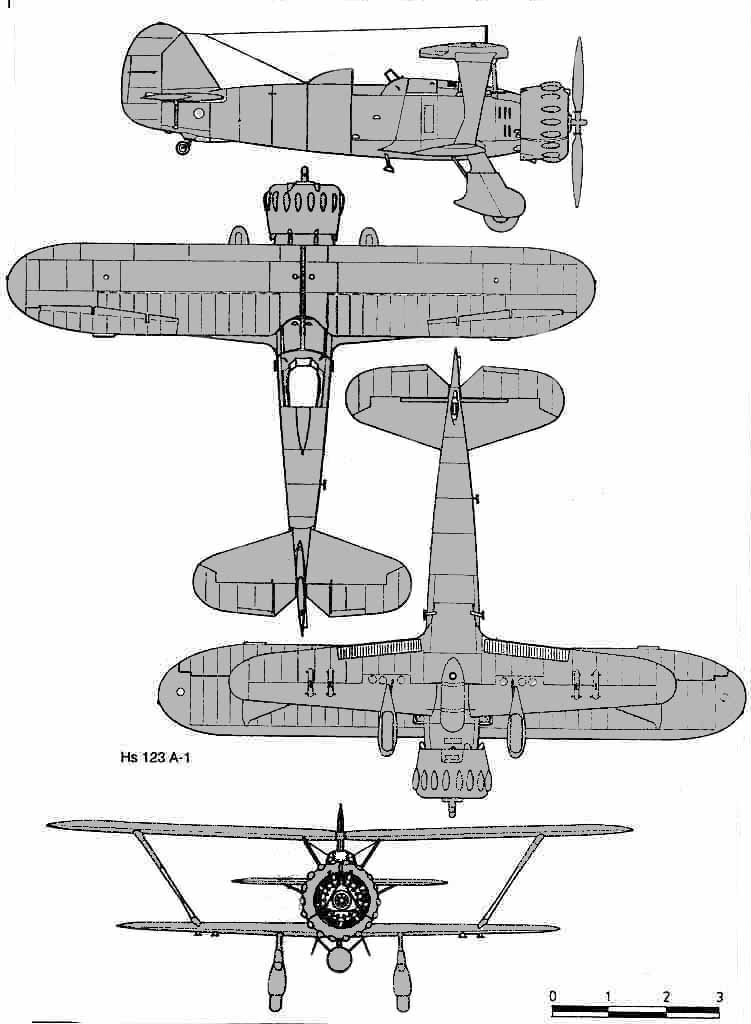
In Spain the Henschel Hs 123 was known as "Angelito". Five aircraft were deployed in early 1937 as part of the Condor Legion, whose equipment list records them under that nickname as dive bombers. At least one Hs 123 remained in Spanish Air Force service after 1945.
"Angelito"
The Spanish Hs 123s were known as "Angelito", meaning dear little angel. The equipment list used by the Condor Legion records the Henschel Hs 123 A with that same nickname and classifies it as a dive bomber. At least one Hs 123 remained in service with the Spanish Air Force after 1945.
Where the nickname comes from
Several versions circulate about the origin of the nickname, without certainty about their accuracy. According to one, it was said at the time that the pilot "had gone to keep the little angels company", hence the name. Another version holds that on those missions the aircraft acted like "guardian angels" for the ground troops, hence "Angelitos".
Five aircraft under evaluation
Five aircraft were deployed to Spain in early 1937 as part of the Condor Legion. Combat evaluation showed remarkable toughness in close support missions: they could absorb a great deal of punishment, including direct hits to the airframe and engine. The Nationalists were impressed with the Hs 123's combat performance, bought the entire evaluation flight, and ordered 11 more aircraft from Germany. The Hs 123s based at Seville were used for ground support, a role in which their range was less limiting and where placing ordnance precisely mattered more than carrying a heavy load.
More questions

Aviation history
Which was the most-produced American fighter of the Second World War?
The Republic P-47 Thunderbolt, of which 15,636 or 15,683 units were built, depending on the source. It was also one of the heaviest fighters of the conflict… more…

Aviation history
Who flew the E-66 at 2,149 km/h?
Konstantin or Vladimir Kokkinaki, depending on the source. Konstantin is credited with the absolute record on a closed 100 km circuit, at 2,148.66 km/h, set… more…

Fly-by-Owen (CC BY SA), vía commons Aviation history
How many I-11Bs were built?
Between 208 and around 450, depending on the source: one of the AISA I-11 reference sheets gives 208 examples built, while All-Aero speaks of around 400 built… more…

Aviation history
How many HH-53s could be converted to Pave Low III?
Eight HH-53C aircraft received an improved systems package and were redesignated HH-53H Pave Low III. The other figure in circulation, nine MH-53H and 32… more…

SCDBob (CC BY SA), vía commons Aviation history
What did the A129 Mangusta's armor protect?
The fuselage: the A129's airframe is armored and, according to All-Aero, designed to protect against 12.7 mm rounds, with partial protection against 23 mm… more…
Fly-by-Owen (CC BY SA), vía commons Aviation history
What landing gear and canopy did the AISA I-11B have?
According to one account, AISA reduced the cockpit canopy and fitted tailwheel gear on the production I-11B. All-Aero claims the opposite: the I-11B was… more…


