Did you know…
What was the Concorde like inside?
Short answer
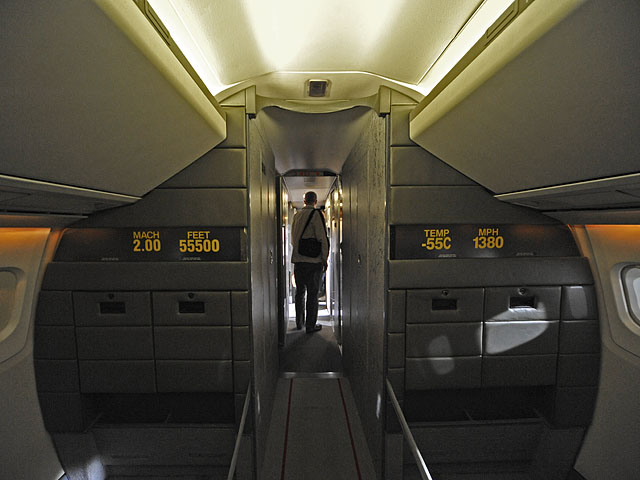
The Concorde was narrow inside: a cabin 2.63 m wide and 1.96 m high, windows the size of a hand, and 100 seats in 2-2 rows split between two cabins, with no classes. A display on the bulkheads showed Mach and altitude, and in the analog flight deck, two pilots and a flight engineer flew the aircraft.
A narrow, long cabin
Inside, the Concorde was surprisingly small. The fuselage, designed to fly at Mach 2, measured just 2.63 m wide inside and 1.96 m high, less than a current regional jet, and the windows were little bigger than a hand to limit depressurization if one broke at 18,000 m. The 100 seats were split between two cabins, of 40 and 60 seats, in 2-2 rows with a single aisle and no classes: the entire aircraft was a single category, pricier than a 747's first class. The seats were comparable to today's narrow business class, and the interior, in gray and blue tones, was deliberately understated.
What the passenger saw
On the forward bulkheads of each cabin there was a digital display showing speed in Mach, altitude, and outside temperature; watching Mach 2.00 appear at 17,000-18,300 m (55,000-60,000 ft) was part of the ritual. At that speed, friction heated the nose to 127°C and the fuselage stretched about 20 cm. Service was provided over roughly three and a half hours of transatlantic flight, with narrow custom-designed trolleys, and the cabin noise was higher than on a subsonic aircraft, especially in the rear cabin, close to the four Olympus 593 engines.
The flight deck
The cockpit held three crew members: two pilots and a flight engineer with a side panel that managed fuel, pressurization, and the transfer of kerosene between tanks to shift the center of gravity when going supersonic. The instruments were analog, from the 1960s, and the droop nose was lowered on approach to see the runway with the aircraft pitched up steeply. Today, complete cockpits can be visited at Aerospace Bristol, Le Bourget, or Brooklands.
More questions

Foto: 4300streetcar (CC BY 4.0) Commercial aviation
Which 747 carried Enterprise "piggyback"?
The first Shuttle Carrier Aircraft was a Boeing 747-123 registered N905NA, originally built for American Airlines and acquired by NASA in 1974. Boeing… more…

Commercial aviation
Was there an amphibious DC-3?
Yes: the Douglas XC-47C was created by fitting Edo Model 78 floats onto a standard C-47. The single-step metal floats carried retractable wheels that also… more…

OTFW, Berlin (CC BY SA), vía commons Commercial aviation
Was a C-47 converted into a glider?
Yes: the Douglas XCG-17 was an assault glider created by converting a twin-engine C-47 Skytrain during World War II. Its engines were removed and the nacelles… more…
Commercial aviation
What did the USSR build from the DC-3?
The USSR built a version of the DC-3 under a licence granted to its government on 15 July 1936. It was designated PS-84 and, in 1942, renamed Lisunov Li-2… more…
Commercial aviation
What was "Puff, the Magic Dragon"?
It was the nickname of the Douglas AC-47 Spooky, the first in a series of fixed-wing gunships developed by the United States Air Force during the Vietnam War… more…
Commercial aviation
How did the RAF refer to the C-47?
The RAF called it Dakota: the Dakota I was the designation for 53 C-47s received under Lend-Lease. The Dakota III designated 962 C-47A Skytrains. The Dakota… more…


