Did you know…
What is gravity in space time?
Short answer
In general relativity, gravity is not a force pulling objects together but the curvature of spacetime itself. Mass and energy bend the four-dimensional geometry around them, and freely moving bodies simply follow the straightest available paths through that curved geometry. Einstein published the theory in 1915, and every test since has matched it.
Geometry instead of force
Newton described gravity as an attraction acting instantly across empty space, a picture that works superbly for planning a lunar trajectory. Einstein replaced the mechanism. In general relativity, presented to the Prussian Academy of Sciences in November 1915, mass and energy determine the curvature of spacetime, and that curvature determines how matter moves. A planet orbiting the Sun is not being tugged; it is coasting along a geodesic, the closest thing to a straight line that the local geometry permits.
The key insight came earlier, from what Einstein called his happiest thought: a person in free fall feels no weight. Being in a windowless box accelerating uniformly is indistinguishable from standing in a gravitational field. If gravity can be made to disappear by choosing a falling reference frame, it cannot be a force like electromagnetism — it is a property of the frame, and therefore of geometry.
Time bends as much as space
The spacetime in question includes the time axis, and the temporal effect dominates in weak fields. Clocks deeper in a gravitational well tick more slowly than clocks higher up. This is not a measurement artefact: GNSS satellites must correct for it, because the combination of their altitude and speed shifts their onboard clocks by tens of microseconds per day relative to the ground, enough to ruin positioning within hours if ignored.
How we know
The theory's predictions have survived a century of increasingly sharp tests. Light bends around the Sun by twice the Newtonian value, confirmed during the 1919 eclipse expeditions. Mercury's perihelion advances at the rate Einstein calculated. In September 2015, the LIGO detectors recorded gravitational waves from merging black holes — ripples in spacetime geometry, travelling at the speed of light, precisely as the field equations require.
More questions
- Image pending
Astronauts and life in space
Why does astronauts float in space?
Because they are in free fall, not because gravity is absent. At the International Space Station's altitude of about 400 km, Earth still pulls almost as hard… more…
- Image pending
Astronauts and life in space
Why did yuri gagarin die?
Gagarin died in an aircraft crash, not in a spacecraft. On 27 March 1968 the MiG-15UTI trainer he was flying with instructor Vladimir Seryogin went down in… more…
- Image pending
Astronauts and life in space
How much an astronaut is paid?
NASA's civilian astronauts are ordinary federal employees, paid on the General Schedule grade-and-step scale with no bonus per flight, per spacewalk or per… more…
.png)
Astronauts and life in space
Why is blue origin so slow?
Blue Origin was built on deliberate, owner-funded incrementalism: its motto is Gradatim Ferociter, step by step, and it spent its first two decades on… more…
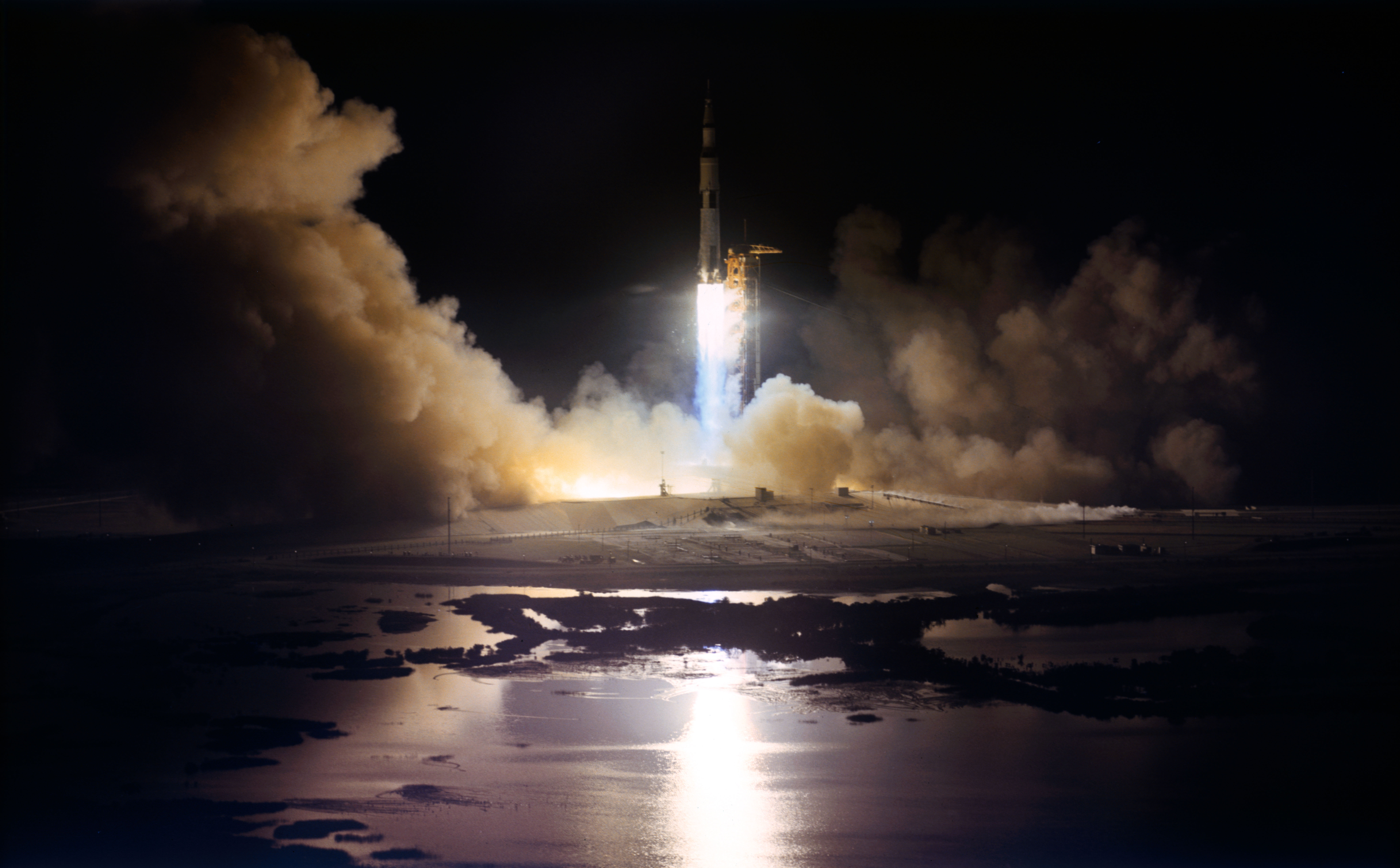
Astronauts and life in space
When did astronauts last walk on the moon?
Apollo 17, in December 1972. Eugene Cernan and Harrison Schmitt landed in the Taurus-Littrow valley on 11 December 1972, worked on the surface for three days… more…
- Image pending
Astronauts and life in space
How high do astronauts orbit the earth?
Crewed spaceflight today happens a few hundred kilometres up. The International Space Station orbits at about 400 km, lapping the planet roughly every 90… more…
