Did you know…
What innovations did the Gazelle introduce?
Short answer
Two above all: it was the first helicopter with a fenestron-type tail instead of a conventional anti-torque rotor and, in its SA 341G version, the first certified for single-pilot instrument flight (IFR). Its original main rotor was inspired by MBB's rigid system for the Bo 105, although production aircraft switched to an articulated one.
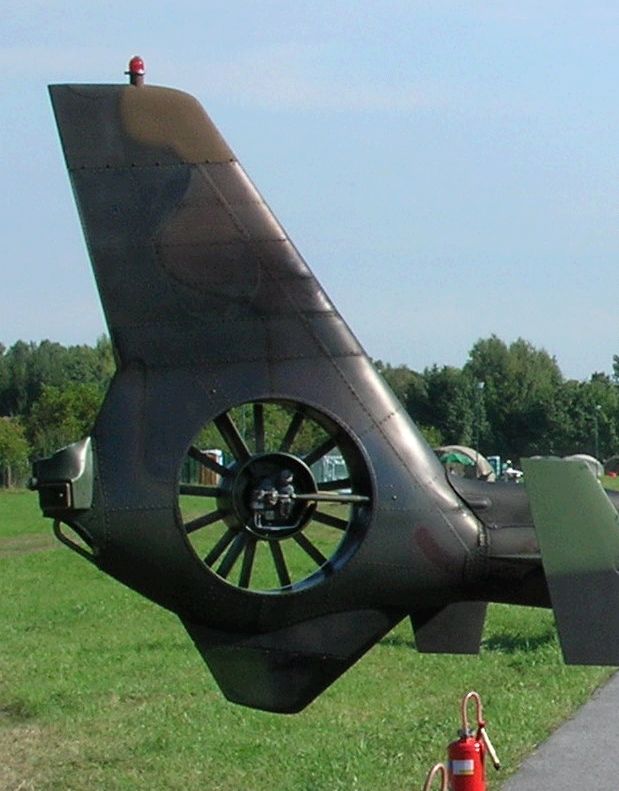
The fenestron
The Gazelle was the first helicopter to carry a fenestron-type tail instead of a conventional anti-torque rotor. The SA 340 prototype first flew on 7 April 1967, still with a classic tail rotor; the fenestron appeared on the second prototype in early 1968. The first production variant flew on 6 August 1971.
The main rotor, from the Bo 105 to an articulated design
The helicopter's original main rotor was inspired by a rigid system created by Messerschmitt-Bölkow-Blohm for the Bo 105. Designers switched to an articulated rotor for the production models after encountering control difficulties during high-speed prototype trials.
Speed and single-pilot certification
On 13 May 1967, a Gazelle set two closed-circuit world speed records: 307 km/h over 3 kilometres and 292 km/h over 100 kilometres. The SA 341G became the first helicopter certified for single-pilot instrument flight (IFR) operations, reflecting its stability and handling characteristics.
More questions

Aviation history
Which was the most-produced American fighter of the Second World War?
The Republic P-47 Thunderbolt, of which 15,636 or 15,683 units were built, depending on the source. It was also one of the heaviest fighters of the conflict… more…

Aviation history
Who flew the E-66 at 2,149 km/h?
Konstantin or Vladimir Kokkinaki, depending on the source. Konstantin is credited with the absolute record on a closed 100 km circuit, at 2,148.66 km/h, set… more…

Fly-by-Owen (CC BY SA), vía commons Aviation history
How many I-11Bs were built?
Between 208 and around 450, depending on the source: one of the AISA I-11 reference sheets gives 208 examples built, while All-Aero speaks of around 400 built… more…

Aviation history
How many HH-53s could be converted to Pave Low III?
Eight HH-53C aircraft received an improved systems package and were redesignated HH-53H Pave Low III. The other figure in circulation, nine MH-53H and 32… more…

SCDBob (CC BY SA), vía commons Aviation history
What did the A129 Mangusta's armor protect?
The fuselage: the A129's airframe is armored and, according to All-Aero, designed to protect against 12.7 mm rounds, with partial protection against 23 mm… more…
Fly-by-Owen (CC BY SA), vía commons Aviation history
What landing gear and canopy did the AISA I-11B have?
According to one account, AISA reduced the cockpit canopy and fitted tailwheel gear on the production I-11B. All-Aero claims the opposite: the I-11B was… more…


