Did you know…
Who produced the biggest explosions of the Vietnam War?
Short answer
The giant conventional bombs dropped from C-130 transports under the Commando Vault program: the 15,000 lb (6,800 kg) BLU-82B, with 12,600 lb (5,700 kg) of GSX slurry, and the 10,000 lb (4,500 kg) M121 with an 8,050 lb (3,650 kg) Tritonal warhead.
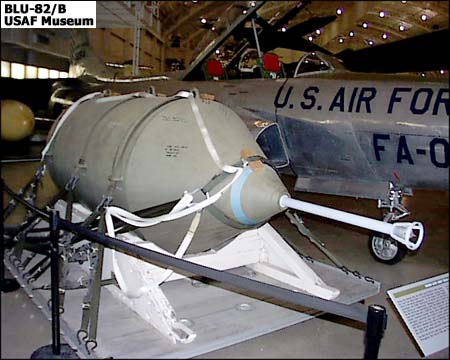
Commando Vault: bombs from a transport
In October 1968, a C-130 crew from the 29th Tactical Airlift Squadron carried out a series of test drops guided by MSQ-77 radar controllers. In March 1969, the 463rd launched Project Commando Vault and the drops became routine. The BLU-82/B was first used in Vietnam on 23 March 1970, and for the rest of the war the USAF used it in tactical airlift operations called Commando Vault.
The BLU-82B, 15,000 lb
The BLU-82B/C-130 weapon system, known through the Commando Vault program and nicknamed "Daisy Cutter," was a conventional 15,000 lb bomb dropped from a C-130 or MC-130, capable of flattening a patch of forest into a helicopter landing zone. Its 15,000 lb (6,800 kg) included 12,600 lb (5,700 kg) of low-cost GSX slurry, based on ammonium nitrate, aluminum powder, and polystyrene. It was originally designed to blast an instant clearing in the jungles of Vietnam, where it was tested in drops.
The M121 and its blast radius
The M121 weighed 10,000 lb (4,500 kg) and carried an 8,050 lb (3,650 kg) Tritonal warhead. Its destructive shock-wave diameter reached 60 meters, with stunning effects on personnel up to 500 meters away.
More questions

Aviation history
What was special about the Vertol 76?
Vertol's VZ-2 tested the tiltwing concept for vertical take-off and landing. After ground trials beginning in April 1957, it first took off on 13 August only… more…

Aviation history
Which was the most-produced American fighter of the Second World War?
The Republic P-47 Thunderbolt, of which 15,636 or 15,683 units were built, depending on the source. It was also one of the heaviest fighters of the conflict… more…

Aviation history
Who flew the E-66 at 2,149 km/h?
Konstantin or Vladimir Kokkinaki, depending on the source. Konstantin is credited with the absolute record on a closed 100 km circuit, at 2,148.66 km/h, set… more…

Fly-by-Owen (CC BY SA), vía commons Aviation history
How many I-11Bs were built?
Between 208 and around 450, depending on the source: one of the AISA I-11 reference sheets gives 208 examples built, while All-Aero speaks of around 400 built… more…

Aviation history
How many HH-53s could be converted to Pave Low III?
Eight HH-53C aircraft received an improved systems package and were redesignated HH-53H Pave Low III. The other figure in circulation, nine MH-53H and 32… more…

SCDBob (CC BY SA), vía commons Aviation history
What did the A129 Mangusta's armor protect?
The fuselage: the A129's airframe is armored and, according to All-Aero, designed to protect against 12.7 mm rounds, with partial protection against 23 mm… more…


