Did you know…
What code names did the British give to the jamming against Knickebein and to the system itself?
Short answer
The British gave the Knickebein system the code name Headache, which the RAF also applied to its beams, and called Aspirin both the efforts to jam it and the transmitters that mimicked its signal. The name Knickebein itself means "bent leg," after the shape of the antennas.
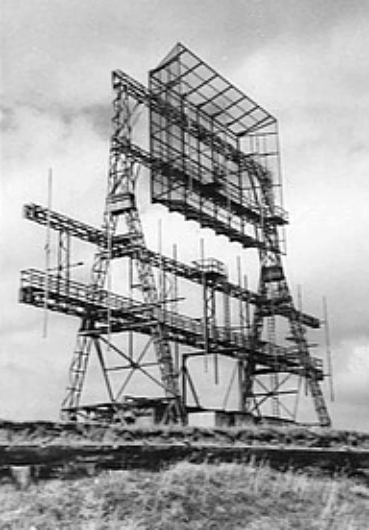
"Headache", the system
The British gave the German system the code name Headache, and the RAF applied that same name to the beams. The German name, Knickebein, means "crooked leg", and it owed that name to the shape of the antennas.
"Aspirin", the jamming
The work to block the Knickebein was given the code name Aspirin. Under that same name, transmitters were built that imitated the beam signal. "Aspirins" was the name of the first jammers, simple jamming equipment used against the Knickebein beams. The founding commander of No. 80 Wing was Wing Commander Edward Addison, a signals specialist who had just returned from the Middle East.
The names of the other systems
British intelligence officers knew as "Ruffians" the system that used the X-Gerät apparatus, based on laying a main beam over the target, cut by two cross beams at points separated from each other and from the target by fixed intervals. The other system, the one that used the Y-Gerät apparatus, was known in the United Kingdom as "BENITO".
More questions

Aviation history
What was special about the Vertol 76?
Vertol's VZ-2 tested the tiltwing concept for vertical take-off and landing. After ground trials beginning in April 1957, it first took off on 13 August only… more…

Aviation history
Which was the most-produced American fighter of the Second World War?
The Republic P-47 Thunderbolt, of which 15,636 or 15,683 units were built, depending on the source. It was also one of the heaviest fighters of the conflict… more…

Aviation history
Who flew the E-66 at 2,149 km/h?
Konstantin or Vladimir Kokkinaki, depending on the source. Konstantin is credited with the absolute record on a closed 100 km circuit, at 2,148.66 km/h, set… more…

Fly-by-Owen (CC BY SA), vía commons Aviation history
How many I-11Bs were built?
Between 208 and around 450, depending on the source: one of the AISA I-11 reference sheets gives 208 examples built, while All-Aero speaks of around 400 built… more…

Aviation history
How many HH-53s could be converted to Pave Low III?
Eight HH-53C aircraft received an improved systems package and were redesignated HH-53H Pave Low III. The other figure in circulation, nine MH-53H and 32… more…

SCDBob (CC BY SA), vía commons Aviation history
What did the A129 Mangusta's armor protect?
The fuselage: the A129's airframe is armored and, according to All-Aero, designed to protect against 12.7 mm rounds, with partial protection against 23 mm… more…


