Did you know…
What tail design was characteristic of Arado aircraft?
Short answer
Single-engine Arados were recognized by having the fin and rudder mounted ahead of the horizontal stabilizer, a feature that became standard at the company and made recovering from spins very easy. On the Ar 68, the stabilizer was joined to the tall rudder by struts, a design very characteristic of Arado.
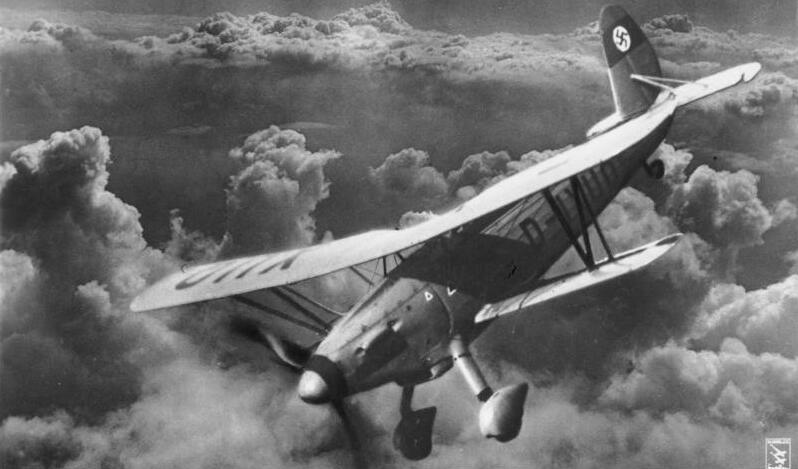
The forward-mounted fin of the Ar 67
The most significant development of the Arado Ar 67 was its new tail, with the fin and rudder mounted ahead of the horizontal stabilizer. That arrangement, with the fin-and-rudder assembly placed ahead of the tailplane, became a standard feature of single-engine Arados. It also made recovering from spins very easy.
Struts and sheet metal on the Ar 68
On the Arado Ar 68 the tail was a design very characteristic of the firm, with the horizontal stabilizer joined to the tall rudder by means of struts. On that fighter, sheet metal covered the stabilizer and the fin.
The fighter that carried this feature to the front
The Ar 68 was the last biplane fighter to see frontline service in the Luftwaffe. It entered Luftwaffe service in early 1936. The Ar 68F version joined I./JG 134 Horst Wessel in late summer 1936. The Messerschmitt Bf 109, a monoplane fighter, overshadowed it before the outbreak of the Second World War. When the war began, in September 1939, the Bf 109 had already replaced it in day fighter units. Even so, the type kept operating, mainly as a trainer, as late as 1944.
More questions

Aviation history
Which was the most-produced American fighter of the Second World War?
The Republic P-47 Thunderbolt, of which 15,636 or 15,683 units were built, depending on the source. It was also one of the heaviest fighters of the conflict… more…

Aviation history
Who flew the E-66 at 2,149 km/h?
Konstantin or Vladimir Kokkinaki, depending on the source. Konstantin is credited with the absolute record on a closed 100 km circuit, at 2,148.66 km/h, set… more…

Fly-by-Owen (CC BY SA), vía commons Aviation history
How many I-11Bs were built?
Between 208 and around 450, depending on the source: one of the AISA I-11 reference sheets gives 208 examples built, while All-Aero speaks of around 400 built… more…

Aviation history
How many HH-53s could be converted to Pave Low III?
Eight HH-53C aircraft received an improved systems package and were redesignated HH-53H Pave Low III. The other figure in circulation, nine MH-53H and 32… more…

SCDBob (CC BY SA), vía commons Aviation history
What did the A129 Mangusta's armor protect?
The fuselage: the A129's airframe is armored and, according to All-Aero, designed to protect against 12.7 mm rounds, with partial protection against 23 mm… more…
Fly-by-Owen (CC BY SA), vía commons Aviation history
What landing gear and canopy did the AISA I-11B have?
According to one account, AISA reduced the cockpit canopy and fitted tailwheel gear on the production I-11B. All-Aero claims the opposite: the I-11B was… more…


