Did you know…
When did the first piloted rotary-wing aircraft lift off?
Short answer
On 29 September 1907: the Breguet brothers' Gyroplane No.I flew for the first time, though it only reached 0.6 m (2 ft) and was not a free flight, since four men stabilised the structure. It was neither controllable nor steerable, but it was the first time a rotary-wing craft had lifted a pilot off the ground.

An open framework with four twin rotors
The Gyroplane No.I was one of the first attempts to create a practical rotary-wing aircraft. It was designed by the Breguet brothers with the help of Professor Charles Richet. It had an open, uncovered steel framework, with a seat for the pilot and the power plant in the centre. Four tubular steel arms, braced with cable, extended from the central structure, each carrying a superimposed pair of four-blade rotors. To cancel out torque effect, two sets of rotors turned clockwise and the other two counterclockwise.
The ascent of 29 September 1907
On 29 September 1907 the Gyroplane No.I flew for the first time, though it only reached a height of 0.6 m (2 ft). It was not a free flight: four men were employed to stabilise the structure. The craft was neither controllable nor steerable, but it was the first time a rotary-wing device had lifted itself and a pilot into the air. It later went on to fly as high as 1.52 m (4.99 ft) above the ground.
The Gyroplane No.II
The No.II carried two two-blade rotors 7.85 m (25.75 ft) in diameter and also carried fixed wings. Powered by a 41 kW (55 hp) Renault engine, it was reported to have flown successfully more than once in 1908.
More questions
Aviation history
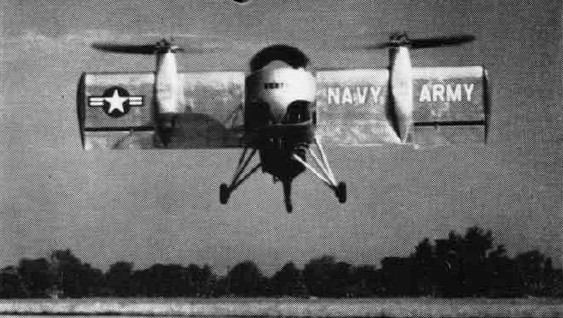
What was special about the Vertol 76?
Vertol's VZ-2 tested the tiltwing concept for vertical take-off and landing. After ground trials beginning in April 1957, it first took off on 13 August only… more…

Aviation history
Which was the most-produced American fighter of the Second World War?
The Republic P-47 Thunderbolt, of which 15,636 or 15,683 units were built, depending on the source. It was also one of the heaviest fighters of the conflict… more…

Aviation history
Who flew the E-66 at 2,149 km/h?
Konstantin or Vladimir Kokkinaki, depending on the source. Konstantin is credited with the absolute record on a closed 100 km circuit, at 2,148.66 km/h, set… more…

Fly-by-Owen (CC BY SA), vía commons Aviation history
How many I-11Bs were built?
Between 208 and around 450, depending on the source: one of the AISA I-11 reference sheets gives 208 examples built, while All-Aero speaks of around 400 built… more…

Aviation history
How many HH-53s could be converted to Pave Low III?
Eight HH-53C aircraft received an improved systems package and were redesignated HH-53H Pave Low III. The other figure in circulation, nine MH-53H and 32… more…

SCDBob (CC BY SA), vía commons Aviation history
What did the A129 Mangusta's armor protect?
The fuselage: the A129's airframe is armored and, according to All-Aero, designed to protect against 12.7 mm rounds, with partial protection against 23 mm… more…


