Did you know…
Why did the Beardmore W.B.III have unstaggered, folding wings?
Short answer
Because it was a Sopwith Pup adapted for shipboard service. The Navy required wings that could be folded by hand, so the wing cell was redesigned without stagger and with straight, parallel struts, plus an extra set of inner struts that made folding for stowage easier.
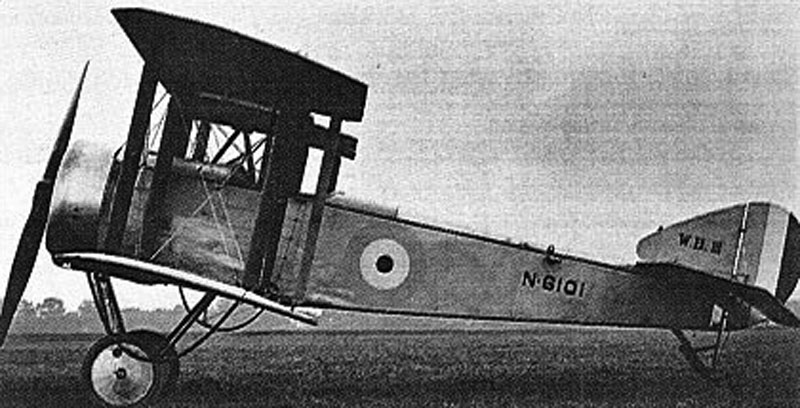
A Sopwith Pup adapted for the sea
The W.B.III was a development of the Sopwith Pup, which Beardmore was then manufacturing under license, specifically adapted for shipboard use.
Unstaggered so the wing could fold
The wing cell was redesigned without stagger and with an extra set of struts on the inner section, which made folding for stowage easier. The struts became straight and parallel, instead of the staggered arrangement of the Sopwith Pup, due to the Navy's requirement that the wings fold by hand. The redesign also reduced the dihedral angle.
A Lewis gun above the cockpit and fleet service
The armament was a .303 Lewis gun mounted on a special fitting ahead of the pilot's cockpit, allowing him to fire through an opening cut into the center section. Up to around a hundred aircraft were built, deployed in small numbers aboard various Royal Navy warships, including the aircraft carriers HMS Furious and HMS Argus and the seaplane carriers HMS Nairana and HMS Pegasus.
More questions

Aviation history
What was special about the Vertol 76?
Vertol's VZ-2 tested the tiltwing concept for vertical take-off and landing. After ground trials beginning in April 1957, it first took off on 13 August only… more…

Aviation history
Which was the most-produced American fighter of the Second World War?
The Republic P-47 Thunderbolt, of which 15,636 or 15,683 units were built, depending on the source. It was also one of the heaviest fighters of the conflict… more…

Aviation history
Who flew the E-66 at 2,149 km/h?
Konstantin or Vladimir Kokkinaki, depending on the source. Konstantin is credited with the absolute record on a closed 100 km circuit, at 2,148.66 km/h, set… more…

Fly-by-Owen (CC BY SA), vía commons Aviation history
How many I-11Bs were built?
Between 208 and around 450, depending on the source: one of the AISA I-11 reference sheets gives 208 examples built, while All-Aero speaks of around 400 built… more…

Aviation history
How many HH-53s could be converted to Pave Low III?
Eight HH-53C aircraft received an improved systems package and were redesignated HH-53H Pave Low III. The other figure in circulation, nine MH-53H and 32… more…

SCDBob (CC BY SA), vía commons Aviation history
What did the A129 Mangusta's armor protect?
The fuselage: the A129's airframe is armored and, according to All-Aero, designed to protect against 12.7 mm rounds, with partial protection against 23 mm… more…


