Did you know…
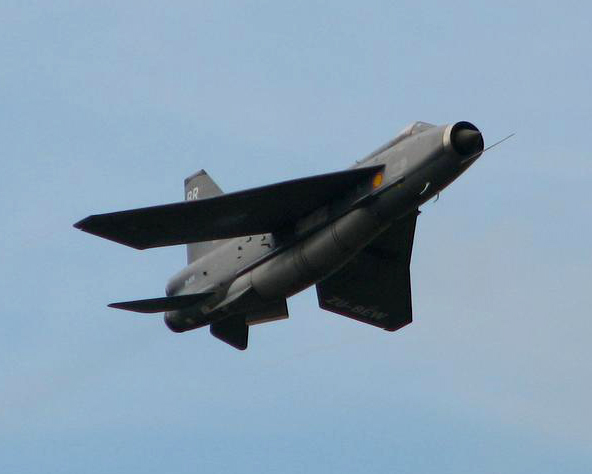
Why does the Lightning have two engines stacked one above the other?
Short answer
To reconcile three conflicting demands: minimising the frontal cross-section, giving the engines an undisturbed airflow across a wide speed range, and housing two engines with enough thrust. This gave the Lightning the cross-section of a single-engine aircraft with the thrust of a twin-engine one.
Three conflicting requirements
Engines stacked vertically and staggered longitudinally were the solution devised by Petter to meet conflicting requirements: minimising the frontal area, guaranteeing the engines undisturbed airflow over a wide range of speeds, and packaging two engines capable of delivering the thrust needed to meet the performance targets. The result offered the thrust of two engines with a drag equivalent to only 1.5 mounted side by side, a 25% reduction compared with more conventional twin-engine installations.
How the assembly was installed
In the Lightning, two Rolls-Royce Avons were stacked vertically, one on top of the other. The upper one exhausted through the top of the rear fuselage and the lower one through the bottom. With that arrangement the aircraft presented the cross-section of a single-engine fighter and the thrust of a twin.
From research aircraft to fighter
The research prototype, conceived to explore transonic speed and built to specification F.23/49, had an ultra-thin wing with extreme sweep, no less than 60°. Its two Bristol-Siddeley Sapphire turbojets were stacked vertically to reduce the frontal cross-section, by 50% in that case, and staggered, with the upper one placed well forward. It first flew from RAF Boscombe Down on 4 August 1954, with WG760 piloted by Roland Beamont. On 11 August it reached Mach 1.01 and became the first British aircraft to exceed the speed of sound in level flight. The experience with the SB.5 validated the wing sweep and the low-tail configuration adopted for the P.1.
More questions
Aviation history
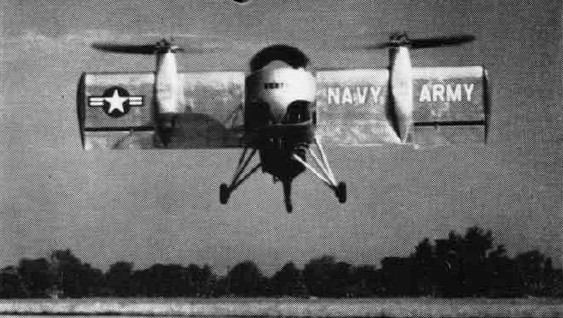
What was special about the Vertol 76?
Vertol's VZ-2 tested the tiltwing concept for vertical take-off and landing. After ground trials beginning in April 1957, it first took off on 13 August only… more…

Aviation history
Which was the most-produced American fighter of the Second World War?
The Republic P-47 Thunderbolt, of which 15,636 or 15,683 units were built, depending on the source. It was also one of the heaviest fighters of the conflict… more…

Aviation history
Who flew the E-66 at 2,149 km/h?
Konstantin or Vladimir Kokkinaki, depending on the source. Konstantin is credited with the absolute record on a closed 100 km circuit, at 2,148.66 km/h, set… more…

Fly-by-Owen (CC BY SA), vía commons Aviation history
How many I-11Bs were built?
Between 208 and around 450, depending on the source: one of the AISA I-11 reference sheets gives 208 examples built, while All-Aero speaks of around 400 built… more…

Aviation history
How many HH-53s could be converted to Pave Low III?
Eight HH-53C aircraft received an improved systems package and were redesignated HH-53H Pave Low III. The other figure in circulation, nine MH-53H and 32… more…

SCDBob (CC BY SA), vía commons Aviation history
What did the A129 Mangusta's armor protect?
The fuselage: the A129's airframe is armored and, according to All-Aero, designed to protect against 12.7 mm rounds, with partial protection against 23 mm… more…


