Did you know…
Why is the CH-53E's tail rotor tilted?
Short answer
The CH-53E's tail rotor was tilted 20° from vertical to provide some lift in hover while counteracting the main rotor's torque. In the same redesign, the low, symmetrical horizontal stabilizer gave way to a larger vertical tail.

From the CH-53D to the S-80
Before the requirement was issued, Sikorsky was already working on an improvement to the CH-53D under the internal designation "S-80". In the early 1970s, prototype trials studied adding a third engine and a larger rotor system with a seventh blade. As the Sikorsky S-80, the aircraft was developed from the CH-53 Sea Stallion mainly by adding that third engine, the seventh blade to the main rotor, and tilting the tail rotor 20°. The starting CH-53 was powered by a pair of General Electric T64-6 turboshafts of up to 2,850 shp (2,130 kW) each.
A tail rotor that also provides lift
The tail configuration was modified. The low, symmetrical horizontal stabilizer was replaced by a larger vertical tail, and the tail rotor was tilted from vertical to provide some lift in hover, in addition to counteracting the main rotor's torque.
The high horizontal surface
In that redesign, the tail incorporated a horizontal surface mounted high, facing the rotor, with an inner section perpendicular to the tail rotor that, from the strut joint onward, is canted 20° relative to the horizontal. That arrangement helps with pitch at high speed.
More questions
Aviation history
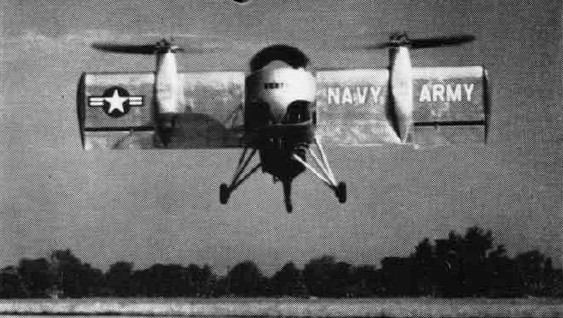
What was special about the Vertol 76?
Vertol's VZ-2 tested the tiltwing concept for vertical take-off and landing. After ground trials beginning in April 1957, it first took off on 13 August only… more…

Aviation history
Which was the most-produced American fighter of the Second World War?
The Republic P-47 Thunderbolt, of which 15,636 or 15,683 units were built, depending on the source. It was also one of the heaviest fighters of the conflict… more…

Aviation history
Who flew the E-66 at 2,149 km/h?
Konstantin or Vladimir Kokkinaki, depending on the source. Konstantin is credited with the absolute record on a closed 100 km circuit, at 2,148.66 km/h, set… more…

Fly-by-Owen (CC BY SA), vía commons Aviation history
How many I-11Bs were built?
Between 208 and around 450, depending on the source: one of the AISA I-11 reference sheets gives 208 examples built, while All-Aero speaks of around 400 built… more…

Aviation history
How many HH-53s could be converted to Pave Low III?
Eight HH-53C aircraft received an improved systems package and were redesignated HH-53H Pave Low III. The other figure in circulation, nine MH-53H and 32… more…

SCDBob (CC BY SA), vía commons Aviation history
What did the A129 Mangusta's armor protect?
The fuselage: the A129's airframe is armored and, according to All-Aero, designed to protect against 12.7 mm rounds, with partial protection against 23 mm… more…


