Did you know…
What did the Arado Ar 234 do with its wheels on takeoff?
Short answer
It dropped them: the early Ar 234s took off on a disposable trolley arranged as a tricycle landing gear and landed on three retractable skids. Arado gave up retractable gear to reduce weight and maximize internal fuel. The trolley was released with five parachutes from about 60 m (195 ft).

A trolley for takeoff, skids for landing
To reduce weight and maximize internal fuel capacity, Arado did not use retractable landing gear. Instead, the aircraft took off on a disposable trolley arranged as a tricycle landing gear and landed on three retractable skids, one under the center fuselage section and one under each engine nacelle. The version fitted with the trolley became known as the Ar 234A.
The trolley and its parachutes
Initially, the takeoff technique involved dropping the trolley at about 60 m (195 ft) of altitude, with five parachutes returning it to the ground. The parachute system caused problems, and after the first two trolleys were destroyed, it was decided to release the trolley immediately on takeoff.
The limits of the system
Landing the skid-equipped prototypes on a wet grass runway was extremely slippery due to the total absence of braking capability. This landing gear also meant the aircraft could not move under its own power after landing, which would have left the aircraft scattered across the airfield, unable to taxi off the runway. On 12 March 1944, the Ar 234 V9 made its first flight, the first to feature a fully retractable tricycle landing gear, with the main gear retracting forward into the mid-fuselage and the nose gear retracting backward.
More questions
Aviation history
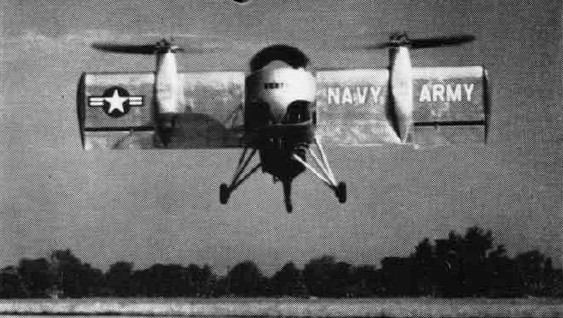
What was special about the Vertol 76?
Vertol's VZ-2 tested the tiltwing concept for vertical take-off and landing. After ground trials beginning in April 1957, it first took off on 13 August only… more…

Aviation history
Which was the most-produced American fighter of the Second World War?
The Republic P-47 Thunderbolt, of which 15,636 or 15,683 units were built, depending on the source. It was also one of the heaviest fighters of the conflict… more…

Aviation history
Who flew the E-66 at 2,149 km/h?
Konstantin or Vladimir Kokkinaki, depending on the source. Konstantin is credited with the absolute record on a closed 100 km circuit, at 2,148.66 km/h, set… more…

Fly-by-Owen (CC BY SA), vía commons Aviation history
How many I-11Bs were built?
Between 208 and around 450, depending on the source: one of the AISA I-11 reference sheets gives 208 examples built, while All-Aero speaks of around 400 built… more…

Aviation history
How many HH-53s could be converted to Pave Low III?
Eight HH-53C aircraft received an improved systems package and were redesignated HH-53H Pave Low III. The other figure in circulation, nine MH-53H and 32… more…

SCDBob (CC BY SA), vía commons Aviation history
What did the A129 Mangusta's armor protect?
The fuselage: the A129's airframe is armored and, according to All-Aero, designed to protect against 12.7 mm rounds, with partial protection against 23 mm… more…


