Did you know…
How powerful was the Fairey Fox VIR's Hispano-Suiza 12Y?
Short answer
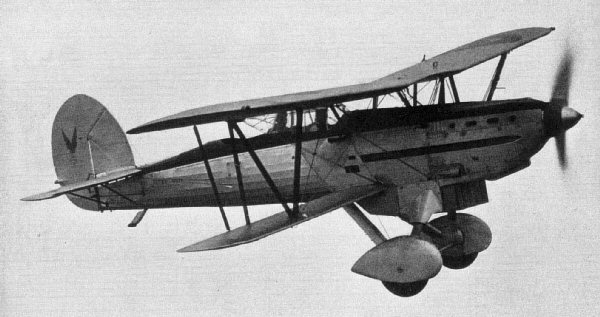
The Fox VIR carried a Hispano-Suiza 12Ydrs of 830 or 860 hp, according to different sources (according to different sources). The intermediate step, the Fox IV, had fitted a 775 hp 12Ybrs. Of this reconnaissance version, 24 were built for Belgium and two for Switzerland.
From the Fox IV to the Fox VM
By the end of January 1934 Fairey had completed a new version of the Fox, the Fox IV. It was a Fox II converted with a Hispano-Suiza 12Ybrs engine, which first flew on 31 January 1934. According to Belgian Wings, the engine was a 775 hp 12Ybrs, and the fuselage was lengthened by 8 cm to compensate for its greater weight. Loaned for testing to the parent company at Hayes, the aircraft was refined with a new cockpit canopy and aerodynamic wheel fairings. In this configuration it was tested as a long-range fighter, under the provisional designation Fox VM.
An even more powerful engine
Back in Belgium it lost the wheel fairings and received an even more powerful engine, the Hispano-Suiza 12Ydrs, of 830 or 860 hp according to different sources (according to different sources). Of the Fox VIR reconnaissance version, 24 were built for Belgium and two for Switzerland. The aircraft received the final designation Fox VIR, the R standing for reconnaissance. It was presented to the Belgian authorities in August 1934, after which an order for 24 aircraft was signed.
Kestrel and Fox VIC
Eight Fox IIICs carried a fully supercharged Rolls-Royce Kestrel V, of 600 hp at 3,000 m. The Aéronautique Militaire Belge ordered 52 aircraft of a simpler modification of the Fox VIR, the Fox VIC. The first Fox VIC left the factory on 21 September 1935.
More questions

Aviation history
Which was the most-produced American fighter of the Second World War?
The Republic P-47 Thunderbolt, of which 15,636 or 15,683 units were built, depending on the source. It was also one of the heaviest fighters of the conflict… more…

Aviation history
Who flew the E-66 at 2,149 km/h?
Konstantin or Vladimir Kokkinaki, depending on the source. Konstantin is credited with the absolute record on a closed 100 km circuit, at 2,148.66 km/h, set… more…

Fly-by-Owen (CC BY SA), vía commons Aviation history
How many I-11Bs were built?
Between 208 and around 450, depending on the source: one of the AISA I-11 reference sheets gives 208 examples built, while All-Aero speaks of around 400 built… more…

Aviation history
How many HH-53s could be converted to Pave Low III?
Eight HH-53C aircraft received an improved systems package and were redesignated HH-53H Pave Low III. The other figure in circulation, nine MH-53H and 32… more…

SCDBob (CC BY SA), vía commons Aviation history
What did the A129 Mangusta's armor protect?
The fuselage: the A129's airframe is armored and, according to All-Aero, designed to protect against 12.7 mm rounds, with partial protection against 23 mm… more…
Fly-by-Owen (CC BY SA), vía commons Aviation history
What landing gear and canopy did the AISA I-11B have?
According to one account, AISA reduced the cockpit canopy and fitted tailwheel gear on the production I-11B. All-Aero claims the opposite: the I-11B was… more…


