Did you know…
How long does it take a rocket to get to Mars?
Short answer
About 200 days, according to NASA, is the length of the interplanetary cruise phase on typical trajectories. And the trip can only begin when Earth and Mars align, which happens once every 26 months. Perseverance, for example, traveled 497 million kilometers in about seven months.

A window every 26 months
You can't go to Mars whenever you want. The two orbits move at different rates, and according to NASA, only once every 26 months do they align in a way that allows the most energy-efficient trip. Missing that opportunity means waiting for the next cycle, which is why missions bunch up within a few weeks of each period: the schedule is dictated by celestial mechanics, not by industry.
Two hundred days of travel
NASA puts the interplanetary cruise phase, the stretch from leaving Earth's vicinity to the final approach to the planet, at around 200 days. During that time the spacecraft isn't "aimed" at Mars: it follows its own orbit around the Sun, calculated so that when it reaches its farthest point, the planet is right there. Course corrections are small nudges; the bulk of the work was done by the launch vehicle in the first few minutes.
A concrete case: Perseverance
NASA's Perseverance rover launched in the July 2020 window and arrived at Mars about seven months later, on February 18, 2021, after traveling some 497 million kilometers. That distance explains why the clock can't simply be shortened at will: the path isn't a straight line between two planets but a wide arc around the Sun. Going faster means arriving with more speed, which then requires spending propellant to brake or facing a more demanding atmospheric entry, with a heavier heat shield and less usable mass for scientific payload.
More questions
Moon and Mars
How does neil armstrong look like?
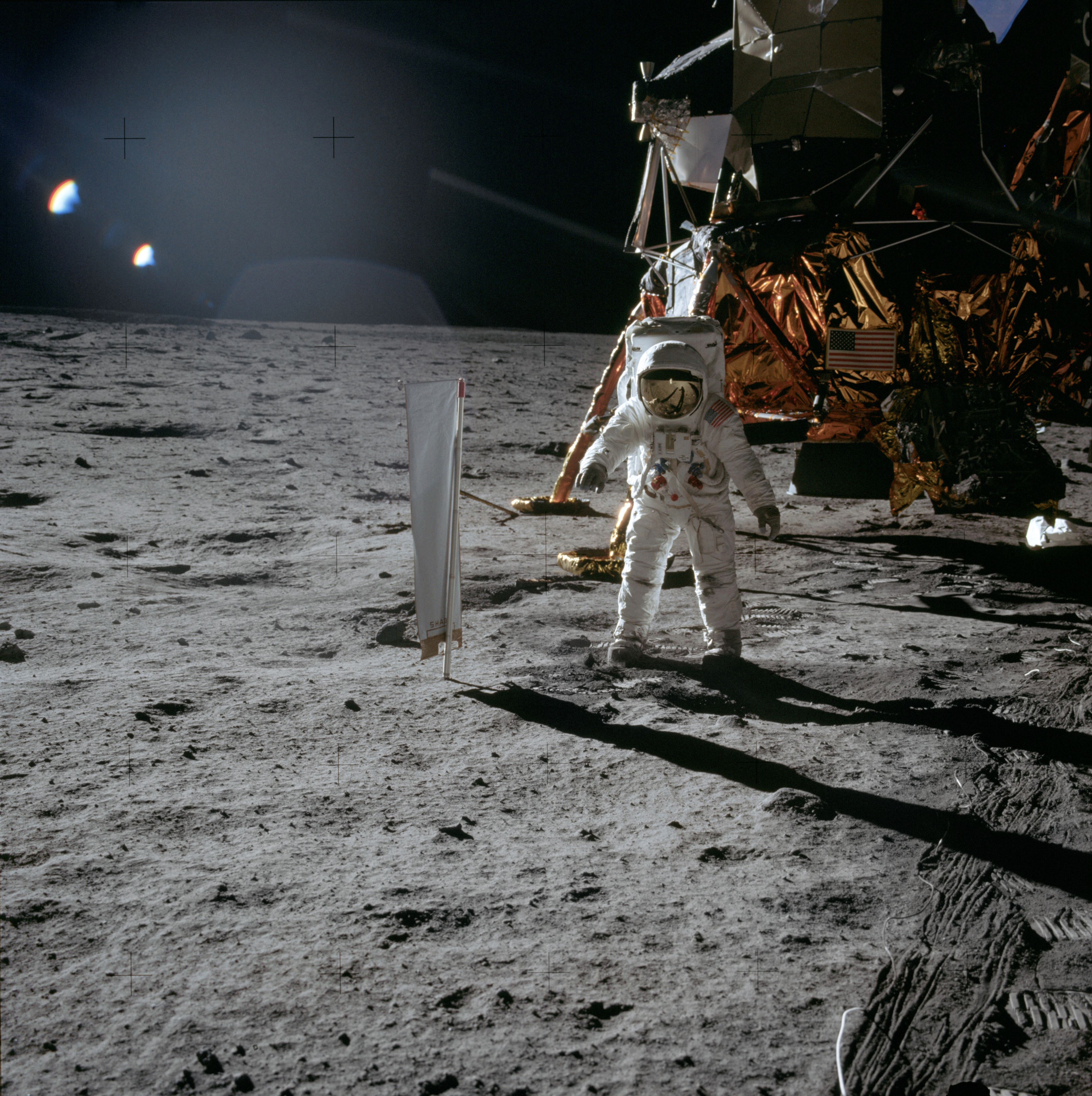
The face most people picture is not his: the gold-visored astronaut in the famous Apollo 11 photograph is Buzz Aldrin, shot by Armstrong. Armstrong himself is… more…

Richard Dorrell (CC BY SA), vía commons Moon and Mars
How does the moon affect the tides?
By pulling unevenly on it. Tidal forces vary inversely as the cube of the distance, so the near side of the Earth is tugged harder than the far side: one… more…
Moon and Mars
Why does neil armstrong have a hollywood star?
Strictly he does not have a star. Armstrong, Aldrin and Collins share four circular monuments resembling the Moon, one at each corner of Hollywood and Vine… more…

Foto: SpaceX (CC0) Moon and Mars
Why did falcon 9 hit the moon?
Because a spent upper stage on a lunar trajectory has no mission and no way to steer. A Falcon 9 upper stage from the January 2025 Firefly Blue Ghost 1 launch… more…
Moon and Mars
How much apollo 11 cost?
NASA never published a price for Apollo 11 on its own; what is documented is the program. The United States spent $25.8 billion on Project Apollo between 1960… more…
Moon and Mars
How much time neil armstrong spent on moon?
Armstrong and Aldrin spent 21 hours, 36 minutes on the Moon's surface, almost all of it inside the lunar module Eagle. Armstrong stepped onto the surface… more…

