Did you know…
How does gravity in space work?
Short answer
Gravity works the same way in space as on the ground: every mass attracts every other, with a pull that weakens as the square of the distance. Nothing shields it and nothing switches it off. Orbits exist precisely because gravity keeps bending a spacecraft's path while its sideways speed, about 7.7 km/s in low Earth orbit, carries it past the planet.
An inverse-square rule with unlimited reach
The governing relationship is simple: attraction grows with the masses involved and falls with the square of the separation, measured from centre to centre. Doubling the distance quarters the pull. Critically, the rule never returns zero. Earth's field reaches the Moon 384,400 km away and beyond; the Sun's holds Neptune at 4.5 billion km. Gravity cannot be blocked, absorbed or cancelled by any material, which is why spacecraft designers treat it as the permanent background condition of every trajectory.
That is also why orbital altitude changes less than people expect. Measured from Earth's centre, a spacecraft 400 km up is only about six percent farther out than someone standing on the ground, so it still experiences roughly 90 percent of surface gravity.
Orbiting is falling sideways
An orbit is a permanent fall that never lands. Give an object enough horizontal velocity and gravity's downward curvature of its path matches the curvature of the planet beneath. In low Earth orbit that velocity is around 7.7 km/s, completing a circuit in roughly 90 minutes. Everything aboard falls at the identical rate, so nothing presses against anything else and the crew float — free fall, not absent gravity.
Navigating by gravity
Mission design exploits the field rather than fighting it. A gravity assist steals a sliver of a planet's orbital momentum to accelerate a probe without propellant; Voyager 2 used successive encounters with Jupiter, Saturn, Uranus and Neptune to cross the outer Solar System. Lagrange points, where the combined fields of two bodies and the orbital motion balance, park observatories such as the James Webb Space Telescope in stable stations 1.5 million km from Earth.
More questions
- Image pending
Astronauts and life in space
Why does astronauts float in space?
Because they are in free fall, not because gravity is absent. At the International Space Station's altitude of about 400 km, Earth still pulls almost as hard… more…
- Image pending
Astronauts and life in space
Why did yuri gagarin die?
Gagarin died in an aircraft crash, not in a spacecraft. On 27 March 1968 the MiG-15UTI trainer he was flying with instructor Vladimir Seryogin went down in… more…
- Image pending
Astronauts and life in space
How much an astronaut is paid?
NASA's civilian astronauts are ordinary federal employees, paid on the General Schedule grade-and-step scale with no bonus per flight, per spacewalk or per… more…
.png)
Astronauts and life in space
Why is blue origin so slow?
Blue Origin was built on deliberate, owner-funded incrementalism: its motto is Gradatim Ferociter, step by step, and it spent its first two decades on… more…
Astronauts and life in space
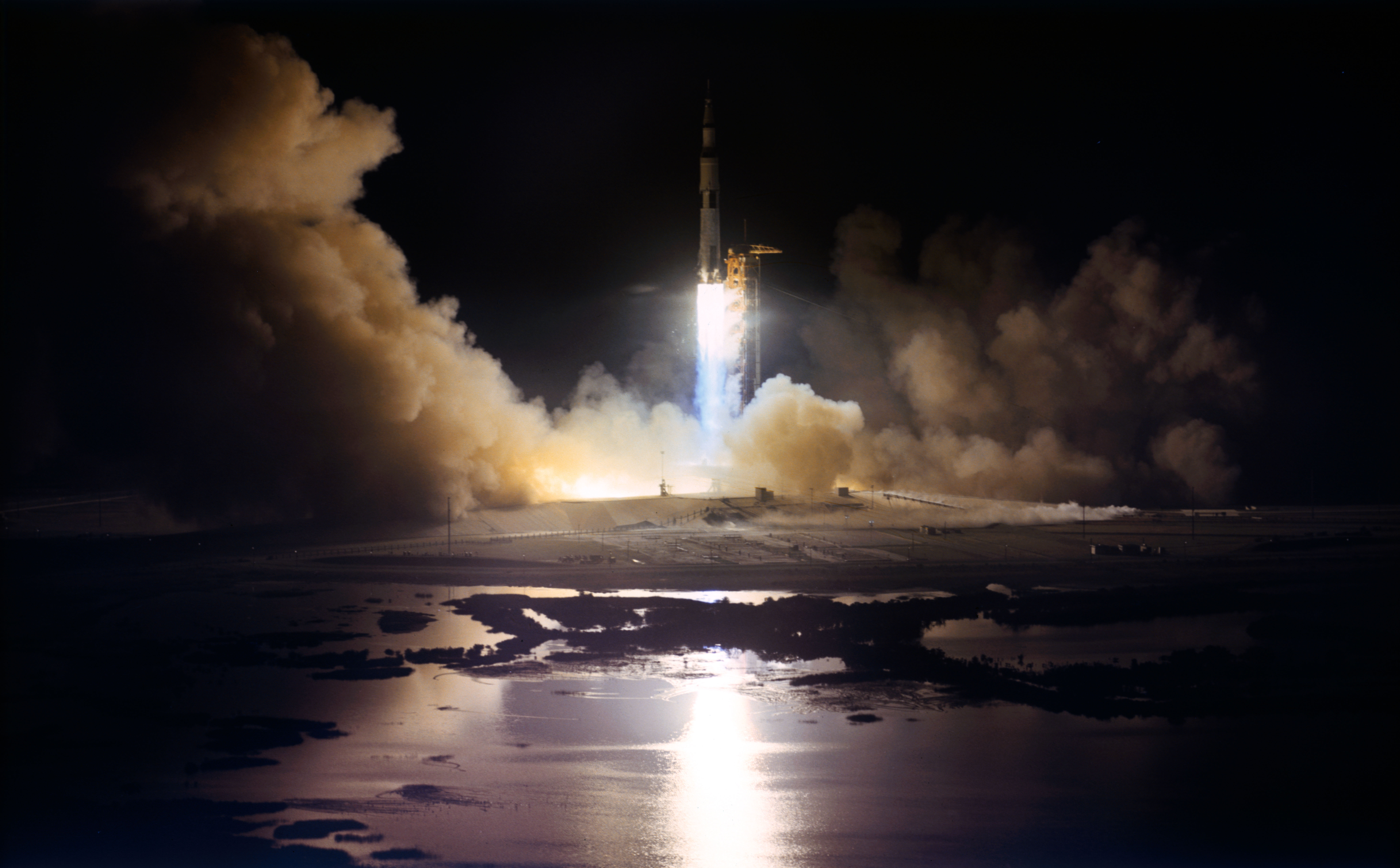
When did astronauts last walk on the moon?
Apollo 17, in December 1972. Eugene Cernan and Harrison Schmitt landed in the Taurus-Littrow valley on 11 December 1972, worked on the surface for three days… more…
- Image pending
Astronauts and life in space
How high do astronauts orbit the earth?
Crewed spaceflight today happens a few hundred kilometres up. The International Space Station orbits at about 400 km, lapping the planet roughly every 90… more…
