Did you know…
How did the operator guide the Bullpup missile?
Short answer
Visually and with a stick: the pilot or weapons operator tracked the Bullpup by watching its flares and steered it toward the target with a joystick that sent commands by radio. Guidance meant keeping the tail flares aligned with the line of sight to the target.
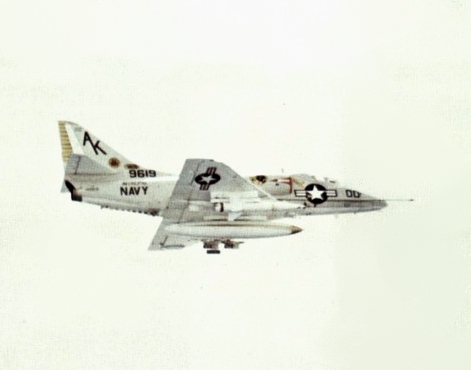
Why the Bullpup was created
Development began in 1953, when experience in the Korean War showed the almost total inability of conventional bombing to hit pinpoint ground targets such as bridges. That same year a competition was announced for a weapon that would carry the AN-M57 or AN-M81 bomb and reach a top speed of Mach 2; the contract was won by Martin Marietta in April 1954.
Flares, joystick, and radio
The pilot tracked the missile's flight through two bright flares mounted on its tail and made corrections with a small stick in the cockpit. Commands from that control reached the weapon via radio signals. The tail section housed the two tracking flares and larger wings that sustained flight and helped keep the airframe from rolling. The pilot's job, therefore, was to continuously compare the flares' position with a direct view of the target. The AGM-12C variant weighed 1,785 pounds (810 kg).
The price of guiding it to impact
The guidance system forced the pilot to fly in a straight line to keep the Bullpup in sight, which increased the threat from anti-aircraft defenses. Gunners on the ground could simply fire at the smoke trail of the missile's flare, with a fair chance of hitting the aircraft that had launched it and was still guiding it.
More questions

Aviation history
Which was the most-produced American fighter of the Second World War?
The Republic P-47 Thunderbolt, of which 15,636 or 15,683 units were built, depending on the source. It was also one of the heaviest fighters of the conflict… more…

Aviation history
Who flew the E-66 at 2,149 km/h?
Konstantin or Vladimir Kokkinaki, depending on the source. Konstantin is credited with the absolute record on a closed 100 km circuit, at 2,148.66 km/h, set… more…

Fly-by-Owen (CC BY SA), vía commons Aviation history
How many I-11Bs were built?
Between 208 and around 450, depending on the source: one of the AISA I-11 reference sheets gives 208 examples built, while All-Aero speaks of around 400 built… more…

Aviation history
How many HH-53s could be converted to Pave Low III?
Eight HH-53C aircraft received an improved systems package and were redesignated HH-53H Pave Low III. The other figure in circulation, nine MH-53H and 32… more…

SCDBob (CC BY SA), vía commons Aviation history
What did the A129 Mangusta's armor protect?
The fuselage: the A129's airframe is armored and, according to All-Aero, designed to protect against 12.7 mm rounds, with partial protection against 23 mm… more…
Fly-by-Owen (CC BY SA), vía commons Aviation history
What landing gear and canopy did the AISA I-11B have?
According to one account, AISA reduced the cockpit canopy and fitted tailwheel gear on the production I-11B. All-Aero claims the opposite: the I-11B was… more…


