Did you know…
How did Mars lose its atmosphere?
Short answer
For lack of a global magnetic field and sufficient mass. More than four billion years ago, Mars's internal dynamo shut down, exposing its atmosphere to the solar wind. NASA's MAVEN mission measured this ongoing erosion: about 100 grams of gas stripped away per second on average, more during solar storms.

A vanished shield
Earth owes its thick atmosphere to a convecting liquid core that sustains a global magnetic field. This shield deflects the solar wind, the continuous stream of charged particles emitted by the Sun. Mars once had the same mechanism: magnetometers aboard the Mars Global Surveyor probe detected remnant magnetization in the oldest terrains of the southern hemisphere, fossils of a now-extinct dynamo. Smaller than Earth, the planet cooled faster, its core stopped churning, and the field collapsed more than four billion years ago.
From then on, the solar wind struck the upper atmosphere directly. It strips away ions and carries them into space, a process the MAVEN mission, in orbit since 2014, was designed to measure. Its finding: an average loss of about 100 grams per second, multiplied several times over during coronal mass ejections. Extrapolated over billions of years, this erosion is enough to explain the shift from an atmosphere dense enough to sustain liquid water to today's thin film.
The weakness of gravity
A structural handicap compounds the problem. With just over a tenth of Earth's mass, Mars poorly retains light molecules: hydrogen produced by the breakdown of water vapor escapes through simple thermal agitation, leading to the irreversible loss of water. The isotopic ratio measured in the Martian atmosphere, enriched in deuterium, bears the trace of this selective leak.
What remains
The current atmosphere, composed of more than 95% carbon dioxide, exerts an average surface pressure of about 6 hectopascals, less than a hundredth of Earth's. Too thin to sustain stable liquid water, but enough to drive planet-wide dust storms and slow down landers.
More questions
Moon and Mars
How does neil armstrong look like?
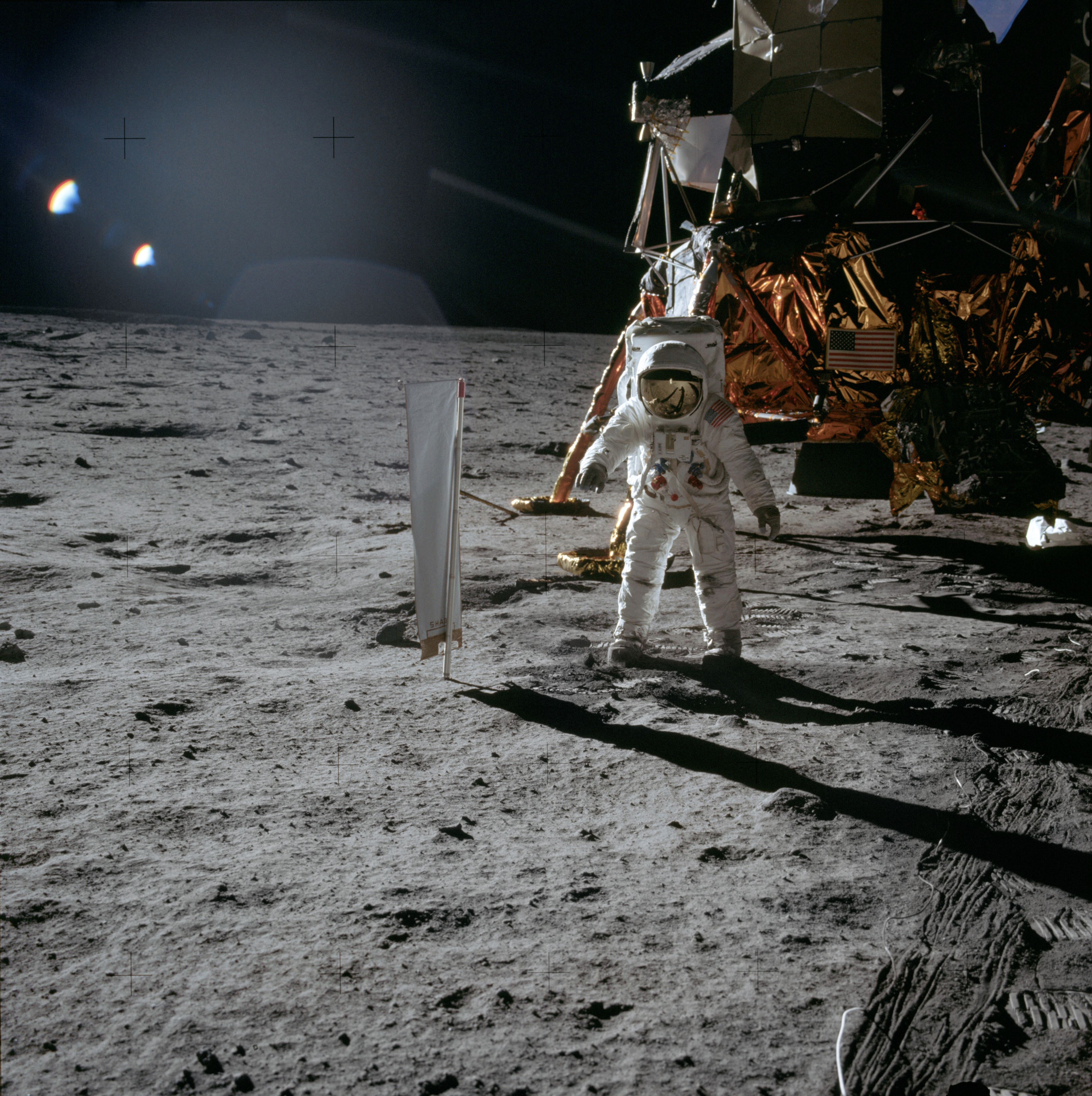
The face most people picture is not his: the gold-visored astronaut in the famous Apollo 11 photograph is Buzz Aldrin, shot by Armstrong. Armstrong himself is… more…

Richard Dorrell (CC BY SA), vía commons Moon and Mars
How does the moon affect the tides?
By pulling unevenly on it. Tidal forces vary inversely as the cube of the distance, so the near side of the Earth is tugged harder than the far side: one… more…
Moon and Mars
Why does neil armstrong have a hollywood star?
Strictly he does not have a star. Armstrong, Aldrin and Collins share four circular monuments resembling the Moon, one at each corner of Hollywood and Vine… more…

Foto: SpaceX (CC0) Moon and Mars
Why did falcon 9 hit the moon?
Because a spent upper stage on a lunar trajectory has no mission and no way to steer. A Falcon 9 upper stage from the January 2025 Firefly Blue Ghost 1 launch… more…
Moon and Mars
How much apollo 11 cost?
NASA never published a price for Apollo 11 on its own; what is documented is the program. The United States spent $25.8 billion on Project Apollo between 1960… more…
Moon and Mars
How much time neil armstrong spent on moon?
Armstrong and Aldrin spent 21 hours, 36 minutes on the Moon's surface, almost all of it inside the lunar module Eagle. Armstrong stepped onto the surface… more…

