Did you know…
Is it true that Mars has life?
Short answer
There is no confirmed life on Mars: no mission has found an organism or conclusive proof (as of October 2026). There are clues, though: in September 2025 NASA published in Nature that the Sapphire Canyon sample, from the Cheyava Falls rock, contains possible biosignatures, still awaiting confirmation.

What Perseverance found
In July 2024 the Perseverance rover analyzed, inside Jezero crater, an arrowhead-shaped rock named Cheyava Falls. It was located in the Bright Angel formation, in the ancient river valley of Neretva Vallis. The extracted sample, called Sapphire Canyon, showed a striking pattern: minerals arranged along reaction fronts, with vivianite — a hydrated iron phosphate — and greigite, an iron sulfide. The rover, which landed on Mars in February 2021, had been searching ever since for records of this kind in a crater that once held water.
What a "possible biosignature" means
NASA defines a potential biosignature as a substance or structure that could have a biological origin but requires more data or further study before reaching a conclusion. The team published the results in the journal Nature on September 10, 2025, after a year of scrutiny, and its wording is deliberately cautious: abiotic explanations for what was observed at Bright Angel seem less likely, but cannot be ruled out. It is not a discovery of life; it is a clue that calls for further investigation.
Molecules, not organisms
Curiosity contributes the other half of the case file from Gale crater. In the Cumberland sample, drilled at Yellowknife Bay in 2013 and dated at around 3.7 billion years old, decane, undecane and dodecane were identified: organic molecules with ten, eleven and twelve carbon atoms, the largest detected on Mars so far. Caution rules here too, because fatty acids can form without life, through geological reactions such as water interacting with minerals in hydrothermal vents. What has been demonstrated is that ancient Mars had the chemistry needed for life; what is still missing, and it is no small thing, is proof that this chemistry ever took that step.
More questions
Moon and Mars
How does neil armstrong look like?
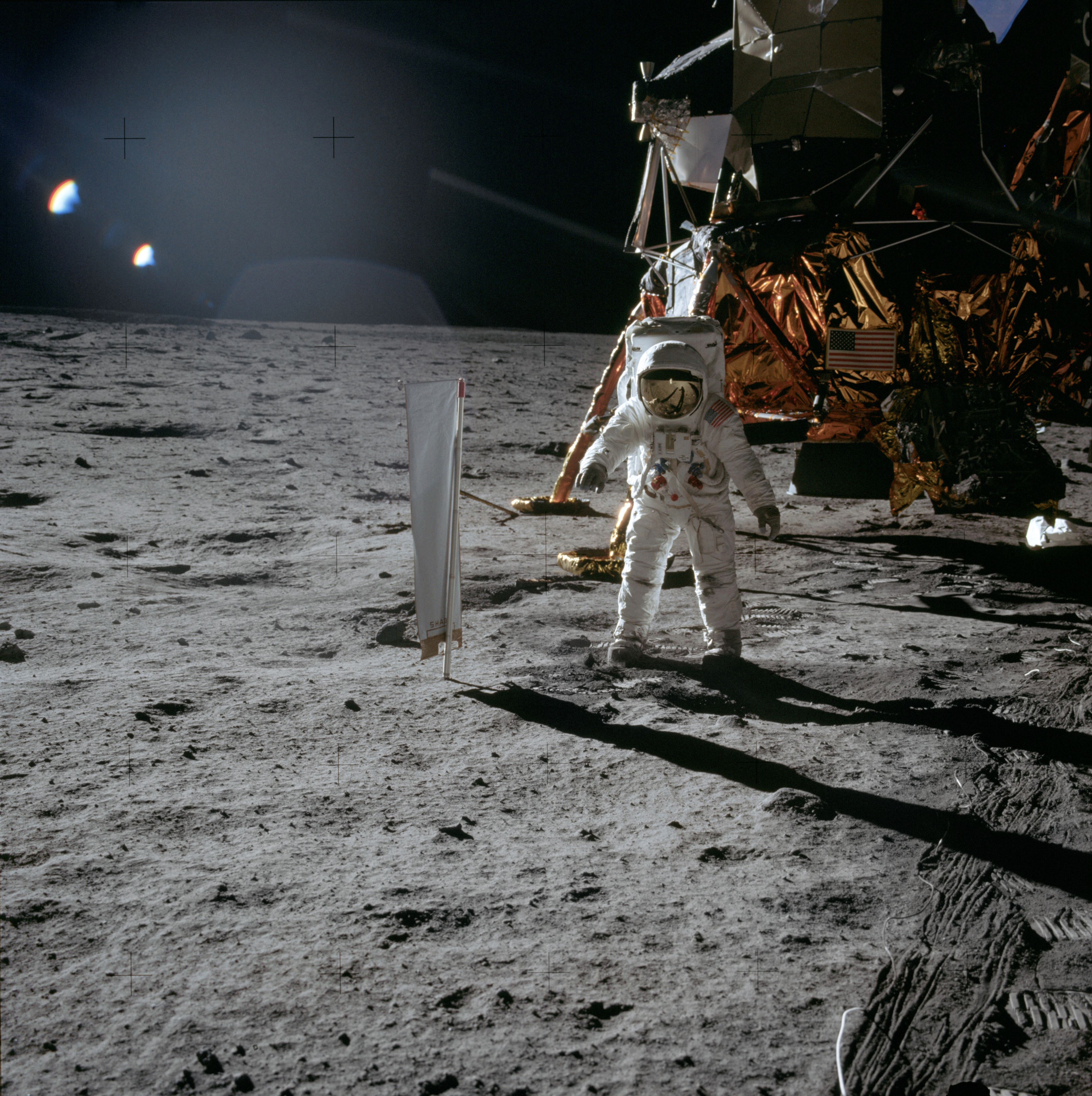
The face most people picture is not his: the gold-visored astronaut in the famous Apollo 11 photograph is Buzz Aldrin, shot by Armstrong. Armstrong himself is… more…

Richard Dorrell (CC BY SA), vía commons Moon and Mars
How does the moon affect the tides?
By pulling unevenly on it. Tidal forces vary inversely as the cube of the distance, so the near side of the Earth is tugged harder than the far side: one… more…
Moon and Mars
Why does neil armstrong have a hollywood star?
Strictly he does not have a star. Armstrong, Aldrin and Collins share four circular monuments resembling the Moon, one at each corner of Hollywood and Vine… more…

Foto: SpaceX (CC0) Moon and Mars
Why did falcon 9 hit the moon?
Because a spent upper stage on a lunar trajectory has no mission and no way to steer. A Falcon 9 upper stage from the January 2025 Firefly Blue Ghost 1 launch… more…
Moon and Mars
How much apollo 11 cost?
NASA never published a price for Apollo 11 on its own; what is documented is the program. The United States spent $25.8 billion on Project Apollo between 1960… more…
Moon and Mars
How much time neil armstrong spent on moon?
Armstrong and Aldrin spent 21 hours, 36 minutes on the Moon's surface, almost all of it inside the lunar module Eagle. Armstrong stepped onto the surface… more…

