Did you know…
Where does the stork on the Hispano-Suiza emblem come from?
Short answer
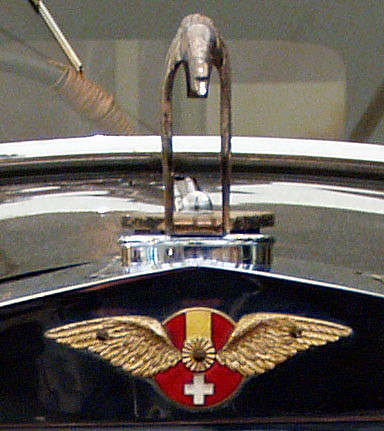
From a French squadron emblem: the mascot that topped Hispano-Suiza radiators after World War I was shaped like a stork, the symbol of the French province of Alsace, taken from the emblem painted on the side of a Hispano-Suiza-engined fighter flown by ace Georges Guynemer.
From the squadron to the radiator
After the First World War, the mascot crowning the radiator of Hispano-Suiza cars was shaped like a stork. The figure is the symbol of the French province of Alsace and was taken from a squadron emblem painted on the side of a fighter powered by a Hispano-Suiza engine and flown by the French World War I ace Georges Guynemer.
Les Cigognes
Escadrille 3, nicknamed Les Cigognes ("the storks"), was a famous French aviation unit during the First World War. It was often referred to as "Stork Escadrille N3" precisely because of its insignia. Captain Felix Brocard took command of it on 28 April 1915. The unit was later re-equipped with SPADs and renamed Escadrille Spa3. On 1 November 1916, the temporary grouping of the four original units was formalised as Groupe de Combat 12, better known as les Cigognes.
The pilot behind the emblem
Guynemer was officially credited with 54 victories at the time of his death. He is also at the origin of the SPAD S.XII: he proposed designing a manoeuvrable single-seat fighter capable of carrying a 37 mm cannon.
More questions
Aviation history
What was special about the Vertol 76?
Vertol's VZ-2 tested the tiltwing concept for vertical take-off and landing. After ground trials beginning in April 1957, it first took off on 13 August only… more…

Aviation history
Which was the most-produced American fighter of the Second World War?
The Republic P-47 Thunderbolt, of which 15,636 or 15,683 units were built, depending on the source. It was also one of the heaviest fighters of the conflict… more…

Aviation history
Who flew the E-66 at 2,149 km/h?
Konstantin or Vladimir Kokkinaki, depending on the source. Konstantin is credited with the absolute record on a closed 100 km circuit, at 2,148.66 km/h, set… more…

Fly-by-Owen (CC BY SA), vía commons Aviation history
How many I-11Bs were built?
Between 208 and around 450, depending on the source: one of the AISA I-11 reference sheets gives 208 examples built, while All-Aero speaks of around 400 built… more…

Aviation history
How many HH-53s could be converted to Pave Low III?
Eight HH-53C aircraft received an improved systems package and were redesignated HH-53H Pave Low III. The other figure in circulation, nine MH-53H and 32… more…

SCDBob (CC BY SA), vía commons Aviation history
What did the A129 Mangusta's armor protect?
The fuselage: the A129's airframe is armored and, according to All-Aero, designed to protect against 12.7 mm rounds, with partial protection against 23 mm… more…


