Did you know…
Can Artemis be seen from Earth?
Short answer
With a telescope, yes; with the naked eye, no. On April 8, 2026, the Falcon telescope at UNSW Canberra Space recorded Orion as the Artemis II crew headed home, over 320,000 kilometers away: the most distant artificial object that team has observed. In the images it looks like a moving star.

A point moving among the stars
During the Artemis II flight, several teams tracked Orion from the ground. On April 8, 2026, the Falcon telescope operated by UNSW Canberra Space, in Australia, recorded the spacecraft for an hour before dawn as the crew headed back to Earth: it appeared as a bright point moving steadily across the night sky, more than 320,000 kilometers away. It is the most distant artificial object observed by that team.
In a single image, the capsule is indistinguishable from any other star in the field. Only by stringing the shots together into an animation and enhancing the contrast does its motion against the fixed starry background become clear — the same technique used to detect faint moving objects. The Falcon is part of a global network of twelve observatories spread across four countries.
Not with the naked eye
Without instruments, the answer changes. A capsule a few meters across, hundreds of thousands of kilometers away, returns far too little light for the human eye, no matter how brightly the Sun illuminates it. The observations also required fine planning: knowing exactly where to point, with what exposure time and at what minute, because the target is very faint and moves quickly against the stars.
The launch is another story
The truly spectacular phase was the departure. Artemis II launched from Kennedy Space Center on April 1, 2026, and splashed down on April 10 off the coast of San Diego; between those two dates, the only way to follow Orion with one's own eyes was through an eyepiece or a camera. That ground-based pursuit also carries technical value: it shows that networks of civilian telescopes can locate and track the position of a spacecraft in deep space.
More questions
Moon and Mars
How does neil armstrong look like?
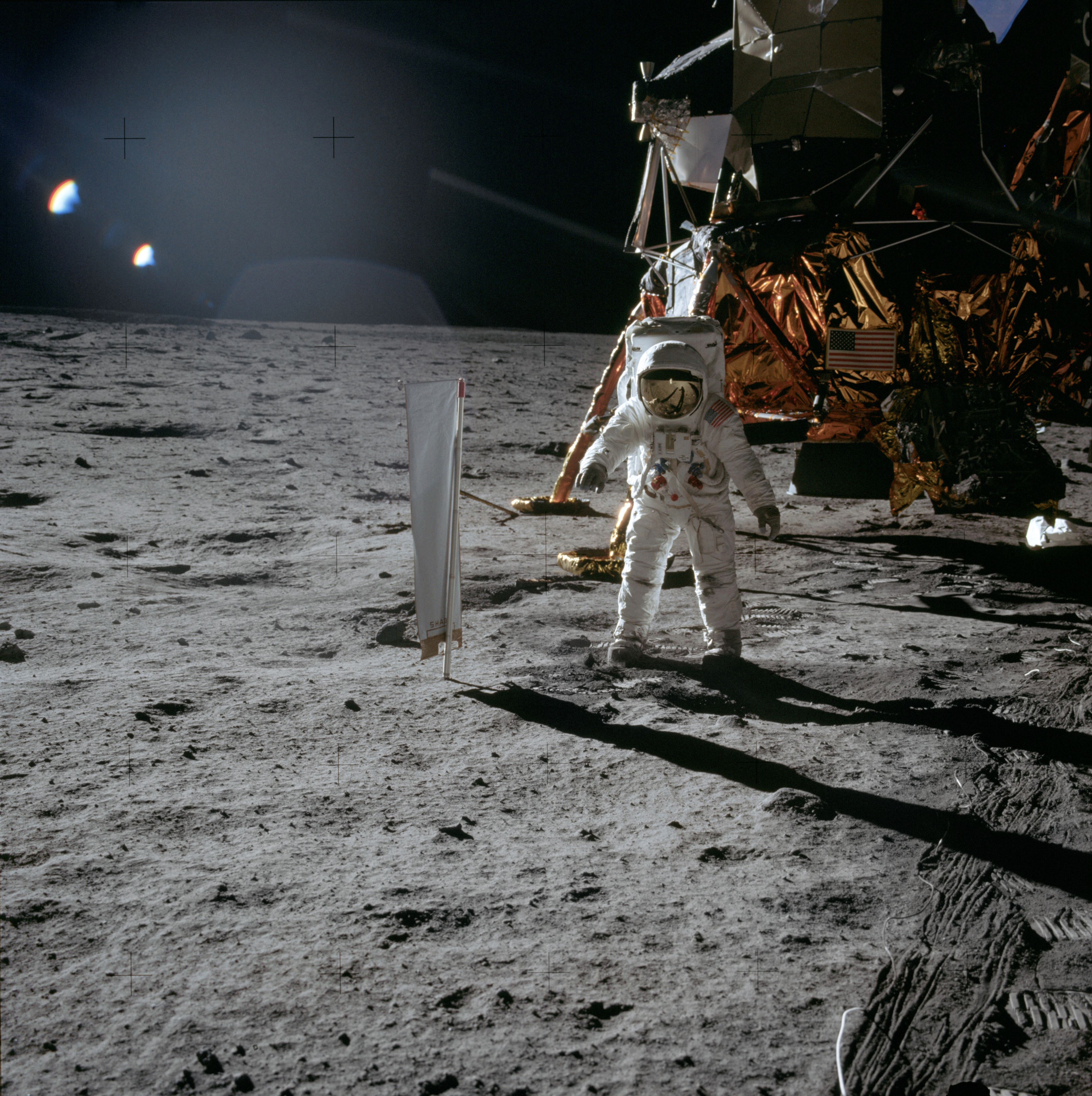
The face most people picture is not his: the gold-visored astronaut in the famous Apollo 11 photograph is Buzz Aldrin, shot by Armstrong. Armstrong himself is… more…

Richard Dorrell (CC BY SA), vía commons Moon and Mars
How does the moon affect the tides?
By pulling unevenly on it. Tidal forces vary inversely as the cube of the distance, so the near side of the Earth is tugged harder than the far side: one… more…
Moon and Mars
Why does neil armstrong have a hollywood star?
Strictly he does not have a star. Armstrong, Aldrin and Collins share four circular monuments resembling the Moon, one at each corner of Hollywood and Vine… more…

Foto: SpaceX (CC0) Moon and Mars
Why did falcon 9 hit the moon?
Because a spent upper stage on a lunar trajectory has no mission and no way to steer. A Falcon 9 upper stage from the January 2025 Firefly Blue Ghost 1 launch… more…
Moon and Mars
How much apollo 11 cost?
NASA never published a price for Apollo 11 on its own; what is documented is the program. The United States spent $25.8 billion on Project Apollo between 1960… more…
Moon and Mars
How much time neil armstrong spent on moon?
Armstrong and Aldrin spent 21 hours, 36 minutes on the Moon's surface, almost all of it inside the lunar module Eagle. Armstrong stepped onto the surface… more…

