Supermarine Spitfire
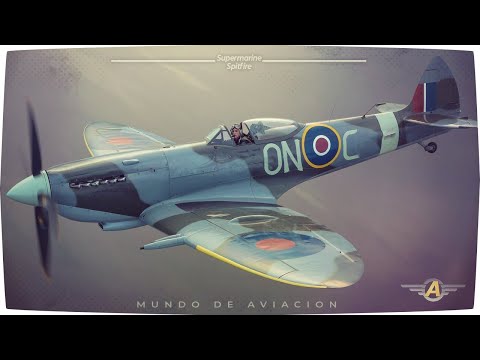
Video from the channel Mundo de Aviación about Supermarine Spitfire, linked on its Above Ten Thousand entry. Duration: 9:17. Language: Spanish. Video type: Documentary.
What it's about
Spanish-language informational entry on the Supermarine Spitfire: its origins, its configuration, its main variants and its service in the Second World War. It was the most-produced British aircraft of the war and the country's only fighter manufactured continuously throughout the conflict.
Historical context
In 1931 the Air Ministry called for a fighter capable of over 400 km/h. R. J. Mitchell's Type 224 was disappointing and gave way to the Type 300, with its characteristic elliptical wing and flush rivets to reduce the thickness of the profile. It first flew on 5 March 1936, with an initial order of 310 aircraft, and the first production example came out in mid-1938. After the Battle of Britain it replaced the Hurricane as Fighter Command's main aircraft. The arrival of the Focke-Wulf Fw 190 in late 1941 put it at a disadvantage until the Mk IX with the Merlin 61 engine appeared in large numbers. In March 1942 the first Spitfires bound overseas took off from the carrier HMS Eagle for Malta.
Highlights
There were 24 basic models, from the earliest with the Merlin engine to the last ones with the Griffon of up to 2,340 hp. It had a maximum take-off weight of 3,039 kg and a top speed of 600 km/h, with up to eight machine guns or a combination of these with 20 mm cannon. The Mk V was the most produced, with 6,479 units, followed by the Mk IX's 5,665. The carrier-borne Seafire was derived from it. It was used by more than 30 countries, and about 70 units remain airworthy.