MiG-15
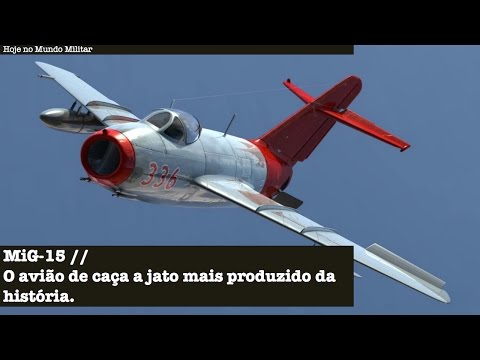
Video from the channel Hoje no Mundo Militar about Mikoyan-Gurevich MiG-15, linked on its Above Ten Thousand entry. Duration: 11:30. Language: Portuguese. Video type: Documentary.
What it's about
A Portuguese-language explainer episode, part of a series on fighter aircraft, devoted to the MiG-15: its origin, characteristics and combat history, especially in the Korean War.
Historical context
After the Second World War, the Soviet Union built the MiG-9 with engines derived from the German BMW 003, but it was unstable and production was discontinued. In 1947 the Soviets bought the Rolls-Royce Nene engine from the British, from which the Klimov RD-45 was derived. The I-310 prototypes, with 35-degree swept wings and fences on the wing to guide airflow, first flew on 30 December 1947 and exceeded 1,000 km/h. The aircraft entered service in 1949, and in 1950 received the more powerful Klimov VK-1 engine. Its baptism of fire came in the Chinese civil war, and its first aerial victory was in April 1950 against a P-38. In Korea it outperformed the F-80 and the Gloster Meteor until the arrival of the F-86 Sabre, with very hard-fought combats in the border area that pilots called "MiG Alley".
Key facts
The first examples were hard to control near the speed of sound, and pilots were forbidden to exceed Mach 0.92. For the MiG-15bis the video gives 10.08 m in length, 3.7 m in height, 3,600 kg empty weight, more than 6 t at takeoff, 850 km/h cruise speed, a 15,500 m ceiling and about 5 minutes to climb to 10,000 m. Armament: two 23 mm cannons with 160 rounds total, one 37 mm cannon with 40 rounds, and up to two 100 kg bombs. MiGs attacked in groups of three pairs. Against the F-86 they climbed and accelerated better and had a somewhat higher ceiling, but were slower below 8,000 m. It was exported to North Korea, China and Cuba, among other countries.