Attack · Military · United States
Fairchild Republic A-10 Thunderbolt II
- May 10, 1972
- First flight
- In service
- Status



_de_un_A-10C_Thunderbolt_II-800.webp)




The Fairchild Republic A-10 Thunderbolt II, universally known by its "Warthog" nickname, is a single-seat, subsonic, straight-wing, twin-turbofan attack aircraft that has served with the United States Air Force since 1977. The USAF's own fact sheet describes it as the first Air Force aircraft specially designed for close air support of ground forces. It grew out of an uncomfortable realisation: while post-war tactical design chased speed and nuclear delivery, close air support in Vietnam still rested on the Douglas A-1 Skyraider, of which the Air Force and Navy lost some 266 in action, mostly to small-arms fire. The programme that produced it was A-X (Attack Experimental), ordered on 8 September 1966 by USAF Chief of Staff General John P. McConnell. The definitive request for proposals of May 1970 required that the aircraft be designed around a 30 mm cannon and set a maximum speed of 740 km/h, an external load of 7,300 kg and a 460 km mission radius. On 18 December 1970 two finalists were chosen: the Northrop YA-9A and the Fairchild Republic YA-10A. The two YA-10 prototypes first flew on 10 May 1972 and, after the comparative fly-off, the USAF announced its selection on 18 January 1973; in 1974 the design still had to prove itself against the LTV A-7D Corsair II already in service. The fuselage was designed literally around its gun. General Electric's GAU-8/A Avenger is a hydraulically driven seven-barrel rotary cannon firing 30 × 173 mm ammunition; the complete weapon weighs 1,828 kg and the usual load is 1,174 rounds. Its rate of fire was eventually fixed at 3,900 rounds per minute. So that the barrel in the firing position lines up with the aircraft's centreline, the gun sits to port and the nose gear to starboard. The other governing criterion was survivability: 540 kg of titanium "bathtub" armour — plates 13 to 38 mm thick, almost 6 per cent of empty weight — doubly redundant hydraulics with manual reversion, and two TF34-GE-100 engines mounted high and aft, which cuts debris ingestion and screens the infrared signature behind the tailplanes. By 1984, 715 aircraft had been delivered, including two prototypes and six development airframes; another source in the same material puts the total run at 716. The only production version was the single-seat A-10A; from 1987 many airframes moved to the forward air control role as OA-10A, and a single experimental two-seater, the YA-10B Night/Adverse Weather converted from an A-10A, explored night and all-weather capability without finding a customer. Between 2005 and June 2011 the surviving 356 A-10s and OA-10s were modernised under the Precision Engagement programme and became A-10Cs: all-weather capability, a new fire-control computer, Link 16, Satcom, two multifunction displays and guided weapons. Its baptism of fire was the 1991 Gulf War, with 132 aircraft deployed: 8,100 sorties, a 95.7 per cent mission capable rate, 90 per cent of the AGM-65 Mavericks fired in the conflict and two Iraqi helicopters shot down with the cannon. It was also costly: four lost to surface-to-air missiles and eleven hit by anti-aircraft artillery, which from 15 February confined them to within 37 km of the southern border. Bosnia followed, then Allied Force over Kosovo in 1999, Afghanistan from 2002, the 2003 invasion of Iraq — 311,597 rounds fired and one A-10 shot down near Baghdad — Libya in 2011 and the campaign against the Islamic State from 2014. On 7 April 2003 Captain Kim Campbell brought one home from Baghdad with an engine damaged and the hydraulics gone, nearly an hour in manual reversion. Since 2014 the aircraft has lived in permanent tension between the USAF, which judges it insufficiently survivable against modern air defences and wants the F-35A in its place, and Congress, which has repeatedly blocked its retirement: frozen "indefinitely" in January 2016, with partial divestments authorised in the 2023 and 2024 defence bills. In June 2025 the Air Force asked to retire the remaining 162 aircraft at a stroke; Congress stopped it again and required at least 103 to be kept. In April 2026 Air Force Secretary Troy Meink deferred retirement until at least 2030 amid the war with Iran, where A-10s flew from the first 24 hours and one was shot down on 3 April. Even so, the service has already ended training for new A-10 pilots and depot-level maintenance of the type.
Category
Three-view drawing
_del_Fairchild_Republic_A-10_Thunderbolt_II.png)
_expuesto_en_el_Pima_Air_%26_Space_Museum.jpg)
_del_Fairchild_Republic_A-10_Thunderbolt_II.jpg)
History
The Fairchild Republic A-10 Thunderbolt II was born out of an institutional discomfort. For decades the United States Air Force had treated close air support — striking targets a few hundred metres from friendly troops, in coordination with them — as an inherited obligation rather than a calling. The service had been built around two governing ideas: strategic bombing and air superiority. The aircraft that would eventually be called the A-10 was the explicit exception to that hierarchy, and the only production-built aircraft designed solely for close air support ever to serve with the U.S. Air Force. Nothing about its configuration — straight wing, modest subsonic speed, armour, engines in high nacelles mounted well aft, twin fins — was the kind of solution an air force devoted to supersonic performance would have chosen willingly. It was arrived at because three successive wars, and one threat that never materialised, convinced a handful of officers that there was no shortcut.
The immediate precedent was Korea. There the USAF's first-generation jets, the F-80C and F-84, proved not entirely effective in the close air support role. The Air Force had already retired its P-47 Thunderbolts, which had been among the most effective ground-attack aircraft of the Second World War, and had to fall back on obsolete F-51Ds for attack missions. The most effective close support aircraft over Korea were the Marine Corps' F4U Corsairs, and the Navy and Marine Douglas A-1 Skyraider also took part in the role. The lesson was unambiguous — the slow, tough, long-endurance aircraft beat the fast jet at this particular job — but it was an uncomfortable lesson and it produced no programme.
Vietnam repeated it at far greater cost. One of the principal drivers behind the A-10's development was the scale of air losses: large numbers of American ground-attack aircraft were shot down by small arms, surface-to-air missiles and small-calibre anti-aircraft artillery. The helicopters of the period, the UH-1 Iroquois and the AH-1 Cobra, which were initially expected to take on part of the close support burden, proved equally vulnerable to ground fire. The fast jets — the North American F-100 Super Sabre, the Republic F-105 Thunderchief and the McDonnell Douglas F-4 Phantom II — proved for the most part ineffective at the task, not least because their high cruising speed and heavy fuel consumption prevented them from remaining over the battlefield for extended periods. Against that background, the USAF's primary close air support aircraft in Vietnam remained a propeller-driven machine of 1940s design, the A-1 Skyraider, able to loiter for hours, absorb punishment and attack slowly and accurately from low level.
Layered on top of that operational dissatisfaction was a dispute over roles. Helicopters belonged to the Army; aeroplanes belonged to the Air Force, and both services wanted the resources allotted to the fire-support mission. In Vietnam the Army complained repeatedly that it was not receiving adequate air support. Those complaints pushed the USAF to bring in aircraft such as the A-7 and the A-1 for ground attack, while the Army, for its part, developed the attack helicopter concept to give itself the fire support it felt it was not getting: in 1966 it launched the Lockheed AH-56 Cheyenne project, a fast, heavily armed compound helicopter that amounted in practice to a close air support machine under Army control. The Air Force saw armed helicopters as a direct challenge to its monopoly on aerial firepower. The criticism that the service did not take close air support seriously came with a specific demand attached: that a specialised attack aircraft be sought. The Cheyenne did not cause A-X, but it was one of its most effective spurs — for as long as it existed, the Air Force had an urgent institutional reason to demonstrate that the mission still belonged to it.
The third factor was Europe. The Air Force called for an aircraft designed specifically for ground attack to cover its deficiencies in the European theatre, a setting considered far more hostile than Vietnam and one in which, unlike Vietnam, armoured fighting vehicles would dominate. The United States was preparing to face a Warsaw Pact invasion of Europe: thousands of tanks and armoured vehicles would have to be stopped, and it fell to the USAF to provide the air support that would offset NATO's numerical inferiority. Helicopters at the time were still considered poorly suited to the anti-armour role, since they carried only machine guns and unguided rockets intended for soft targets. Ground attack still relied on rockets, bombs, napalm and gunfire, all of which required closing with the target — and it was precisely that proximity that made the environment lethal.
Two historical references shaped the requirement explicitly. The first was the Israeli Air Force's success in ground attack during the Six-Day War, which gave the decisive push to the idea that fixed-wing aircraft could be used devastatingly in that kind of mission. The second was the German experience of the Second World War: the Luftwaffe's ground-attack record was studied, and in particular that of pilots such as Hans-Ulrich Rudel, who achieved extraordinary results thanks in part to intensive use of the Junkers Ju 87 fitted with 20 mm MG 151/20 automatic cannon and, later, with 37 mm BK 37s. In the programme studies the ideal aircraft was described as one combining the best elements of the Ilyushin Il-2, the Henschel Hs 129 and the Skyraider itself: long loiter time, low-speed manoeuvrability, massive cannon firepower and extreme survivability.
In mid-1966, seeking a new attack aircraft, the U.S. Air Force formed the Attack Experimental — A-X — programme office. The officer in charge of the project was Colonel Avery Kay. On 6 March 1967 the Air Force released a request for information to twenty-one defence contractors; the stated objective was a design study for a low-cost attack aircraft. The requirements were not deduced in an office: discussions were held with A-1 Skyraider pilots operating in Vietnam, and the effectiveness of the aircraft then used in the role was analysed. Out of that work came the list of attributes that would define the future aeroplane. Turboprop engines were called for in the initial request; by May 1969 the requirement had changed to specify turbofans.
In May 1970 the Air Force issued a modified and much more detailed request for proposals. By then the threat of Soviet armoured forces and the need for all-weather attack operations had become more pressing. The document's decisive novelty was that the aircraft was to be designed specifically around the 30 mm rotary cannon: this was not a matter of fitting a weapon into an airframe, but of building an airframe around a weapon. The remaining figures described a deliberately modest machine: a maximum speed of 740 km/h (460 mph), a takeoff distance of 1,200 m (4,000 ft), an external load of 7,300 kg (16,000 lb), a mission radius of 460 km (285 miles) and a unit cost of US$1.4 million. Simplicity and low cost were themselves vital requirements, and that $1.4 million flyaway ceiling was calculated on a production run of 600 aircraft; performance was expressly to be sacrificed wherever necessary to keep development and production costs under control. At the same time a separate request for proposals was released for A-X's 30 mm cannon, demanding a high rate of fire — 4,000 rounds per minute — and a high muzzle velocity.
The settled 1970 requirements came down to five demands. Long loiter time over the combat zone, because close air support is measured in time available above the troops rather than in speed of arrival. High survivability against air defences: the USAF faced the SA-2 and SA-7 missiles in 1972, and the following year Israel had to contend with the SA-2, SA-3, SA-6 and SA-7 and with the ZSU-23 anti-aircraft gun, a catalogue that confirmed just how lethal low airspace had become. Ease of maintenance. Large weapons capacity with emphasis on anti-armour weapons: the GAU-8 cannon was under development and was to be installed in the new aircraft. And the ability to operate from forward or improvised bases, close to the front, with minimal facilities.
All of this amounted to a considerable doctrinal break. A-X would be the first USAF aircraft designed exclusively for close air support, within a service whose professional culture rewarded speed, altitude and versatility. Senior commanders were distinctly reluctant to buy ground-attack aircraft and argued instead for supersonic types, on the grounds that their versatility would also let them perform attack missions. The analysis of Vietnam pointed the other way: only three USAF aircraft had proved capable of performing close air support satisfactorily, and none of them was suitable for Europe. The Cessna A-37 Dragonfly, a variant of a trainer, was not contemplated outside a guerrilla war. The A-1 Skyraider was as tough and capable as it was obsolete, and incapable of facing a modern air defence of the kind the Warsaw Pact would deploy in Europe. And the A-7 Corsair II, by far the best modern ground-attack aircraft in USAF service at the time — adopted for its low cost to complement the F-111 and F-4 — was not optimised to destroy tanks and armour. The requirements took as their baseline the A-1 Skyraider, the German wartime experience with anti-tank cannon aircraft, and that of American fighter-bombers such as the P-47 Thunderbolt.
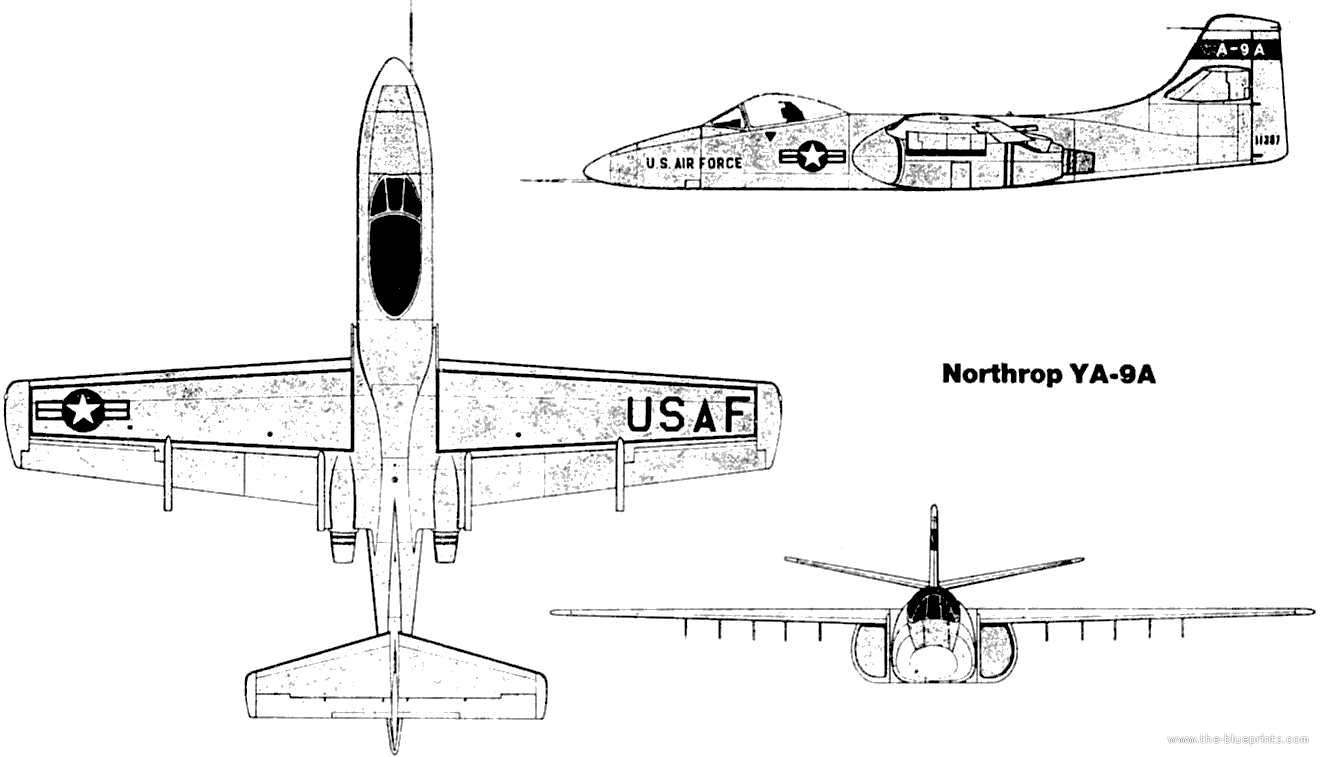
Six companies submitted proposals. On 18 December 1970 the Air Force selected Northrop and Fairchild Republic — the latter with its programme office in Germantown, Maryland — to build prototypes: the Northrop YA-9A and the Fairchild Republic YA-10A respectively. In parallel, General Electric and Philco-Ford were chosen to build and test GAU-8 cannon prototypes. The two airframes were very different answers to the same specification. The A-9 was a shoulder-wing monoplane of all-riveted aluminium alloy construction with honeycomb structure, its engines buried in the fuselage flanks alongside the wing root — a compact, aerodynamically clean solution. The YA-10A went the other way: two bulky nacelles on tall pylons above the rear fuselage, twin fins, a large-area straight wing and a centre fuselage dominated by the gun and its ammunition drum. Neither prototype could fly with the weapon it had been conceived around, because the GAU-8 was not available during the initial competition; the 20 mm M61 Vulcan was fitted as a temporary substitute.
The YA-10A made its first flight on 10 May 1972. The head-to-head competition between the two prototypes began on 10 October and ran for close to two months of comparative evaluation. On 18 January 1973 the Air Force announced that Fairchild Republic's YA-10A had been selected for production. The flight-test figures were close and did not decide the matter on their own: the YA-10A had completed 138.5 flight hours in 87 sorties, while its competitor accumulated 147 hours in 123 takeoffs. The principal reasons for the choice were practical and industrial rather than a question of raw performance: the Fairchild Republic aircraft's wings offered greater load-carrying capacity and better access for maintenance and armament, the aircraft was easier to handle on the ground, and it was simpler to manufacture. In June 1973 General Electric was selected to produce the GAU-8 cannon, closing the second of the two competitions the programme had run in parallel.
Winning A-X was not enough. When senior USAF commanders saw the Fairchild YA-10A they were not especially pleased, and in 1974 the aircraft had to survive an additional competition against the LTV A-7D Corsair II, then the Air Force's principal attack aircraft, with the declared purpose of demonstrating that buying a new attack aeroplane was unnecessary. The comparison failed to achieve that aim and the A-10 went forward into series production; the episode, however, set a pattern that would follow the aircraft for the rest of its life. Years later the exercise was repeated with a version of the F-16 adapted to the ground-attack role, and once again the comparison came out strongly in the A-10's favour. Every so often, someone inside the Air Force itself would propose again that the Thunderbolt II's work be done by a multi-role fighter; every time, the practical trial returned the same result and the A-10 survived without gaining prestige.
The heart of the aircraft is its gun. The General Electric GAU-8/A Avenger is a hydraulically driven seven-barrel 30 mm Gatling-style autocannon, and its programme ran in parallel with the A-X competition that produced the A-10: the specification for the weapon was laid out in 1970, with General Electric and Philco-Ford offering competing designs. The complete assembly, properly designated the A/A 49E-6 gun system, accounts for roughly 16 per cent of the aircraft's unladen weight. That figure alone explains the architecture of the airframe: whenever the gun is removed for inspection, a jack must be installed beneath the tail to stop the aeroplane tipping backwards, because the weapon plays a decisive part in its balance and centre of gravity. The gun itself weighs 280 kg (620 lb), but the complete weapon, with feed system and drum at maximum ammunition load, reaches 1,828 kg (4,029 lb) and measures 5.931 m from the muzzle to the rearmost point of the ammunition system; the drum alone is 88 cm in diameter and 1.82 m long. Power to drive it comes from twin hydraulic motors fed by two independent hydraulic systems.
The ammunition was as purpose-built as the weapon. The standard anti-armour mixture is five-to-one PGU-14/B armour-piercing incendiary rounds, with a projectile weight of about 395 g, and PGU-13/B high-explosive incendiary rounds of about 378 g. The PGU-14/B projectile has a lightweight aluminium body cast around a smaller-calibre depleted uranium penetrating core, a material chosen for its density and for its pyrophoric behaviour on penetrating armour. A less visible innovation was the use of aluminium alloy cartridge cases in place of the traditional steel or brass: that change alone adds 30 per cent to ammunition capacity for a given weight. The projectiles carry a plastic driving band to extend barrel life, and each cartridge is 290 mm long and weighs 0.69 kg or more. Muzzle velocity when firing armour-piercing incendiary rounds is 1,013 m/s, almost the same as that of the substantially lighter 20 mm round of the M61 Vulcan, giving the weapon a muzzle energy of just over 200 kilojoules. In 1979 the Avenger was tested against M47 Patton tanks and caused "severe damage".
The rate of fire was originally selectable by the pilot: 2,100 rounds per minute on the low setting or 4,200 on the high setting. It was later fixed at a single value of 3,900 rounds per minute. The gun takes about half a second to spin up to full speed, so it fires some 50 rounds in the first second and between 65 and 70 thereafter. At that rate, eighteen seconds of sustained fire would empty the drum, but in practice the weapon is limited to one- and two-second bursts to avoid overheating and to conserve ammunition; barrel life also weighs, since the USAF specified a minimum of 20,000 rounds for each set of barrels. There is no technical limit on how long the gun may be fired continuously — a pilot could in principle expend the entire load in a single burst with no damage or ill effects to the weapon system — but doing so would shorten barrel life considerably and force additional inspections. The feed is linkless, which saves weight and removes much of the potential for jamming, and it is double-ended: spent cases are returned to the drum rather than ejected, minimising shifts in the aircraft's centre of gravity during firing.
Accuracy is the ultimate justification for the whole arrangement. The 30 mm shell has twice the range, half the time of flight to the target and three times the mass of the projectiles fired by guns mounted in comparable close air support aircraft. Although its muzzle velocity is similar to the M61 Vulcan's, it uses heavier ammunition and has superior ballistics: the time of flight to 1,200 m (4,000 ft) is 25 to 30 per cent less than that of an M61 round, the GAU-8/A projectile decelerates far less after leaving the barrel, and it drops a negligible amount, about 3 m over that distance. The weapon's precision when installed in the A-10 is rated at "5 mil, 80 per cent", meaning that 80 per cent of rounds fired will strike within a cone of five milliradians, equivalent to a circle roughly 12 m in diameter at the design range of 1,200 m; the M61, by comparison, has an 8-milliradian dispersion. The whole system is optimised for the sight depression produced from 1,220 m with the A-10 in a 30-degree dive, which is the aircraft's canonical attack profile.
Recoil dictated the geometry of the aeroplane. The average recoil force of the GAU-8/A is 45 kN (10,000 lbf), slightly more than the thrust of each of the aircraft's two General Electric TF34 engines, which produce 40.3 kN (9,065 lbf) apiece. Because those forces could push the whole aircraft off target while firing, the weapon is mounted laterally off-centre, slightly to port of the fuselage centreline, so that the firing barrel — the one occupying the nine o'clock position as seen from the front — lies exactly on the aircraft's longitudinal axis and just below the centre of gravity, bore-sighted along a line 2 degrees below the line of flight. That arrangement centres the recoil forces precisely and prevents changes in pitch or yaw when the gun fires. The GAU-8/A also uses recoil adapters, the interface between the gun housing and the gun mount: by absorbing the recoil forces in compression they spread the recoil impulse over time and reduce the counter-recoil energy transmitted to the supporting structure. The same decision freed the space needed for the nose landing gear, which is therefore mounted slightly off-centre to starboard. The asymmetry has a curious consequence on the ground: the turning radius is uneven, and turning right while taxiing takes less distance than turning left, because the gap between the inner wheel and the steering wheel is smaller.
The gun's exhaust gases raised an unexpected problem. The A-10's engines were initially susceptible to flameout when subjected to the gases generated by firing, something that actually occurred during initial flight testing: gun smoke is essentially oxygen-free and is capable of extinguishing a gas turbine. The engines were subsequently given a self-sustaining combustion section, and when the gun fires the igniters come on automatically to reduce the possibility of a flameout.
The ammunition sits in a drum whose protection received disproportionate attention, and with reason: detonation of the full load by an enemy explosive round would be catastrophic. Multiple armour plates of varying thickness were installed between the drum and the aircraft skin, calculated so that a round striking that area detonates before reaching the drum, and the drum itself carries a final layer of armour against fragmentation. Sources disagree on the exact capacity: the aircraft description gives a 1.82 m drum with a maximum capacity of 1,350 rounds of 30 mm that is generally loaded with only 1,174, while the monograph on the weapon states that the magazine holds 1,174 rounds and that 1,150 is the typical load-out. They also differ on the designation of the ammunition loading cart built specifically for the A-10/GAU-8 combination: some sources call it the GFU-7/E, others identify a Syn-Tech linked-tube GFU-8/E.
Around the gun was built an aircraft designed to absorb damage. The cockpit and parts of the flight control system are protected by 540 kg of titanium armour known as "the bathtub". Its plates vary in thickness between 25.4 and 38.1 mm (one to one and a half inches), determined by a study of possible trajectories and deflection angles, and the assembly was tested to resist 23 mm cannon fire and some hits from 57 mm projectiles. The protection has a price: the armour alone accounts for almost 6 per cent of the aircraft's empty weight. To shield the pilot from the fragments that would spall off the inside of the bathtub under impact, the entire interior surface directly exposed to him is covered by a multi-layer nylon liner. The windscreen and the rest of the canopy are made of bulletproof acrylic composites able to withstand small-arms fire.
Survivability, however, rested less on armour than on redundancy. The airframe can survive direct hits from projectiles of up to 23 mm, both armour-piercing and high-explosive. The flight controls have triple redundancy, with a mechanical system backing up hydraulics that are themselves dual-redundant. If the aircraft loses all hydraulic pressure, the manual reversion flight control system takes over, handling pitch and yaw automatically and leaving roll to the pilot; in that mode the aircraft is controllable enough in favourable conditions to return to base and land, although control forces are much higher than normal. The A-10 is designed to be able to fly with one engine, one vertical stabiliser, one elevator and half of one wing missing. The main landing gear is arranged so that the wheels protrude partly from their fairings when retracted, making a wheels-up belly landing — required if the gear fails — more controllable and less damaging to the underside. The legs always fold forward, so that if hydraulic power is lost the pilot can simply release the mechanism and let gravity and airflow swing the gear down and lock it in place.
The fuel system received the same treatment. The four tanks sit close to the centre of the aircraft, which reduces both the likelihood of a hit and the risk of their being separated from the engines. The tanks are set away from the fuselage skin, so a projectile must penetrate the outer surface first; the refuelling system is purged after use so that no unprotected fuel remains anywhere in the aircraft; all lines are self-sealing if severed; most components of the fuel system are housed inside the tanks themselves, so that a leak in one of them causes no loss of fuel; and check valves prevent fuel from flowing into a damaged tank. The most important measure is the application of reticulated polyurethane foam both inside and outside the tanks, which contains fragments and restricts spillage when they are damaged. The engines, the other possible source of ignition, are separated from the fuel system and from the rest of the structure by firewalls and fire-extinguishing equipment. Even in the extreme case of every tank being damaged and drained, enough fuel remains in two self-sealing sump tanks to let the aircraft fly a further 370 kilometres.
The unusual position of the two General Electric TF34-GE-100 turbofans, each rated at 40.32 kN (9,065 lbf) of thrust, answers half a dozen accumulated reasons. Because the aircraft is meant to operate from bases near the front line, often with poor-quality runways, the risk of foreign object damage is high, and the height of the intakes reduces the chance of sand or stones being ingested. It also allows the engines to be left running safely with ground crew working alongside during rearming and minor maintenance between missions, which shortens turnaround times in the sortie cycle. It eases maintenance and rearming in general, since the wings sit far closer to the ground than would be possible with wing-mounted engines. The exhaust passes above the horizontal stabiliser and between the two fins, which lowers the aircraft's infrared signature — already low thanks to the engines' 6:1 bypass ratio — and reduces the chance of being hit by heat-seeking missiles. And the position behind the wings partly shields the engines from anti-aircraft fire coming from ahead and below. Because of their elevated position the engines are canted 9 degrees relative to the aircraft's horizontal line, in order to direct the combined thrust line towards the aerodynamic centre and so avoid the nose-down pitching moment that would otherwise have to be trimmed out. Being heavy, each engine is attached to the fuselage by four bolts.
The structure follows the same logic of repairable simplicity. Most of the stabilising surfaces are made of honeycomb-structure panels, which provide strength at minimum weight penalty and are less prone to deform in any direction even when part of the panel has been damaged; the A-10 uses them in the wing leading edge, the flap shrouds, the elevators, the rudders and other fin sections. The skin panels are integrally machined, with the spars integrated into the skin itself, which removes joint and sealing problems; machining them with computer-controlled tools cuts production time and therefore cost. Combat experience showed that this type of panel resists damage better, and because the skin carries no structural load, damaged sections can easily be replaced in the field, with improvised materials if necessary. An unusual feature is that many components are interchangeable between the left and right sides, including the engines, the main landing gear and the vertical stabilisers, which simplifies spares provisioning at forward bases.
In the air, the A-10 is highly manoeuvrable at low speed and low altitude thanks to broad wings of large area and aspect ratio with oversized ailerons. The ailerons sit at the outermost part of the wing, as on most aircraft, but with two distinguishing features: they are far larger than conventional, close to 50 per cent of the wing chord, which gives better control even at low speeds, and they are split into two halves that can be operated separately as airbrakes. Those same wings permit short takeoffs and landings from rudimentary airfields near the front; the rugged landing gear, low-pressure tyres and straight wing let the aircraft use short and poorly surfaced runways even with a heavy weapons load, and operate from damaged airbases. If runways are destroyed in an attack, the A-10 can use taxiways or straight sections of road such as the German autobahns. It is also designed to be refuelled, rearmed and repaired with minimal equipment. It can loiter for long periods and operate below 300 metres with 2.4 km visibility, and it normally flies at relatively slow speeds, of the order of 560 km/h, which lets it perform the ground-attack role better than fast fighter-bombers, which tend to struggle against small and moving targets. Slowness, in this aircraft, is not a shortcoming but a specification.
In figures, the A-10A is 16.2 m long, spans 17.4 m and stands 4.4 m high, with 47 m² of wing area and NACA 6716 and NACA 6713 aerofoils at root and tip. Empty weight is 11,321 kg and standard loaded weight 13,782 kg. External stores are carried on eleven stations — eight under the wings and three under the fuselage — able to take up to 7,200 kg of mixed ordnance: Mk-82 500-pound and Mk-84 2,000-pound bombs in low- and high-drag versions, incendiary cluster bombs, combined effects munitions, mine-dispensing munitions, AGM-65 Maverick missiles, laser- and GPS-guided bombs and unguided weapons. The Maverick, in its electro-optical (television) and infrared-guided variants, is the weapon that allows targets to be engaged at far greater range than the gun and is therefore the safer option in the presence of modern air defences. Hydra 70 rocket pods are also common. Although the aircraft is capable of delivering laser-guided bombs, their use was relatively rare for years: at the low altitudes and speeds at which the A-10 usually operates, standard unguided bombs offer adequate accuracy at far lower cost. For self-defence the aircraft typically carries an ALQ-131 electronic countermeasures pod under one wing and a pair of AIM-9 Sidewinder air-to-air missiles under the other.
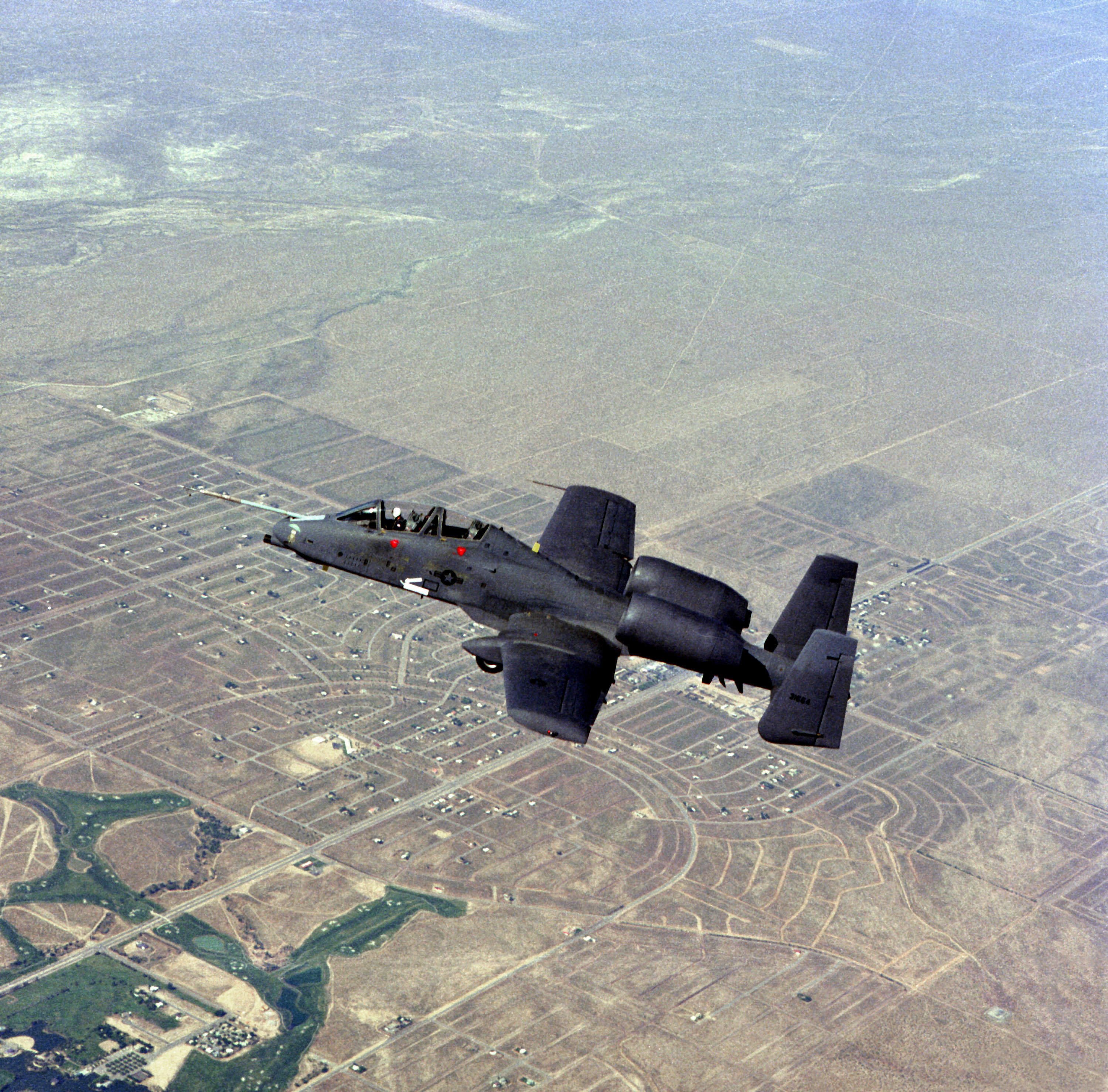
The initial avionics fit was deliberately austere, and that austerity became the aircraft's weak point. The A-10A was a daylight attack aircraft with no real night or bad-weather capability, in a European theatre famous precisely for its weather. Fairchild was well aware of this, not least because it limited the aircraft's appeal to potential foreign customers. In late 1977 an all-weather version designated Night/All Weather was studied with the USAF, and in 1979 work began to convert one aircraft, a job that would take thirteen months. In March 1979 Republic began building the two-seat A-10 Night Adverse Weather prototype by converting the first pre-production A-10A, 73-1664, which had been used for demonstration and evaluation testing. The cockpit was rebuilt with two seats in a central tandem arrangement under a side-opening canopy; the weapon systems officer's station, positioned above the ammunition drum, forced the fitting of a smaller drum holding only 750 rounds. That station received two cathode-ray tube displays to manage information from the FLIR, the radar and a low-light-level television, and duplicate flight controls were added in case the pilot were wounded or killed. ACES-II ejection seats designed to break through the canopy glass on ejection were installed, the vertical stabilisers were extended by 50 cm to counter the aerodynamic interference of the new cockpit, and a fairing housing additional avionics was added behind it. The centreline pylon carried a pod with an AN/AAR-42 FLIR working with a Ferranti laser designator; under one wing went a Westinghouse WX-50 weather radar modified to act as a navigation and attack radar; a low-light-level television replaced the Pave Penny pod under the nose; and a Litton LN-39 inertial navigation set was added. The intended division of labour was clear: the systems officer would guide the aircraft using the new equipment and call out reference points to the pilot, the pilot would attack using the FLIR and the television and fire the gun, and the officer would handle Maverick launches. The electronic equipment was sophisticated for its time and considerably cheaper than that fitted to contemporaries such as the F-111. Tested by the Air Force Flight Test Center between late October and early December 1979, and despite successfully completing the flight-test phase, the N/AW failed to interest the Air Force and was cancelled. Weighing against it were the LANTIRN pod that Lockheed was developing to offer equivalent capability with the advantage of being universal and adaptable to any aircraft, expected to be ready before 1985; the cost of training a second crew member; and the fact that in good weather the added capability was irrelevant. The sole two-seater built remained at Edwards Air Force Base awaiting a place in the Flight Test Historical Foundation museum. In parallel, the USAF considered a two-seat trainer version, the A-10B, and in 1981 ordered twenty aircraft converted, but the project was dropped after reports came in from the units already operating the type.
Series production followed the test programme, for which several pre-production examples had been built. The first production A-10A flew in October 1975 and deliveries to the Air Force began in March 1976. Counting two prototypes and six pre-production aircraft, the total built is given as 715 machines, with the last delivery in 1984; it should be noted that sources disagree on this figure and that others give 716 aircraft delivered, a one-unit difference that usually stems from whether a particular development airframe is counted in the total. The programme's target unit cost, set in 1970 at $1.4 million on a run of 600 aircraft, was one of the keys to the whole design: the A-10 was conceived from the outset as an aeroplane that had to be cheap to buy and cheap to maintain, because its role required buying it in quantity and exposing it to fire.
The first Air Force unit to receive the Thunderbolt II was the 355th Tactical Training Wing at Davis-Monthan Air Force Base, Arizona, in March 1976. The first squadron became operational in October 1977, and the first unit to reach full combat readiness was the 354th Tactical Fighter Wing at Myrtle Beach Air Force Base, South Carolina, in 1978. Deployment continued to other bases inside and outside the United States: England AFB in Louisiana; Eielson AFB in Alaska; Osan Air Base in South Korea; and RAF Bentwaters and RAF Woodbridge in the United Kingdom. In Europe some 120 A-10s came to be based in Britain, since the 81st Tactical Fighter Wing comprised six squadrons; two of them were later transferred to the 10th Tactical Fighter Wing at Alconbury. The England-based squadrons deployed regularly to Germany, to the forward operating locations from which they would have flown in war. The two British-based wings also had five Air National Guard squadrons earmarked to reinforce them if conflict broke out — the 103rd TFS of Connecticut, the 104th of Massachusetts, the 128th of Wisconsin, the 174th of New York and the 175th of Maryland — which began receiving A-10s from 1979.
The employment doctrine followed directly from the strategic problem. Until then, the planned response to a Warsaw Pact attack had rested to a large extent on the use of tactical nuclear weapons and on the threat of turning the war atomic, a highly risky approach with which the European allies were not comfortable; the United States therefore looked to technological superiority in conventional weapons as the way to offset Soviet numerical superiority. The A-10 was designed so that NATO could face the Soviet armoured divisions in Europe: thousands of T-64, T-72, T-80 tanks and their derivatives were expected to attack with massive artillery and tactical air support, and Western tanks — the M60, M1 Abrams, Leopard 1 and 2, Challenger, AMX-30 and Leclerc — would not on their own be enough to halt the advance. Weapons were needed to offset that numerical inferiority, and the anti-tank gun aircraft was one of them. NATO's European allies were initially somewhat sceptical about the A-10's ability to operate in central European weather. It soon became clear that, working at speeds of the order of 555 km/h, the aircraft could fly without difficulty at heights down to 30 metres during exercises, always below the cloud base so frequent over Germany. That would let pilots see Warsaw Pact targets with the naked eye and destroy them with bombs, rockets or the 30 mm gun, with an accuracy that allowed friendly forces to remain very close to the targets being engaged — which is exactly the definition of close air support. A-10s trained not only in Germany but in the other theatres where they were expected to fight: the USAF had committed eight fighter-bomber squadrons to Norway and five to Denmark in the event of war.
Within the Air Force itself, the reception was cool. Most fighter pilots did not want to move to the new aircraft, because the professional culture traditionally prized the speed and the looks of fighters such as the F-16, and the A-10 offered neither. It was also an aeroplane that demanded a great deal of training to master its mission, with a low, slow, exposed flight profile that left little margin for error. The result was that the A-10 kept a discreet profile for years, with little publicity from the USAF, while the institution went on looking for ways to replace it with multi-role platforms. In 1987 many aircraft were reassigned to the forward air control mission and redesignated OA-10; in that role they normally carried up to six pods of 70 mm Hydra rockets, generally with smoke or white phosphorus warheads for marking targets, although the OA-10s underwent no physical change and retained their full combat capability. With the end of the Cold War and budget constraints, the USAF again saw an opportunity to be rid of the aircraft, arguing that retiring it in favour of multi-role platforms made better economic sense.
Nor did it find buyers abroad. Unlike almost any other American aircraft of its generation, the A-10 was never sold to another country, even though Fairchild promoted it actively among the allies — one aircraft was lost in a crash during a display flight at Le Bourget. Neither its cost nor its specialisation justified it in the eyes of European air forces that in the 1980s were committing themselves to the F-16 Fighting Falcon and the Panavia Tornado, multi-role aircraft that covered several missions with a single fleet. Only two allies faced the threat of thousands of tanks and had the budget to respond, Israel and Germany; but in the doctrine of both, the best weapon against a tank was another tank, and their efforts went into the Merkava and the Leopard 2, while their air forces likewise preferred multi-role aircraft. In Israel the A-4 Skyhawk performed close air support effectively and its 30 mm cannon had proved effective against armour, and the Luftwaffe, looking for a replacement for its Fiat G.91R/3s in the ground-attack role, chose the Dornier Alpha Jet. Added to this was the lesson of the Yom Kippur War, which made plain how far radar-directed missiles and anti-aircraft guns had advanced, and the falling cost of the anti-tank missile, a cheap and effective weapon that could be fielded in large numbers from ground vehicles or helicopters. Against that background, so specialised an aircraft found no room in tight budgets. There was passing interest from Morocco, and later studies by Taiwan, India and South Korea regarding surplus airframes; Turkish negotiations in 1993 for fifty surplus aircraft, which foundered on price and on American reluctance to export depleted uranium ammunition; and a 2003 offer to Colombia to lease between twelve and eighteen aircraft reactivated from Davis-Monthan, which ran aground on bureaucratic obstacles and objections from the USAF itself.
What it did acquire was a name and an unmistakable silhouette. Officially the aircraft was named Thunderbolt II after the Republic P-47 Thunderbolt of the Second World War, the fighter-bomber from which it descended by industrial lineage and by doctrine; in practice everyone called it the "Warthog", a nickname that spoke at once of ugliness and ferocity and that the pilots themselves adopted without reservation. Because it flies low and at subsonic speeds, camouflage mattered: the European forest scheme, mixing dark green, medium green and dark grey to blend it against typical central European woodland seen from above — hostile fighters were then judged a greater threat than ground fire — was used from the 1980s until the mid-1990s. The A-10 is also one of the few modern combat aircraft to keep the tradition of painting the open jaws of snakes, sharks or hogs on the nose, in the manner of Second World War aircraft; the emblematic shark-teeth design belongs exclusively to the USAF's 23rd squadron, nicknamed the "Flying Tigers", which inherited the motif from the P-40B Warhawks of the American Volunteer Group. By the time the 1990s arrived, the aircraft had been fifteen years in service without firing its gun in combat, carrying a mediocre internal reputation and a retirement date circulating in the offices.
The A-10 entered 1990 as an aircraft already condemned on paper. To much of the Air Force leadership the Thunderbolt II was an irritant: a slow, ugly, single-mission machine occupying squadron slots and budget lines in a service that saw itself in speed and deep penetration. The decision had effectively been taken — F-16s would relieve the A-10 of the attack mission — and most fighter pilots had no wish to convert to the Warthog, since they traditionally prized the speed and the appearance of aircraft like the F-16 itself. What undid that plan was not a study or a fly-off but the Iraqi invasion of Kuwait on 2 August 1990 and the war that followed.
The deployment to Saudi Arabia did not come from Air Force initiative but from an explicit request by Army commanders, who wanted over the battlefield the aircraft built to protect them. The sources disagree on how many airframes went: the Spanish-language material gives 144 aircraft in five wings, while the English-language material puts the number of A-10s deployed at 132. On either count it amounted to nearly the whole available fleet, and to an aircraft whose capabilities had until then been demonstrated only on paper and on the gunnery ranges of Germany and the American West. In the desert it had to prove them for real.
The air campaign opened on 17 January 1991. In its early days the A-10s flew missions against the Republican Guard — that is, against the best equipped and best defended formations of the Iraqi Army — and the resulting attrition forced a change of plan: from 15 February they were restricted to a band within twenty nautical miles, thirty-seven kilometres, of the southern border. The detail is worth holding on to, because it captures in a single stroke the tension that would follow the type for the rest of its operational life: the A-10 does its work better than anyone where the enemy is already beaten or disorganised, and pays dearly where the air defences remain intact.
Inside and outside that band, the A-10s also took on the hunt for mobile launchers. Scud-hunting missions — against the weapon with which Iraq tried to break the coalition by firing at Israel and at Saudi Arabia — meant covering vast stretches of desert at low level, looking hard and looking slowly, and attacking whatever appeared. It was precisely the profile that a fast-penetration doctrine could not cover. Pilot reports list 53 Scud missiles and launchers destroyed, a figure which, like the whole tally that follows, comes from aircrew claims rather than from independent verification on the ground.
The type's headline numbers for the war are the ones the Air Force has repeated in its official fact sheets ever since: some 8,100 sorties, a mission-capable rate of 95.7 per cent, and 90 per cent of all AGM-65 Maverick missiles launched in the conflict. The Spanish-language material adds two comparisons that explain why the aircraft emerged from the war untouchable: F-16s in the same campaign had an availability rate of 60 per cent against that 95.7 per cent, and A-10s flew around 30 per cent of the attack missions while being credited with 50 per cent of the targets destroyed. An aircraft criticised for being too simple turned out to be the one that flew most, needed the least maintenance and put the most targets on the board.
The detailed target count deserves careful reading, because the sources themselves do not agree between summary and list. The synthesis speaks of more than 900 tanks, some 2,000 military vehicles and close to 1,200 artillery pieces; the tabulation drawn from pilot reports gives 987 tanks destroyed, 926 artillery pieces and mortars, 501 armoured vehicles, 249 command posts, 11 Frog missile launchers, 281 military structures, 96 radar installations, 72 bunkers, 9 SAM sites, 8 fuel dumps, 2,000 military utility vehicles, 1,306 trucks, 53 Scud missiles and launchers and 10 aircraft destroyed on the ground, together with anti-aircraft artillery emplacements and early-warning radars attacked and more than 5,000 Maverick missiles fired. The discrepancy between the two series — above all in the artillery figure — is not resolved in the material, and the honest course is to record it: these are combat claims, with the margin of error that always implies.
To that ledger were added two air victories entirely unusual for an attack aircraft. On 6 February 1991, over Kuwait, Captain Robert Swain shot down an Iraqi helicopter with the GAU-8 cannon, the Thunderbolt II's first air-to-air victory. Two helicopters in all were brought down by gunfire during the war, identified in the material as a Bo 105 and a Mi-8. It is not a trivial footnote: a weapon conceived to punch through the top armour of Soviet tanks also proved to be an airborne anti-aircraft gun, simply because its reach and its accuracy allowed a shot at a target moving slowly and low.
Own losses were real but contained. Four A-10s were shot down during the war, all by surface-to-air missiles, and eleven more were hit by anti-aircraft artillery rounds. Another two battle-damaged A-10s and OA-10As returned to base and were written off, and some sustained further damage in crash landings. Set against 8,100 sorties the proportion is modest; set against the doctrine which held that a subsonic aircraft at low level would not survive the first day of a modern war, the figure was read at the time as a refutation. The opposite reading — that the A-10s were able to keep flying only after they had been pulled back from the Republican Guard and after the coalition had dismantled the Iraqi air-defence system — was equally available from the start, and it is the one that resurfaces in every subsequent argument.
There is an irony in the 1991 balance sheet worth keeping in view: in the war that made the A-10 a legend, the A-10 flew comparatively few close air support missions in the strict sense. The ground battle began on 24 February 1991 and the coalition halted its advance one hundred hours later; on the first day, according to the material, a third of the A-10s did not fire at all for lack of targets. Most of the type's work had been done earlier, in interdiction and in the systematic attrition of a deployed and static army that the air campaign had been grinding down for weeks. The aircraft designed to blunt a Warsaw Pact armoured assault made its combat debut destroying equipment parked in the desert.
In the most disputed episode of that ending, two A-10s attacked the Iraqi column withdrawing from Kuwait along the road towards Basra, after a patrolling E-8 Joint STARS detected the movement and relayed the information to the air operations centre in Riyadh. The result was a sixty-kilometre stretch of highway strewn with wreckage — the so-called Highway of Death — and a political and journalistic controversy that accompanied the closing of the war. The aircraft was not the object of the argument; the decision to strike a retreating force was. But the image stayed attached to the A-10 for years.
The institutional effect was immediate. Shortly after the Gulf War the Air Force abandoned the idea of replacing the A-10 with a close air support version of the F-16. The type won the favour of senior commanders and, above all, of politicians in Washington, who had discovered an aircraft that was cheap, visible and easy to defend before an electorate. It was the first of several occasions on which a war saved the A-10 from a retirement already scheduled.
The reverse of that reputation arrived in the same campaign. On 26 February 1991 an A-10 mistook a British column for Iraqi forces and attacked two Warrior infantry fighting vehicles; nine British soldiers were killed. The figure weighs heavily in Britain's account of that war: of 47 British dead, nine — every one of the friendly-fire fatalities, all inflicted by US forces — are explained by that single attack. The material does not record the findings of the investigation, so no specific causes can be attributed here beyond what is documented: an identification error against a moving column, in a featureless desert, by an aircraft working at a speed and an altitude where recognition is essentially visual.
The problem did not close in 1991. On 28 March 2003, during the invasion of Iraq, an A-10 of the 190th Fighter Squadron attacked a unit of the Blues and Royals: Lance-Corporal of Horse Matty Hull was killed and five others wounded. A separate incident in the same conflict saw an A-10 attack two British Scimitar light armoured vehicles. The aggregate statistics are no more comfortable: between 2001 and 2015 the A-10 was involved in the friendly-fire deaths of ten US service members across four incidents, and between 2010 and 2015 in the deaths of 35 Afghan civilians, more than any other US military aircraft in that period. The material itself qualifies these episodes as having been assessed as "inconclusive and statistically insignificant" as regards what they say about the aircraft's capability — that is, the sheer volume of close support missions the A-10 accumulates means it also accumulates the errors of a mission type that is intrinsically dangerous for whoever is underneath.
Cutting against that reading is an argument voiced repeatedly by those who receive the support, and it is the exact inverse: special forces commanders held that the A-10 was the only aircraft in the American inventory able to fly close enough to the enemy to release weapons without risking friendly casualties. In Afghanistan targets were engaged fifty metres from friendly personnel, and the ability to fly low enough and slow enough to tell friend from enemy was repeatedly praised by soldiers on the ground. Both things are true at once, and that is the heart of the argument: the A-10 is the aircraft that comes closest to the line most often, with everything that implies as lifeline and as hazard.
The Balkans were the next theatre and, in a sense, the most formative. The Air Force assigned twelve A-10s to Aviano as part of the force deployed over Bosnia, and between 1994 and 1995 American aircraft fired approximately 10,000 rounds of 30 mm depleted-uranium ammunition over Bosnia and Herzegovina. Following the seizure of armoured vehicles and heavy weapons by Bosnian Serbs from a warehouse at Ilidža, multiple sorties were launched to locate and destroy the captured equipment; on 5 August 1994 two Warthogs found and strafed one of them, an old tank destroyer, and after the attack the Serbs agreed to return the remaining heavy weapons. A little over a month later an OA-10 and two RAF SEPECAT Jaguars attacked a Serb tank inside the twenty-mile exclusion zone around Sarajevo.
In August 1995 NATO launched Operation Deliberate Force, and the A-10s flew close air support missions against Bosnian Serb artillery and positions. In late September they returned to patrol work, and they also took part in the unsuccessful attempt to rescue the crew of a downed Mirage 2000D. Those weeks taught two lessons the Gulf War could not: that the A-10 would mostly be used in conflicts where the object was coercion rather than the destruction of a front, and that its most valuable role did not always consist of shooting.
That role had a formal name as well. From 1987 many A-10s had been shifted to the forward air control mission and redesignated OA-10, with no physical change and retaining full combat capability. In that role the aircraft typically carries up to six pods of 2.75-inch — 70 mm — Hydra rockets with smoke or white phosphorus warheads for target marking, and its work consists of finding targets, marking them and directing other aircraft onto them. The combination of long time on station, good visibility from the cockpit and the ability to shoot for itself made the OA-10 the Air Force's reference airborne forward air controller, and in the Balkans that function counted for as much as the gun.
The A-10s returned to the region for Operation Allied Force, which began over Kosovo in March 1999, and their first notable contribution was a rescue. On 27 March 1999 an F-117 Nighthawk was brought down by air defences some forty kilometres from Belgrade; as soon as it was known that the pilot had ejected behind enemy lines, a combat search and rescue package of three MH-53 Pave Low and MH-60 Pave Hawk helicopters was sent in, escorted by two A-10s. Escorting and supporting rescue helicopters was in fact the type's initial task in the campaign, and only afterwards did it begin to receive ground attack missions.
The A-10s' first successful attack in Allied Force came on 6 April 1999, when together with aircraft from USS Roosevelt they struck close to thirty targets in south-western Kosovo. As NATO degraded the Serbian air-defence system the Warthogs were assigned progressively more ground attack work, and they remained in the operating area until the end of combat in mid-June. Two A-10s were hit and damaged by enemy missiles over Kosovo: one on 2 May, by a shoulder-launched Strela 2, which had to make an emergency landing at Skopje International Airport in Macedonia; and another on 11 May, lightly damaged by a 9K35 Strela 10. None was lost.
The aftermath in Kosovo, however, left the most uncomfortable lesson in the type's entire operational record — and not only the type's. After some 38,000 sorties in the campaign, running at 200 a day at the start and more than 1,000 at the end, NATO's damage assessment held that 93 tanks out of roughly 600 deployed, 153 armoured personnel carriers, 339 other vehicles and 389 artillery systems had been disabled or destroyed with certainty. The Department of Defense and the Joint Chiefs of Staff had earlier given higher figures — 120 tanks, 220 APCs and 450 artillery systems — while a Newsweek piece published around a year later put the real total at only 14 tanks, 12 self-propelled guns, 18 APCs and 20 artillery systems. The figures cover the whole allied campaign and not the A-10 alone, but they bear directly on what can be said about it: against an enemy that disperses, conceals and decoys its equipment among the population and the terrain, an aircraft that hunts armour one vehicle at a time produces far fewer kills than it claims, and no amount of time on station compensates for the difficulty of finding the target.
Operation Iraqi Freedom began on 20 March 2003, and sixty A-10s and OA-10s took part in the early fighting. On 30 April 2003 United States Air Forces Central Command published the declassified report Operation Iraqi Freedom: By the Numbers, which credits the type during the invasion with an 85 per cent mission-capable rate and 311,597 rounds of 30 mm ammunition fired, along with 32 missions flown to airdrop propaganda leaflets over Iraq. A single A-10 was shot down by Iraqi anti-aircraft fire near Baghdad International Airport, late in the campaign.
The employment was both predictable and new. A-10s struck Republican Guard positions and armoured vehicles and some of the regime's command centres, and worked over urban areas and their approaches, where the precision of the gun and the ability to identify the target visually mattered more than bomb load. One A-10 pilot supporting the 3rd Infantry Division's advance across the Tigris destroyed three T-72 tanks, six armoured vehicles and several other vehicles, helping to break Iraqi resistance at the crossing. It is the kind of action — one aircraft, one sector, one tactical problem solved in minutes — that explains the Army's loyalty to the aircraft far better than any aggregate statistic.
That campaign also produced the image that sums up the A-10's structural toughness. On 7 April 2003, over Baghdad, Captain Kim Campbell took extensive flak damage that knocked out one engine and crippled the hydraulic system, forcing the stabiliser and flight controls to be worked through the mechanical backup. The A-10 has double-redundant hydraulic flight systems and a mechanical system as a backup: in manual reversion mode pitch and yaw control engage automatically and roll control is pilot-selected, and the aircraft is sufficiently controllable under favourable conditions to return to base, though control forces are greater than normal. Campbell flew for nearly an hour in that configuration, with the aircraft badly torn up, and landed safely at her base.
In Afghanistan the A-10 recovered its original mission after more than a decade spent doing something else. The material says so bluntly: between 1991 and 2001, despite all the activity accumulated, its combat use was more ground attack than close air support, to the point that the Air Force again considered replacing it with F-16s and in 1994 went so far as to offer the Army the A-10s together with the close air support mission itself. It was the sustained presence of soldiers on the ground that gave the mission the aircraft had been conceived for its meaning back.
The A-10s took no part in the opening stages of the 2001 invasion of Afghanistan. From March 2002 squadrons were deployed to Pakistan and to Bagram Air Base for the campaign against the Taliban and Al-Qaeda, taking part in Operation Anaconda and then remaining in country fighting the Taliban and Al-Qaeda remnants. In 2003 they were sent to Iraq and they returned to Afghanistan in 2005. Although the F-16s present in the theatre came to be three or four times more numerous than the A-10s, half of all close air support missions were flown by the latter.
The reasons for that imbalance are operational and very concrete. The ability to shoot very close to friendly troops — targets were engaged fifty metres from friendly personnel — and to fly low enough to tell the difference between friend and enemy were the ones most often cited by those underneath. To them was added the ability to link with other aircraft and with ground forces through radio equipment and the Link 16 data link, which proved its worth repeatedly. During Anaconda the A-10s flew in support of troops attacking the Taliban in the Afghan mountains and demonstrated again and again their ability to locate and destroy anti-aircraft artillery, machine guns and enemy positions in terrain where the target is small, dug into the hillside and invisible until it fires.
Two episodes illustrate the pattern. In 2007 a Royal Marines raid in Helmand province went wrong, and two A-10s held the Taliban off while cut-off soldiers were extracted by AH-64 helicopters. In 2008 a Marine special forces unit was discovered and surrounded; cloud cover made it impossible for the Marines' F-18s to intervene, and two A-10s provided support for hours, killing dozens of fighters. The type's ability to work under low ceilings — the Air Force material specifies operation beneath thousand-foot ceilings, 303 metres, with a mile and a half, 2.4 kilometres, of visibility — is not a curiosity of the data sheet: it is what separates support delivered from support promised.
The volume of effort accumulated in those years is recorded in the material in some detail. A-10s flew 32 per cent of the combat sorties of Operations Iraqi Freedom and Enduring Freedom, at a tempo that ranged between 27,800 and 34,500 sorties annually from 2009 to 2012, and in the first half of 2013 alone they logged 11,189 sorties in Afghanistan. From the start of 2006 to October 2013 they conducted 19 per cent of close air support missions in Iraq and Afghanistan, more than the F-15E Strike Eagle and the B-1B Lancer but less than the 33 per cent flown by F-16s. That last figure is the one the Air Force deploys in the opposite direction: since 2001, it argues, multirole aircraft and bombers have performed 80 per cent of operational close air support missions.
In March 2011 six A-10s deployed for Operation Odyssey Dawn, the coalition intervention in Libya. On 26 March they began combat operations alongside AC-130 gunships against ground forces, and they were the first American aircraft used against Gaddafi's troops: earlier strikes had been directed at air-defence and command infrastructure. On 28 March one of the A-10s and a US Navy P-3 Orion attacked three Libyan Coast Guard vessels that were firing on the city of Misrata and on merchant shipping; the P-3 launched AGM-65F Maverick missiles at a Vittoria-class patrol boat, whose crew abandoned it, and the A-10 strafed the two smaller craft with the GAU-8, sinking one and forcing the crew of the other to abandon ship. Airspace management data and the maritime picture were supplied by the destroyer USS Barry (DDG-52). An anti-tank aircraft sinking boats off the Libyan coast is a fair measure of how far its real employment had drifted from the original script.
The campaign against the Islamic State repeated the 1991 mechanism almost point for point. Before the group's irruption in Iraq and Syria the A-10 was again facing a retirement plan, this time to shift the money spent keeping it in service to the F-35 procurement programme; and again a war saved it. The 122nd Fighter Wing announced its deployment to the Middle East in October 2014 with twelve A-10s, planned a year in advance in a support role but coinciding in time with Operation Inherent Resolve; the United States also decided to deploy twelve A-10s to Incirlik air base in southern Turkey at the regional command's request, and based them at Al-Asad in Iraq as well. From mid-November American commanders began sending them against Islamic State targets in central and north-western Iraq on an almost daily basis, and over a two-month period the A-10s flew 11 per cent of all Air Force sorties since operations began in August 2014.
The most cited episode of that campaign is Operation Tidal Wave II. On 15 November 2015, two days after the Islamic State attacks in Paris, A-10s and AC-130s destroyed a convoy of oil tanker trucks operated by the group in Syria, as part of an effort to cut the oil smuggling that financed it; sources put the convoy at more than a hundred trucks, and the Spanish-language material specifies 116 tankers destroyed. The operation's name deliberately echoed the Second World War's Tidal Wave, the failed raid on the Romanian oil fields. In the debate that followed, special forces commanders insisted that the A-10 was the only aircraft in the inventory able to get close enough to the enemy to release weapons without risking friendly casualties, and that the ability to maintain precise and sustained contact with enemy ground targets by day, by night and in any weather was a capability it would be unwise to lose.
Combat employment did not stop there. In January 2018 twelve A-10s of the 303rd Expeditionary Fighter Squadron deployed to Kandahar Airfield to provide close air support, the first time in more than three years that the type had returned to Afghanistan. In November and December 2024 A-10s were used against targets in Syria in defence of US forces in the east of the country, destroying vehicles, mortars and a T-64 tank according to the Air Force, and coinciding with the fall of the Assad regime they took part alongside B-52s and F-15Es in what the Air Force described as "dozens" of strikes against more than seventy-five Islamic State targets. In March 2025 several A-10s of the 124th Fighter Wing deployed to the Middle East over the conflict with Houthi forces in Yemen, and in March 2026 US Central Command stated that A-10s had been employed during the first twenty-four hours of the war with Iran, where according to the most senior American general they were used for hunting and killing fast-attack watercraft in the Strait of Hormuz; on 3 April 2026 an A-10 was shot down by Iranian air defences in the Persian Gulf during a combat search and rescue mission for a downed F-15E weapon systems officer, though the aircraft reached Kuwaiti airspace and the pilot ejected and was rescued.
It is worth pausing on how the aircraft is actually fought, because it explains both its results and its limits. The centrepiece remains the gun, and its use is tightly disciplined: pilots are trained to fire precise bursts of one or two seconds in order to husband a combat load of 1,174 rounds. The GAU-8 achieves around 80 per cent hits on target when fired at 1,250 metres, with a six-metre dispersion radius, with projectiles leaving the muzzle at 1,010 metres per second and a maximum effective range of 3,660 metres; improvements introduced shortly before the Gulf War added accuracy to the gun and made it useful even at 4,575 metres. Against tanks the real effect depends on where the round lands, because frontal and side armour is far thicker than top armour; it was known to work against T-55s and T-62s and remained an open question against T-72s and T-80s, while against artillery, self-propelled guns, infantry fighting vehicles and air-defence vehicles there was never any doubt.
The rest of the aircraft is organised around the gun. The A-10 can carry up to eight AGM-65 Maverick missiles, bombs and rockets of various kinds, two AIM-9 Sidewinders for self-defence, and electronic countermeasures or targeting pods. In the Gulf the Maverick was the decisive weapon — the type launched 90 per cent of all those fired in the conflict — and its infrared seeker served for years as an improvised substitute for the FLIR the aircraft lacked, allowing pilots to fly night missions looking at the world through a missile's seeker head. The official fact sheet sums up the combination of qualities that made the type valuable in Desert Storm and in Noble Anvil: large military loads, long loiter and wide combat radius, together with the ability to make austere landings, to operate under thousand-foot ceilings and in reduced visibility, and to employ both precision-guided and unguided munitions above, below and in the weather.
The way it works with troops on the ground also has deep roots. The Air Force studied with the Army which support tactics were most efficient and found that the best answer was to operate in teams with AH-1S Cobra and AH-64 Apache attack helicopters: from that came the Joint Air Attack Team doctrine, in which the helicopters mark targets for the A-10, hide behind trees and buildings and suppress the air defences so that the aircraft can then destroy the tanks and armoured vehicles, while controllers on the ground direct the attacks, select the targets and coordinate them so that the exposure of both is the minimum necessary. That arrangement — someone on the ground who sees the problem, someone in the air who stays over it as long as necessary, and a continuous conversation between the two — is what became daily routine in Afghanistan and what the Link 16 data link came to accelerate.
The underlying objection, however, has never gone away, and the record itself feeds it. Because it operates close to enemy positions, the A-10 is an easy target for man-portable air-defence systems, for surface-to-air missiles and for enemy aircraft, which is why it carries both flares and chaff cartridges and why its design concentrated on absorbing hits. The data from its own campaigns point the same way: four aircraft shot down and eleven hit by anti-aircraft artillery in 1991, with withdrawal from the Republican Guard's airspace from 15 February; two aircraft hit by man-portable missiles over Kosovo; one shot down by anti-aircraft fire over Baghdad in 2003. The Air Force maintains that the aircraft is increasingly vulnerable to modern anti-aircraft weapons; the Army replies that it has proved invaluable for the versatility of its weapons loads, for its psychological impact on the enemy and for its limited logistical needs. Both positions describe the same aeroplane accurately: irreplaceable as long as the sky is clear of serious threats, and hard to justify on the first day of a war against an adversary whose air defences are still intact.
For an aircraft with so long a career, the A-10's list of variants is remarkably short: almost everything the aeroplane actually became fits into four designations, and almost everything it might have become stopped at sales brochures, studies and a single two-seat prototype. The early machines carried the designation YA-10A, although the sources disagree on how many there were: the English-language encyclopaedia describes it as the pre-production variant with twelve aircraft built, while the Spanish edition distinguishes between two prototypes built for the A-X programme and six later pre-production airframes. Both agree on the bulk of the run: 707 production A-10As, single-seat ground-attack and close air support aircraft that made up essentially the whole fleet. To that must be added the OA-10A designation, which corresponds to no physical modification at all but to a change of task: A-10As assigned to airborne forward air control, marking targets and directing other attackers, took the letter without a single part of the airframe being altered. The distinction matters, because for decades the Air Force counted A-10s and OA-10s separately in its inventories, and the later modernisation programmes had to cover both as though they were different fleets when they were the same aeroplane wearing two labels.
The great variant that never happened was the two-seater. The A-10 was born as a daylight, good-visibility attack aircraft, and that limitation was obvious to everyone from the first day: at night or in bad weather the aeroplane lost precisely the ability to read the battlefield on which its whole way of fighting rested. Fairchild also had a commercial interest in fixing it, because the gap crippled any attempt at an export sale and discouraged further orders from the Air Force itself. In late 1977 the company began studying an all-weather attack version with the USAF, designated Night/Adverse Weather (N/AW), and in March 1979 it started converting the first pre-production A-10A, 73-1664, an airframe already used for demonstration and evaluation testing. The work took about thirteen months. The cockpit was rebuilt with two seats under a side-opening canopy; the rear station, occupied by a weapon systems officer, sat above the ammunition drum, which forced the fitting of a smaller one holding only 750 rounds, at a direct cost in gun endurance. That second crewman handled electronic countermeasures, navigation and target acquisition, and had two cathode-ray displays to manage information from the FLIR, the radar and the low-light television, plus duplicated flight controls in case the pilot was wounded or killed.
The N/AW's equipment was sophisticated for its day and yet appreciably cheaper than that fitted to contemporaries such as the F-111. The centreline pylon carried a pod with an AN/AAR-42 FLIR working alongside a Ferranti laser designator; another underwing pylon took a Westinghouse WX-50 weather radar modified to serve as a navigation and attack radar; a low-light-level television replaced the Pave Penny pod under the nose; and a Litton LN-39 inertial navigation set was added. The fins were lengthened by fifty centimetres to counter the aerodynamic interference of the new cockpit, behind which a fairing was added to house extra avionics, and ACES-II ejection seats were fitted, designed to break through the canopy glass during ejection. The intended division of labour was clear: the back-seater flew the aircraft to the target using the new sensors and called out references to the pilot, the pilot attacked using the FLIR and low-light television and fired the gun, and the release of the Mavericks was left to the rear crewman. The Air Force Flight Test Center evaluated the aircraft between late October and early December 1979 and the trials programme closed successfully: the aeroplane did exactly what it had been built to do.
It made no difference. The Air Force showed no interest and the programme was cancelled. Two reasons weighed. The first was technological: the USAF was developing the LANTIRN pod with Lockheed, which promised equivalent low-altitude navigation and night infrared targeting capability and, crucially, was universal and adaptable to any aircraft rather than requiring a dedicated airframe; it was expected to be ready before 1985. The second was economic: the second crewman meant training and retaining an extra officer per aircraft, and on the majority of missions — those flown in good weather — his capabilities were irrelevant. The economics of the single-seater killed the N/AW-10, which never received an order. The sole example built is preserved at Edwards Air Force Base, awaiting a place in the Flight Test Historical Foundation's museum. Here the sources disagree again on designation: the English-language encyclopaedia calls that experimental night and adverse-weather two-seat prototype the YA-10B, converted from an A-10A, while the Spanish edition reserves YA-10B for a different thing, a proposed two-seat trainer version that was cancelled with no units built, and calls the prototype simply the A-10 Night/Adverse Weather. That a trainer project also existed is certain: in 1981 the USAF went as far as ordering twenty A-10s to be converted to an A-10B trainer configuration, and dropped the project after receiving the reports of the units already operating the aircraft.
The unbuilt proposals round out the picture. The A-10 PCAS was an unmanned version studied under DARPA's Persistent Close Air Support programme, which explored automated close air support; here too the sources disagree on who was behind it, the English version naming Raytheon and Aurora Flight Sciences and the Spanish one Raytheon, Rockwell Collins and GE Aviation. The PCAS effort eventually abandoned the idea of using an optionally manned A-10. The SPA-10, for its part, was a proposal by the South Dakota School of Mines and Technology to replace its North American T-28 Trojan thunderstorm-penetration aircraft: the A-10 would have swapped military engines, avionics and oxygen system for civil equivalents, engines and airframe would have received hail protection, and the GAU-8 Avenger would have given way to ballast or scientific instruments. The project was cancelled after the partial modification of a single A-10C. It had a precedent: in 2011 the National Science Foundation granted eleven million dollars to convert an A-10 for weather research for CIRPAS at the U.S. Naval Postgraduate School, in collaboration with scientists from the same South Dakota school, and in 2018 the plan was dropped because the necessary modifications were judged too risky and costly. In a different register the A-10 served as a testbed for alternative fuels: on 25 March 2010 it made the first flight of an aircraft with all engines running on a biofuel blend, a one-to-one mix of JP-8 and camelina-derived fuel, and on 28 June 2012 it became the first aircraft to fly on ATJ (Alcohol-to-Jet), a cellulosic fuel produced from wood, paper, grass or any cellulose-based material fermented into alcohols and then hydro-processed; it was the third alternative fuel evaluated by the USAF as a replacement for petroleum-derived JP-8, after synthetic paraffinic kerosene from coal and natural gas and a biomass fuel derived from plant oils and animal fats.
Against that catalogue of abandoned projects, the only deep transformation the A-10 actually underwent was the one that produced the A-10C, and it arrived through successive upgrades rather than as a new model. The chain began early: in 1978 the aircraft received the Pave Penny laser receiver pod, mounted on a pylon below the right side of the cockpit, a passive seeker that picked up radiation reflected from a laser designator, allowing faster and more precise target identification and the delivery of laser-guided munitions. In 1980 it began receiving an inertial navigation system. In the early 1990s came the Low-Altitude Safety and Targeting Enhancement (LASTE), which added computerised weapon aiming, an autopilot and a ground-collision warning system, and from then on the aircraft was compatible with night vision goggles. In 1999 aircraft began receiving GPS navigation and a multifunction display. LASTE was later upgraded with the Integrated Flight and Fire Control Computer (IFFCC). Other proposed improvements — integrated combat search and rescue locator systems, better early warning and anti-jam self-protection — stayed on paper, and with them the most ambitious of all: the USAF had recognised since at least 2001 that the A-10's engine power was sub-optimal and had planned to replace the engines at an estimated cost of two billion dollars, but the re-engining never happened.
Precision Engagement was a different order of thing. Managed since 2001 by the A-10 Program Office at Hill Air Force Base, Utah, with a team of about twenty-five people acting as liaison between Air Combat Command and prime contractor Lockheed Martin Systems Integration, the programme carried an estimated cost of 360 million dollars and an explicit aim: to give the aircraft the ability to employ the smart weapons the previous model could not use. The first A-10 modified with precision engagement technology flew at Eglin Air Force Base, Florida, in January 2005, and was redesignated A-10C for it. Between 2005 and June 2011 the entire fleet — 356 aircraft between A-10s and OA-10s — went through the modification. From outside the aeroplane looked identical, because the changes were almost all in software and cockpit hardware; the difference showed only when it was loaded with the new array of munitions, and the centre of gravity moved slightly forward without noticeable consequence.
What changed inside was the way the pilot worked. The A-10C received integrated glass-cockpit controls and displays, with two 5.5-inch (140 mm) colour multifunction displays carrying a moving-map function, and a new central interface control unit with three processors handling stores management — the control of weapons release and pod employment — and overall avionics integration. The controls became a hands-on-throttle-and-stick arrangement, putting weapons, targeting pod and navigation controls on the stick and throttle in a combination that married the F-16's flight stick to the F-15's throttle. A digital integrated stores management system was added, together with a datalink including a Link 16 radio and satellite communications, and ROVER (Remotely Operated Video Enhanced Receiver), which fed sensor imagery from the aircraft to troops on the ground. The reduction in pilot workload was the point programme officials repeated most: a simple laser-guided bomb delivery that required roughly fourteen cockpit switch changes in the A model took four in the C, and the pilot had, by the programme office's own account, ten times the information available from on- and off-board sources, with the ability to process and act on it far faster. The A-10C could carry six smart munitions, with a standard load of four.
The new weapons were the heart of the matter. Precision Engagement integrated the Joint Direct Attack Munition (JDAM), the guidance kit that turns conventional bombs into precision weapons, and the Wind Corrected Munitions Dispenser (WCMD), its equivalent for submunition dispensers, along with Northrop Grumman's LITENING AT and Lockheed Martin's Sniper XR targeting pods, both with their own laser designators and rangefinders. Fitting those pods made the old Pave Penny redundant, since it could only receive, and both the pods and their pylons were removed from the aircraft. The doctrinal consequence was considerable: an aeroplane conceived to attack from very low level, at close range and relying on its gun, could now detect, identify and strike targets from much greater altitudes and distances, with genuine all-weather capability and with standoff from short-range defences. The A-10C stopped being exclusively a low-pass aircraft and became a medium-altitude designation and delivery platform as well, which opened up higher-value target missions previously withheld from it. The Ogden Air Logistics Center at Hill completed the upgrade of the hundredth aircraft in January 2008. The Government Accountability Office estimated in 2007 that the combined upgrade, refurbishment and service life extension plans for the fleet would total 2.25 billion dollars through 2013.
The process did not stop with the physical modification. Successive operational flight program suites followed over the A-10C's life, and one of them became a political episode. In February 2014, as part of the plans to retire the aircraft, the Air Force intended to halt software work; Secretary of the Air Force Deborah Lee James ordered that the latest upgrade, designated Suite 8, continue, in response to congressional pressure. Suite 8 brought IFF Mode 5, modernising the way the A-10 identifies itself to friendly units, and in 2017 it served as the vehicle for fitting the Lightweight Airborne Recovery System (LARS) V-12 across the active-duty, Air National Guard and Air Force Reserve Command fleets, integrated into the central interface control unit to improve communication with people on the ground such as downed aircrew and pararescuemen. Suite 9, fielded in 2019, added Situational Awareness Position, letting joint terminal attack controllers report their location digitally, with validation built in to prevent inadvertent targeting of friendly positions with inertially aided munitions, and introduced engagement of multiple targets with precision-guided weapons: six weapons released on a single press of the pickle button, each sent to a different target on one pass, with the aircraft telling the pilot whether they can all reach their intended aimpoints. The A-10C employs 500-pound-class JDAMs (GBU-38 and GBU-54) and 2,000-pound-class weapons (GBU-31). Suite 9 also included provision for an improved helmet-mounted sight, the Hybrid Optical-based Inertial Tracker (HObIT). Earlier, in July 2010, the Air Force had awarded Raytheon a contract to integrate a Helmet Mounted Integrated Targeting system into the A-10C. In 2012 Air Combat Command asked for testing of a 600-US-gallon (2,300-litre) external fuel tank that would have extended the aircraft's loiter time by 45 to 60 minutes; such a tank had been flight-tested in 1997 without combat evaluation, and the 40th Flight Test Squadron flew more than thirty sorties to characterise handling and performance across different load configurations, finding a slight reduction in yaw-axis stability but no decrease in tracking performance.
While the avionics advanced, a far more earthbound problem threatened to end the fleet before any budget decision could: the wings. In 1987 Grumman Aerospace took over support of the A-10 programme, and in 1993 it updated the damage tolerance assessment, the Force Structural Maintenance Plan and the damage threat assessment. Over the following years, fatigue problems in the wing structure that had first been noticed during production years earlier came to the fore. Implementation of the maintenance plan was greatly delayed by the base realignment and closure commission (BRAC), which led to eighty per cent of the original workforce being let go. Inspections in 1995 and 1996 found cracks at the WS23 location on many A-10s; most were in line with the updated 1993 predictions, but two were classified as "near-critical", well beyond what had been forecast. In August 1998 Grumman produced a new plan to address the issue and raise airframe life to 16,000 hours, from which the HOG UP programme was born, beginning in 1999 and growing over time to include new fuel bladders, flight control system changes and engine nacelle inspections. In 2001 the cracks were reclassified as "critical", which made the work repairs rather than upgrades and allowed normal acquisition channels to be bypassed for faster implementation.
The independent review of HOG UP, presented in September 2003, was devastating: it concluded that the data on which the wing upgrade relied could no longer be trusted. Shortly afterwards a test wing failed prematurely in fatigue testing, and aircraft began failing in-service wing inspections at an increasing rate. The Air Force estimated that it would run out of wings by 2011. Of the options explored, the cheapest turned out to be the least intuitive: building new wings, at an initial cost of 741 million dollars and a total of 1.72 billion over the life of the programme. In 2005 a business case set out three options for extending the fleet's life; the first two involved expanding the service life extension programme (SLEP) at costs of 4.6 billion and 3.16 billion dollars respectively, and the third, at 1.72 billion, called for building 242 new wings and avoiding any SLEP expansion. The third was chosen. The sources disagree on when Boeing was awarded the work: the English-language account places it in 2006, the Spanish one in June 2007, with a contract for 242 wing sets. The base contract covered 117 wings with options for 125 more; in 2013 the Air Force exercised part of the option to add 56, bringing the order to 173 wings with options remaining for 69. In November 2011 the first two A-10s flew with the new wings fitted. The re-winging work was organised under the Thick-skin Urgent Spares Kitting (TUSK) programme, and the new wings improved mission readiness, cut maintenance costs and allowed the aircraft to be operated up to 2035 if required.
The A-10 Enhanced Wing Assembly Replacement programme began in 2011 and went on to replace the wings of 173 of the 282 A-10s then in service: 162 at Ogden and the remaining eleven at Osan Air Base in South Korea. The enhanced wings offer a service life of up to 10,000 flight hours, and in 2019 Boeing won a contract to manage the production of up to 112 additional wing sets and spare kits. The figure of 173 re-winged aircraft out of a fleet of around 280 explains much of the later argument about remaining structural life: roughly a third of the fleet never received a new wing and carried on with the limited life of the original. The programme also came close to dying for budgetary reasons: in 2014, as part of the retirement plans, the Air Force considered halting wing replacement to save a further 500 million dollars, but by May 2015 it was too far advanced for cancellation to be financially efficient. Boeing stated in February 2016 that with the new TUSK wings the A-10 could operate to 2040.
That 500 million was one line in a much larger offensive. The battle between the Air Force and Congress over the A-10's survival is almost as old as the aircraft and rests on an underlying tension: the USAF never entirely wanted a slow, subsonic, single-mission aeroplane devoted to a task it regarded as secondary and as an inefficient use of air power. The early episodes go back a long way. In 1985 a competition was opened for a fast attack aircraft on the grounds that the A-10 was too slow; the winner was the YA-7F, an adaptation of the A-7 Corsair II with a Pratt & Whitney F100-PW-220, able to carry a heavy bomb load at high speed, in all weathers and over long range, and part of the project envisaged arming it with the GAU-13, a reduced version of the GAU-8 carried in a pod; the idea was dropped in favour of the F-16 with LANTIRN. In the same decade came the F/A-16, a close air support version of the F-16 with a 30 mm gun pod on the centreline and strengthened wings: twenty-four F-16A/B Block 10 aircraft of the 174th Tactical Fighter Wing were painted in A-10 camouflage and modified to that configuration. In 1988 an F-16 was armed with the four-barrel 30 mm gun to prove the concept, and the vibration on firing made aiming and manoeuvring so difficult that the trials were suspended. The project also ran into Congress, which in 1990 ordered the Air Force to keep the A-10. The twenty-four F/A-16s were sent to Saudi Arabia for the Gulf War in a last attempt to revive the idea, but their performance fell far short of the A-10s', the gun pod again gave poor results and the pilots themselves asked for it to be removed. The F/A-16 was abandoned in 1992 in favour of fitting F-16C/D Block 40/42 aircraft with LANTIRN. In 1991, 183 A-10s were ordered into storage at Davis-Monthan.
The decisive fight came two decades later. In the fiscal 2015 budget the Air Force proposed retiring the A-10 and other single-mission aircraft in order to prioritise multi-mission platforms, arguing that cutting a whole fleet along with its supporting infrastructure was the only way to achieve major savings; retirement, the USAF said, would save 3.7 billion dollars between 2015 and 2019, plus another 500 million in avoided upgrade costs. In 2014 the Air Force Chief of Staff, General Mark Welsh III, argued that the A-10 had to go entirely if substantial budget cuts were to be made and if funding and manpower were to be freed for standing up new F-35 units. The USAF case had three legs: the A-10 was increasingly vulnerable to modern anti-aircraft weapons; guided munitions allowed many more aircraft to perform close air support, reducing the need for a specialised platform — since 2001, multirole aircraft and bombers had flown eighty per cent of operational CAS missions; and the money was needed elsewhere. Against it, the U.S. Army replied that the A-10 had proved invaluable for its versatile weapons loads, its psychological impact and its limited logistical needs; it went as far as expressing interest in taking over some airframes if the USAF retired them, though it later said there was "no chance" of that happening. The aircraft's supporters insisted that its armour and cannon were superior to those of aircraft such as the F-35 for ground attack, that guided munitions could be jammed, and that ground commanders routinely asked for A-10 support by name.
The question of the replacement dominated the debate. In 2007 the Air Force expected to keep the aircraft in service until 2028 and possibly beyond, when it would most likely be replaced by the Lockheed Martin F-35 Lightning II; Winslow Wheeler, director of the Straus Military Reform Project at the Project On Government Oversight and a critic of that plan, called replacing the A-10 with the F-35 a "giant leap backwards" given the A-10's performance and the F-35's high costs. In 2012 the USAF considered the short-takeoff, vertical-landing F-35B as a replacement CAS aircraft and concluded it could not generate sufficient sorties. In August 2013 Congress and the Air Force examined various proposals, including the F-35 and the MQ-9 Reaper unmanned aircraft taking on the role. In January 2015 USAF officials told lawmakers it would take fifteen years to fully develop a new attack aircraft; that year General Herbert J. Carlisle, head of Air Combat Command, said a follow-on weapon system might need to be developed, and the interim plan was for F-16s and F-15Es to pick up CAS sorties first, with the F-35A taking over once enough became operationally available. In August 2015 Air Combat Command announced plans to develop a replacement, and in 2016 the Air Force began studying future CAS aircraft for low-intensity "permissive" conflicts such as counterterrorism and regional stability operations, noting that the F-35 was too expensive to operate in day-to-day roles; the candidates ranged from low-end turboprops such as the AT-6 Wolverine and A-29 Super Tucano and the Textron AirLand Scorpion to clean-sheet attack designs or "AT-X" derivatives of the T-X next-generation trainer. Part of Congress demanded a fly-off to settle once and for all whether the F-35 could replace the A-10 in this mission; comparative trials between the two aircraft were held in 2018 and their results were heavily disputed. Dan Grazier of the Project On Government Oversight argued that the Air Force was ill-prepared for the transition because it required no close air support training of its F-35 pilots despite advertising the aircraft as the A-10's principal replacement. Another recurring argument from the aircraft's defenders compared its survivability with that of the AH-64 Apache attack helicopter: one A-10 lost in combat since 2001 against twelve AH-64s.
Congress won every early round. The House and Senate Armed Services Committees inserted stipulations into the fiscal 2015 spending plan that effectively blocked retirement of the fleet; to that was added the campaign against the Islamic State, which was ramping up at exactly that moment and put the A-10 back in the front line. In January 2016 the Air Force "indefinitely froze" its retirement plans: beyond congressional opposition, what weighed were the aircraft's use in anti-ISIS operations, its deployments to Eastern Europe in response to Russia's military intervention in Ukraine, and a reassessment of F-35 delivery numbers. In February 2016 the USAF deferred the final retirement date to 2022, conditional on F-35s replacing the A-10 squadron by squadron; that October Air Force Materiel Command brought the depot maintenance line back to full capacity to re-wing the fleet; and in June 2017 it was announced that the A-10 would be retained indefinitely. The reversal had collateral effects that had to be undone: the retirement plan had effectively shut down operational testing by the 422nd Test and Evaluation Squadron at Nellis and by the A-10 Program Office at Hill, and had briefly stalled some supply chains. With Operation Inherent Resolve at its height, by the summer of 2016 all of that was being reversed, and by 2020 the aircraft was not only still in service but receiving a raft of improvements — new weapons, a reworked cockpit layout, an overhaul of tactics — under a Common Fleet Initiative meant to keep it credible out towards 2035, with the declared aim of making it survivable in a contested environment by striking threats with precision weapons from extended ranges before swinging into more traditional missions. Those improvements included integration of the GBU-39 Small Diameter Bomb to minimise collateral damage, a new large central multifunction display, the Link 16 datalink, a pod carrying a small synthetic aperture radar and the helmet-mounted HObIT sight, along with the AGR-20 APKWS II guided rocket — added to the aircraft's arsenal in 2013 — which turns the veteran unguided 2.75-inch rocket into a precision weapon and lets the A-10 attack fast attack craft. The tactics work of the 422nd and 59th Test and Evaluation Squadrons, coordinated with the Air National Guard and Air Force Reserve Command Test Center at Tucson, ran from night medium-altitude survivability and low-altitude tactics to adapting combat search and rescue tactics and operating from austere environments with minimal support.
Retirement eventually arrived by accumulation. Despite congressional opposition, the Air Force's plan to divest twenty-one A-10s gained approval in the 2023 National Defense Authorization Act; the aircraft retired at Fort Wayne were replaced by an equal number of F-16s. The 2024 act was expected to retire a further forty-two, and Air Force Chief of Staff Charles Brown expected the whole fleet to be gone by 2028 or 2029, though Congress made further cuts conditional on the USAF demonstrating how other aircraft would cover the close air support missions the A-10 was then flying. In June 2025, with the fiscal 2026 spending plan, the Pentagon asked to retire all 162 remaining A-10s at once as part of a divestment of 340 aircraft, a drastic acceleration of the previous timeline, which had run to the end of the decade. The Senate did not accept it in full: the version of the authorisation act approved by its Armed Services Committee required the Air Force to keep at least 103 Warthogs in 2026, and that figure is what ended up in law. Even so, the dismantling machinery kept turning: the Air Force had already cut a quarter of the inventory since 2024, ended pilot training for new A-10 aviators, closed depot-level maintenance in February 2026 with the deactivation of the 571st Aircraft Maintenance Squadron at Hill — which had done that work since 1998 — and planned to shutter the A-10 Weapons School that same year. The 357th Fighter Squadron at Davis-Monthan graduated its last ten students, who completed mission qualification training in mid-March 2026 with a close air support exercise and received their certificates at a formal ceremony on 3 April. On 29 July 2026 a two-ship formation flown by the commander of the 355th Operations Group, Lieutenant Colonel Rodney Dwyer, and the commander of the 357th Fighter Squadron, Lieutenant Colonel Ryan Rutter, made the last fini-flight of an A-10 that will ever land at Davis-Monthan, the base where its pilots had been trained for five decades and the home of the boneyard. South Korea had said goodbye earlier: the Air Force withdrew its last A-10s from there in 2025 and replaced them with F-16s, closing the story of the 25th Fighter Squadron at Osan.
And then the calendar moved again. In April 2026, in the middle of the war with Iran, Secretary of the Air Force Troy Meink announced on social media that A-10 retirement was being deferred until at least 2030, a decision taken in consultation with Secretary of Defense Pete Hegseth and justified as a way to "preserve combat power as the Defense Industrial Base works to increase combat aircraft production". The announcement came on the eve of the fiscal 2027 budget rollout and at a moment when the aircraft was being used intensively: Central Command A-10s had struck Iranian-aligned militias in Iraq and armed Iranian small boats in the Strait of Hormuz during Operation Epic Fury, were among the aircraft enforcing a blockade of Iranian ports, and had provided close air support during the recovery of two downed F-15E aircrew from Iran, a mission in which one A-10 was severely damaged by Iranian fire, kept flying, helped bring the downed crew home and then forced its own pilot to eject over friendly territory. The United States had doubled its A-10 presence in the Middle East that month; the type had been continuously deployed to CENTCOM since 2023. The Air Force, meanwhile, maintains that the close air support role passes to the F-35A, of which it plans to buy thirty-eight in fiscal 2027, and Davis-Monthan is being converted into the service's centre of excellence for close air support and combat search and rescue. On Capitol Hill, an amendment from Abe Hamadeh, Republican representative for Arizona, calls on the Air Force to sustain A-10 training, testing, experimentation, maintenance and sustainment through to the retirement date, including a formal training unit for pilots; to preserve the lessons learned and operational expertise of A-10 missions to help shape future replacement systems; to report to Congress on the aircraft's combat employment, recent operational relevance and modernisation options — electronic warfare, decoy or stand-in effects delivery, digital communications, sensor integration, precision weapons integration, survivability improvements, open-systems architecture and human-machine teaming, alongside the recently added nose-mounted aerial refuelling probe first used with an HC-130J in May 2026; and to draw up a competitive experimentation plan for autonomous and non-traditional capabilities relevant to the A-10 mission set. The law in force also required Secretary Meink to deliver a report to Congress on the state of the fleet and the proposed retirement plans, a briefing that has not been made public. What remains unresolved is how many aircraft actually survive the current fiscal year — the Air Force has permission to fall from 162 to 103, that is, to divest another 59, thirty-six per cent of what is left — which units keep the mission, and whether the deferral to 2030 is a reprieve or the start of another decade of them.
None of this would have played out the same way but for one peculiarity of the A-10: it never had a customer outside the United States. It is one of the very few American combat aircraft of its generation never exported, and not for want of commercial effort. Fairchild promoted it actively among allies — one A-10 crashed at Le Bourget during a display flight at an arms show — but ran into several barriers at once. European budgets in the 1980s could not stretch to so specialised an aircraft when those same countries were committing to the F-16 and the Tornado, multirole machines that did many things reasonably well. Only two allies faced the threat of thousands of tanks and had the budget for it, Israel and Germany, and both held to a doctrine in which the best weapon against a tank was another tank, and were absorbed in fielding the Merkava and the Leopard 2; their air forces also preferred multirole aircraft, and in the Israeli case the A-4 Skyhawk was covering close air support effectively. The Luftwaffe, looking for a replacement for its Fiat G.91R/3 in the ground-attack role, chose the Alpha Jet. To that were added the A-10's lack of night and all-weather capability — the commercial motive that had driven the two-seat project — and the lesson of the Yom Kippur War, which had shown how far missiles and radar-directed guns complicated attacks on armoured formations, while the anti-tank missile offered a cheap, effective weapon deployable in quantity from vehicles or helicopters. Many countries went for the anti-tank helicopter instead. There were interested parties that came to nothing: Morocco, then embroiled in the war in the Sahara; Taiwan, India and South Korea, which at various points studied acquiring surplus aircraft through the Excess Defense Articles programme. Turkey came close in 1993, negotiating the purchase of fifty surplus A-10s that would have modernised its attack aviation against the PKK insurgency and vis-à-vis its neighbours, but the price and American reluctance to export depleted uranium ammunition cooled its interest. Colombia came closer still: in 2001 the State Department unsuccessfully requested eleven A-10s for its counter-narcotics programme in Latin America, to escort the aircraft spraying herbicide over illegal drug crops, and in 2003 the United States offered the Colombian Air Force a lease of between twelve and eighteen aircraft for three to five years, reactivating airframes stored at Davis-Monthan; despite political approval the deal foundered on bureaucratic obstacles and objections from the USAF itself, which feared interference with the upgrade of its own fleet, and Colombia bought Super Tucanos. When Boeing sounded out the possibility in July 2015 of selling retired or stored A-10s in near-flyaway condition to international customers, the Air Force replied that it would permit no such sale. The most persistent case has been Ukraine: the Russian invasion of 2022 revived the idea of transferring A-10s to Kyiv, with critics pointing to the diplomatic and tactical complications; Ukrainian Defence Minister Oleksii Reznikov said in December 2022 that in late March he had asked Secretary of Defense Lloyd Austin for a hundred surplus A-10s, citing their value against Russian tank columns, and that Austin told him the plan was "impossible" and that the "old-fashioned and slow" A-10 would be a "squeaky target" for Russian air defences. The sources disagree on the number requested: the Ukrainian request has also been described as being for around thirty aircraft.
Inside the United States, by contrast, the A-10 was from very early on an aircraft of the reserve components as much as of the active force, and that proved decisive for its political longevity. It has been flown exclusively by the United States Air Force, the Air Force Reserve Command and the Air National Guard. In September 2008 the USAF had 335 A-10s: 188 in front-line units of Air Combat Command, Pacific Air Forces and United States Air Forces in Europe, 96 in the Air National Guard and 51 in the Reserve, spread across twenty squadrons — nine active, six Guard and five Reserve. In 2017, 282 A-10Cs were reported operational: 141 USAF, 55 AFRC and 86 ANG; in 2025 there were 270 in service, and fiscal 2026 budget documents recorded 162 at the start of the year. With nearly half the fleet in Guard and Reserve hands, every retirement attempt touched squadrons rooted in particular states, each with its own congressional delegation and its own community of veterans behind it: there lies the engine of the congressional resistance that unpicked one plan after another for more than a decade. Among the units that lasted to the end were the 74th and 75th Fighter Squadrons at Moody, the 190th of the Idaho Guard at Gowen Field, the 107th of the Michigan Guard at Selfridge, the 303rd of the Reserve and the 358th at Whiteman, the 76th at Moody, the 422nd and 85th Test and Evaluation Squadrons, the 66th Weapons Squadron at Nellis and the 514th Flight Test Squadron at Hill; among those that closed down, the 25th at Osan until 2025, the 104th of the Maryland Guard until 2025, the 163rd of the Indiana Guard until 2023, the 184th of Arkansas until 2014, the 354th at Davis-Monthan until 2024 and the 357th, the last of all, until 2026.
What remains is the legacy, and it is twofold. The A-10 demonstrated, against the sustained resistance of the institution that bought it, that close air support is a mission with demands of its own rather than a by-product of tactical attack: it requires persistence over the area, the ability to absorb damage, fluent communication with the people on the ground, and a relationship with the target that is not settled by coordinate accuracy alone. Every time the Air Force tried to abolish it, it had to explain who would do that instead, and the answers — the F-16 with LANTIRN, the F/A-16 with a gun pod, the F-35, the MQ-9, a light turboprop — were acceptable on paper and contestable in front of the ground commanders who asked for the aeroplane by name. That is the argument that sustained the debate for thirty years and that remains unsettled: those who favour retirement can point to an average airframe age now past forty-three years on a design frozen in 1973, and to the fact that the aircraft cannot be meaningfully modernised against the kind of integrated, mobile air-defence network a peer adversary such as China or Russia fields; those who favour keeping it point to a recent record — militias with almost no air defences, fast boats, combat search and rescue escort — in which the aeroplane still does things nobody else does as well for the same money. When retirement is finally completed it will take with it not merely a set of aircraft but an ecosystem: a weapons school, a training syllabus, a body of low-altitude close air support tactics and a community of pilots and maintainers built up over five decades, which is why the congressional amendments insist on capturing the lessons learned before they scatter. On the material side there is preservation: the single N/AW two-seater waits at Edwards for a place in the Flight Test Historical Foundation museum, and hundreds of airframes have accumulated at Davis-Monthan, the base whose boneyard received its first batch in 1991 and whose training squadron flew its last sortie in 2026. And there is the name. Warthog was given by the pilots and the people of the attack squadrons, and it extended a house tradition: the Republic F-84 Thunderjet was the Hog, the F-84F Thunderstreak the Superhog and the F-105 Thunderchief the Ultra Hog; the A-10 was the last Republic combat jet to serve with the U.S. Air Force, by then under Fairchild's roof, and it closed that genealogy of nicknames with the humblest and best remembered of them, joined by the less-used Tankbuster. With it came an aesthetic: the A-10 is one of the few modern combat aircraft to have kept the habit of painting threatening jaws of snakes, sharks or boars on the nose, in the manner of Second World War fighter personalisation, and the shark's teeth of the 23rd, the Flying Tigers, inherited from the P-40Bs of the American Volunteer Group, are the image by which the aircraft has fixed itself in popular culture. Few ugly aeroplanes have been so loved, and none has had to earn the right to keep flying quite so many times.
Variants
| A-10A | A-10C | A-10PCAS | OA-10A | SPA-10 | YA-10A | YA-10B Night/Adverse Weather (N/AW) | |
|---|---|---|---|---|---|---|---|
| Aircraft type | Twin-turbofan, single-seat, subsonic close air support and anti-armor attack aircraft. | — | — | — | — | — | — |
| Powerplant | Two General Electric TF34-GE-100 turbofans rated at 40.32 kN (9,065 lbf) thrust each, mounted in pods high on the rear fuselage to shield the engines from ground fire and ease field maintenance. Top speed is 706 km/h at sea level, clean, with a 13,636 m service ceiling. Maximum takeoff weight is given as 23,000 kg by the A-10A-specific data table (GlobalSecurity/Jenkins/Spick), while the same source's A-10C specification table lists 20,865 kg (46,000 lb): the discrepancy between the two figures is recorded here rather than silently resolved. The A-10A data table labels the engine 'TF34-GE-100A', while the article's general running text consistently calls it 'TF34-GE-100'; the latter, the original unmodernized engine designation, is used here. | — | — | — | — | — | — |
| Powerplant | 2 × TF34-GE-100 | 2 × turbofan | — | 2 × turbofan | — | 2 × turbofan | 2 × turbofan |
| Thrust per engine | 40.3 kN | — | — | — | — | — | — |
| Length | 16.2 m | — | — | — | — | — | — |
| Wingspan | 17.4 m | — | — | — | — | — | — |
| Height | 4.4 m | — | — | — | — | — | — |
| Wing area | 47 m² | — | — | — | — | — | — |
| Empty weight | 11,321 kg | — | — | — | — | — | — |
| MTOW | 23,000 kg | — | — | — | — | — | — |
| Top speed | 706 km/h | — | — | — | — | — | — |
| Max speed altitude | 0 m | — | — | — | — | — | — |
| Cruise speed | 560 km/h | — | — | — | — | — | — |
| Service ceiling | 13,636 m | — | — | — | — | — | — |
| Initial climb rate | 30.5 m/s | — | — | — | — | — | — |
| Range | 1,287 km | — | — | — | — | — | — |
| Ferry range | 4,150 km | — | — | — | — | — | — |
| Combat radius | 460 km | — | — | — | — | — | — |
| Endurance | 113 min | — | — | — | — | — | — |
| Range conditions | Range of 1,287 km on internal fuel. Combat radius varies by mission profile: 460 km for close air support (with 1h53m of single-engine loiter at 1,500 m and 10 minutes of combat) or 467 km for the anti-armor mission (sea-level penetration and egress, 30 minutes of combat); the CAS figure is used as the representative combat radius. Ferry range is 4,150 km with external tanks, 90 km/h headwinds and a 20-minute reserve. The material consulted gives no total endurance figure (enduranceMin) or cruise altitude (cruiseSpeedAltM) for the A-10A: left unfilled pending a source. | — | — | — | — | — | — |
| Armament | GAU-8/A Avenger 30 mm rotary cannon with a 1,174-round drum (1,150 rounds as the typical operational load), originally selectable between 2,100 and 4,200 rounds per minute and later fixed at 3,900. Up to 7,260 kg of external stores across 11 hardpoints (8 underwing, 3 under-fuselage): Mark 80-series bombs, Mk 77 incendiaries, Rockeye II/BL-755/CBU cluster bombs and Paveway laser-guided bombs, plus 2 AIM-9 Sidewinder self-defense missiles, up to 8 AGM-65 Maverick missiles, and LAU-61/68, LAU-5003 (CRV7) and LAU-10 (Zuni) rocket pods. The JDAM/WCMD guidance and Sniper/LITENING targeting pods that appear in the same article's newer specification table are specific to the A-10C, not the original A-10A. | — | — | — | — | — | — |
| Max weapons load | 7,260 kg | — | — | — | — | — | — |
| Payload | 0 kg | — | — | — | — | — | — |
| Cargo capacity | The A-10A is single-seat with no cargo hold: it carries one pilot and its external ordnance, with no room for passengers or additional payload (payloadKg = 0). The 11,679 kg useful-load figure in the source covers fuel and ordnance above empty weight, not transportable cargo. | — | — | — | — | — | — |
| Crew | 1 Best value in this row | — | — | 1 Best value in this row | — | 1 Best value in this row | — |
| Passengers | 0 | — | — | — | — | — | — |
| Units built | 707 Best value in this row | 356 | — | — | — | — | 1 |
Images
Elsewhere
- DVIDSA-10 del 422nd Test and Evaluation Squadron disparando el cañón, cohetes y misiles ↗
- DVIDSCañón GAU-8 Avenger de 30 mm en un A-10C con la cubierta retirada ↗
- DVIDSA-10 de Osan en el Sacheon Air Show ↗
- DVIDSOperaciones de A-10 en Kandahar Airfield ↗
- DVIDSCañón Gatling GAU-8/A ↗
- DVIDSA-10 del 47th Fighter Squadron en la competición Hawgsmoke 2024 ↗
- DVIDSReabastecimiento en vuelo de A-10 y F-18 ↗
- DVIDSA-10 Thunderbolt II totalmente armado ↗
- DVIDSCañón Gatling GAU-8/A, otra vista ↗
- DVIDSA-10 Thunderbolt II totalmente armado, otra vista ↗
- NMUSAFFicha del Fairchild Republic A-10A Thunderbolt II expuesto ↗
- NMUSAFExposición «A-10 Thunderbolt: Close Air Support, Close Cooperation» ↗
Show the 6 more
- NMUSAFFairchild Republic A-10A Thunderbolt II, galería fotográfica del museo ↗
- AMC MuseumA-10C Thunderbolt II en el Air Mobility Command Museum ↗
- Air Force Armament MuseumA-10A Thunderbolt II en el Air Force Armament Museum ↗
- Wings of Freedom MuseumA-10 Thunderbolt II en el Wings of Freedom Museum ↗
- National Archives (NARA)Arte pintado en el morro de un A-10A durante la Tormenta del Desierto ↗
- Imperial War MuseumsA-10 Thunderbolt II, artículo de IWM sobre su uso en Irak ↗